
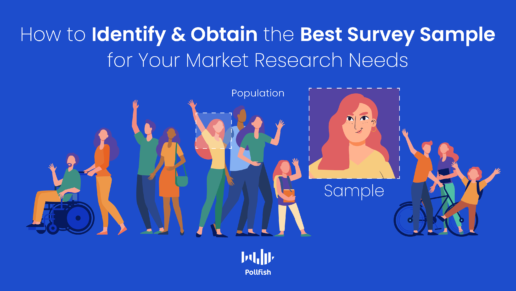
How to Find and Obtain a Survey Sample for Accurate Market Research
How to Find and Obtain a Survey Sample for Accurate Market Research

A survey sample is a critical batch of respondents studied in market research campaigns. Given that this group forms the core of any campaign, it needs to be dealt with correctly.
This involves extracting the sample, reaching out to it across various digital properties, analyzing it and moving forward with all the necessary steps to generate effective survey studies.
As such, market researchers and marketers should be acquainted with the various survey sampling methods used to obtain a survey sample and all of its other particulars.
This article provides insights into the survey sample, including how to collect one and proceed with analysis and other crucial next steps.
Defining the Survey Sample
Also called the survey pool, a survey sample is a group of participants who take part in a market research study, specifically, a survey study.
As its name suggests, this sample is derived from the method known as survey sampling, in which researchers extract respondents to represent a population of study. There are various methods and sub-methods involved in survey sampling.
In market research, the survey sample comprises a business’s target market, that is, a portion of a market population that is most willing and likely to purchase from the business. As such, all marketing efforts are directed at this group of the population.
A survey sample does not have to be broad, meaning that it does not necessarily need to study all the members that make up a target market. Instead, it can be composed of a specific segment of a target market.
In order to procure this segment, researchers must perform market segmentation.
Understanding the Various Ways to Obtain a Survey Sample
As aforementioned, there are various ways to acquire a survey sample, one of the most critical preliminary steps in conducting market research techniques.
Acquiring a survey sample includes two major undertakings:
- Deciding on the makeup of the survey sample itself
- Choosing a method to obtain the survey sample
The former involves determining who will take part in the sample and how many respondents to include in the sample. The latter is known as survey sampling and it entails garnering the members of a target population to take part in a survey study.
In regards to the latter, there are two main methods of survey sampling: probability and random sampling. First, you will need to identify the makeup and scope of your survey pool. Then, you can move forward with it by deciding on a survey sampling method to obtain the pool.
The following explains how to carry out the formation of the survey sample.
How to Choose the Makeup of the Survey Sample Itself
In reference to the above section on understanding the ways to obtain a survey sample, the second aspect of acquiring a sample — after choosing between the probability and non-probability sampling methods — is to decide who should be in the survey sample itself and how big it should be.
In order to decide on the makeup of the sampling pool, follow these steps.
- Refer to the purpose of your market research campaign.
- Ask yourself, what are its main themes and variables, along with its appropriate macro markets.
- For example: To learn how to market a new product to middle-aged adults in the US, your target market, or target population is middle-aged adults in the US.
- Decide whether you are looking to study the wider target population, or if it is more convenient for your business to study a particular segment of the population of interest.
- In this case, you would need to conduct market segmentation.
- You can also perform market research to reach the correct target market sample.
- Determine your accuracy requirements. This involves understanding the degree of the risk your survey study will take in terms of receiving answers that do not accurately describe the entire population.
- This is because you won’t be surveying the entire population.
- To determine how closely your answers reflect the views of your studied population, you’ll need to calculate the margin of error.
- Ex: If your margin of error is 4%, that means 4% is added on both sides of the results of your survey sample. So if 70% of your sample likes shopping online, then the results show that 66-74% of your sample actually likes online shopping.
- Your margin of error should be kept under 10% to maintain quality findings.
- Find the proper confidence interval. Also called the confidence level, this metric shows the likelihood of the sample you used matters in your results, as repeated studies would form the same results.
- For example, a 95% confidence level would yield the same results 95% of the time.
- 95% is the most common confidence level used in statistics. The ideal confidence level range is between 90-99%. Anything lower than 90% is not recommended.
- Finally, decide on the most fitting survey sampling method to extract your survey pool.
The Two Main Methods for Obtaining a Survey Sample
Once you’ve identified the makeup of your survey sample, you’ll need to deploy your surveys. To do so, you must decide on a method for obtaining your survey sample. The following explains the two main types of survey sampling methods.
Market researchers ought to understand these methods and all that they entail before initiating any market research campaign. Being versed in these methods will help guide your study.

Probability Sampling
Also called random sampling, this method involves giving every member of a studied population an equal chance of being selected in the survey sample. In order to select the respondents, researchers would use a random process, in which selected participants are presented as unbiased representations of the total population.
Probability sampling has several more complex sub-methods, such as stratified sampling, which involves selecting participants from subgroups of a population, such as those based on age, location, ethnicity, interest, etc. There are various other methods that makeup probability sampling.
Random sampling aims to gain a sample that represents an entire population of study. Therefore, the results of the study must be generalizable to the studied population. As such, this method is viable for quantitative market research, since it is focused on understanding a larger population by studying a much smaller subset.
This kind of sampling is therefore not ideal for qualitative market research, which seeks to elucidate a specific group of people, without generalizing the findings to a larger population.
Non-Probability Sampling
Also referred to as non-random sampling, non-probability sampling acts antithetically to probability sampling, as it does not use random means to select respondents. Thus, the members of a studied population do not have an equal chance of being selected; some of them will have no chance of being selected.
This main sampling method also has several of its own methods, such as convenience sampling, in which participants are selected if they are readily available and willing to participate. For example, if your study requires studying librarians and you only select those in your zip code, as opposed to those across geographic locations.
All procedures that avoid random selections and involve the judgment of the researchers fall under the non-probability sampling method. As such, even an online survey platform — which has a far wider reach than focus groups or one-on-one interviews — is considered a non-probability sampling tool. This is because in such a platform, the survey sample is not derived from every member of the target population. These kinds of platforms may also not rely on random processes.
One of the most powerful forms of non-probability sampling is organic sampling or Random Device Engagement. This method procures respondents organically, that is, it reaches them in their natural digital settings, as opposed to using survey panels, a sampling method that involves pre-recruiting a set of respondents.
RDE polling engages digital users where they are voluntarily; as such, participants join on their own will and can be found on a vast network of publishing websites and apps. Thus, although the respondents aren’t extracted through organic means, RDE still offers a survey sample that joined through organic settings.
How to Proceed with a Survey Sample
After determining the correct people to use for your survey sample, choosing which sampling method is best, along with the correct sub-method to use, launch your survey. Then analyze your initial results by performing a survey data analysis.
This will be the preliminary analysis, as based on your findings, you may need to conduct another survey, either on the same group or on a specific segment of your target market, if your study was aimed at your general target market.
 If you surveyed a segment of your target market, you may need to study another to compare the two. Perhaps some segments are more inclined to generate customer loyalty than others.
If you discovered a particular behavior from your survey studies that require further studying, consider embarking on experimental research. This will help you prove whether there are correlational factors at play between your variables.
Once you’ve received a valuable share of insights, take action. A valuable amount will differ from company to company and research campaign to research campaign. Consider the findings of your survey studies. If they point to the utility in certain actions, especially if those actions seem prospective for your study or business at large, then take them. The goal of a survey sample is to forge ahead in your market research, which should always be actionable.
Leading the Charge on Your Survey Pool
The survey sample, also referred to as the survey pool, is indispensable for all market research campaigns, as those of the present-day usually rely on survey research. As the core of the survey campaign, the survey sample will determine the accuracy of the entire market research operation.
As such, it must be identified carefully and obtained properly. Aside from the actions to take in regards to these practices, another crucial factor in developing surveys for the correct survey sample is an online survey platform. Such a platform should not simply allow you to create surveys and deploy them, but to reach the correct people, i.e., your survey sample.
A potent online survey platform will allow you to choose the respondents making up your survey pool in the screening or audience section of the survey tool. In this section, you should be able to add and filter the respondents you seek on a variety of categories, including demographics, psychographics and geolocation.
The key is to choose the correct online survey provider.


How to Increase Market Share with Surveys
How to Increase Market Share with Surveys

Companies that want to achieve brand leadership must evaluate and work towards increasing their market share. Businesses with a large market share yield larger profits and brand equity, granting them instant recognition and household name status.
While elevating market share may be the objective of many businesses, it is often difficult to come by, especially for startups and smaller companies. Small businesses are particularly at risk, as 20% of small businesses fail within their first year.
A significant market share prevents business failure, while a shrinking market share can lead to bankruptcy in the worst cases. Thus, it is in the best interest of businesses to assess and attempt to grow their market share, as it will help them achieve recognition and increase profitability.
This article explores the concept of market share, its importance, calculation and how market research, particularly surveys, help increase market share.
Understanding Market Share
Market share refers to the portion of a market that an individual company controls. Specifically, it is the percentage of total sales generated by a particular company in an industry.
This metric is calculated by factoring in a company’s sales over a period of time along with the total sales over the same period. Market share is typically assessed over a year or quarter. (The formula and explanation are in a below section).
This calculation provides a general idea of the size of a company in relation to its market and its competitors. A company with the largest market share is considered a market leader in its industry. These companies tend to be well-established brands with a strong brand equity and consumer loyalty.
Market share shows a business’s monetary standing and its portion of dominance within an industry. As such, it shows how it measures up against other businesses in its market. To increase market share and outperform competitors, a business would need to earn more sales, those that exceed the sales of competitors.
The Importance of Market Share

It is important to keep track of market share in order to understand how a business fares in its overall market and how it performs compared to its competitors. Additionally, growing market share begins with analyzing it.
Businesses of all sizes should aim at scaling their market share, as a higher market share gives companies a competitive advantage. This is because companies with higher shares yield higher buying power, allowing them to save money by receiving better prices from their vendors.
This is made possible by making larger order volumes, something businesses with high market shares engage in, as larger market shares reveal a higher demand for their products or services.
As such, an increased market share works in parallel with larger production, and greater production lessens a company’s cost of producing an individual product. This is due to the economies of sale.
Additionally, the market share metric is a measure of market competitiveness, allowing business owners and executives to forecast market growth and reduction. It indicates whether a business is poised for success or needs to strategize more on avoiding market declines.
It allows businesses to gauge their market potential and focus on improving their standing. Moreover, it is a critical measurement to be used in tandem with studying customer behavior, as it places it in perspective with a business’s market performance.
When businesses increase their market share, they essentially wield a larger slice of the market; a high-performing business will see increases in its market share quicker than its competitors. It is critical to mark down changes to a market share — these include both changes in a business’s own market share and those of its competitors.
This is because, in stable markets, changes in share distribution can distort the well-balanced market forces. In growth markets, however, changes are expected and are less consequential.
Despite the dynamics of a market, increasing market share is crucial for businesses to grow their company. Thus, a larger percentage of the market yields higher sales and revenue.
How to Calculate Market Share
This metric follows a fairly simple calculation. Market share is calculated with only two variables: a company’s sales within a certain time period and the total sales within an industry during that same time period.
To calculate market share, you need to divide a company’s total sales over a specific time period, such as a quarter, by the total sales of its industry within that period. The result is your market share for that time period.
The Market Share Formula
The following displays the simple calculation of the formula:
Market share (MS) = Total sales (S) / Total industry revenue (R) X 100
The following is an example of a business’s market share for one year:
S= 900,000
R= 100,000,000
MS= 900,000 / 100,000,000 = 0.009
MS= 0.009 x 100 = 0.9%
MS= 0.9%
However, businesses can also calculate their relative market share, the measure of a business’s share in comparison to a specific market competitor or market leader. In this case, you would need to have measured your market share already, as it is one of the variables.
Divide your market share by that of the relevant rival. The formula is as follows:
Relative Market share (RMS) = Individual market share (MS) / Largest industry market share (LMS) X 100
How to Grow Your Market Share
Growing a business’s market share relies on a multitude of factors and strategies. Business owners and marketers must apply all of these methods and more to successfully increase their market share.
These methods also help businesses improve across various functions, making them useful contributors to overall business success.
Marketing and branding
Marketing and branding campaigns help businesses improve on a wealth of KPIs. These functions drive demand, awareness and grow a digital following. Branding is one of the many branches of marketing and it is essential for long-term success.
Reduced prices
Price reductions and their various offshoots (promotions, holiday specials, etc.) have long been trusted methods to draw more sales. This allows businesses to beat the prices their competitors offer, luring in new customers before using regular prices again.
Nurturing and Retention
Nurturing customers leads to customer retention, as it allows businesses to be fresh on the minds of their target market. There are numerous ways to do this, such as via email marketing, newsletters, a content subscription, social media, ads and more, such as follow-up calls. This creates relationships with customers, the kinds that nurture them to continue patronizing the company — thus helping raise its market share.
New Features, Products and Services
Creating new offerings helps a brand stay relevant and opens the door for more revenue and sales pools. Many major companies profit off of their innovation, such as Apple, which annually offers new products and product upgrades.
Acquisition
Acquiring the competition not only removes a competitor as a threat to a business, but also gives a business all of the acquired company’s sales, revenue and shares. Mergers and acquisitions grant businesses a major growth spurt and all the assets from its acquired company, directly increasing their market share.
How Surveys Help Increase Market Share

Surveys are a prominent market research method, especially the online survey variety, which connects businesses with the masses, including with those in their target market.
Surveys allow businesses to access the minds of their customers, showing them how to better serve and market to their target market. Surveys also allow companies to uncover the makeup of their target market via market segmentation and identifying customer personas.
Studying the needs, desires, opinions, sentiments and aversions of your target market is an absolute necessity for businesses. In fact, 14% of businesses fail due to not paying attention to their customers’ needs. Those that do are more equipped to acquire new customers and retain existing ones.
Surveys allow brands to be data-driven, providing a tried and true method for obtaining data for decision-making.
Surveys also have the capability to influence customers’ purchasing decisions. This is especially true if a brand inserts its name and offerings into its survey. Or, it can pinpoint customer pain points and the lack of other companies’ means of correcting them.
Surveys enable businesses to ask any questions they seek, thereby bringing them answers they wouldn’t otherwise find from conducting secondary research alone. They are superior to other primary research methods, as they are completely anonymous and lessen the pressure of respondents to answer in a particular way.
As such, survey research makes businesses well-attuned to their customers, allowing them to market to, nurture and communicate with them more effectively. In turn, their performance will improve, raising revenue and therefore their market share.
Netting a Larger Slice of the Market
Businesses of all sizes must assess and work towards increasing their market share, as it represents the portion of a market that an individual company controls in relation to the overall market.
It helps businesses understand their market standing in comparison to their competitors and predict growth and declines. A larger market share lets businesses increase their capacity and efficiency.
In order to evaluate and grow market share, businesses ought to conduct survey research. However, they must use the correct online survey software.
A strong online survey platform offers a plethora of capabilities and extracts only the most quality data.
Such a platform should offer full customization of the screener and questionnaire, deploy the survey to targeted individuals in a massive publisher network, offer filtering data after the survey completes all of its quotas and use artificial intelligence to perform quality checks that remove poor quality data.
This kind of platform provides the most useful customer data, allowing a business to make headway to its market share.

Using Survey Research to Unlock Cultural Trends
Using Survey Research to Unlock Cultural Trends

In order to stay adept at serving customers, brands must be attuned to cultural trends, whether they’re operating domestically only or marketing to customers abroad.
Our Global Customer Expectations poll revealed that almost a quarter of global customers seek brands that are more sensitive to the cultural aspects of their country.
Another supporting study found that brand involvement in cultural trends makes up a full 25 percent of a customers’ purchase decision. Evidently, brands have a stake in cultural involvement when it comes to satisfying their customers.
Unlike some of the more static aspects of marketing, cultural trends are, by nature, inclined to shift and fluctuate. Thus, the challenge becomes not merely discovering cultural trends but assuring their relevance and showing cultural deference.
This article delves into cultural trends, the need for businesses to be culturally competent and relevant, how surveys uncover various cultural trends and how to set up a survey to extract this information.
Understanding Cultural Trends
Cultural trends refer to popularized alterations and tendencies in culture, whether they are material or nonmaterial. These involve emerging or continuous behaviors, items and the relations of both. For example, product use; some trends involve using products in a particular way or for a particular act.
Cultural trends can also specifically apply to the dominant or emerging cultural aspects present among different cultures. This is a matter of concern for businesses that operate both internationally and domestically, as customers expect businesses to understand cultural matters that pertain to their country — as our survey found — along with others.
For example, a study by Salesforce found that 66% of customers expect companies to understand their unique needs and expectations, yet 66% also say that they are treated like numbers. Additionally, 52% of customers expect offers to always be personalized.
Understanding cultural differences and trends is crucial in each case. In regards to the former, understanding cultural practices and other concerns is crucial to make customers feel distinguished and as more than just another number being marketed to.
Regarding the latter, personalization cannot be fully achieved without paying attention to cultural matters. In fact, companies may incur issues when trying to personalize, by not taking into account cultural differences.
Businesses must also take heed to the cultural trends present within their country, as it is a means of staying relevant. Some cultural trends align with certain values, which is crucial to include in marketing campaigns. This is because 71% of customers prefer buying from companies aligned with their values.
Understanding cultural trends is key for market research, especially if a brand uses its name in its research; it is also important for a wide breadth of marketing campaigns.
The Importance of Cultural Trends

To piggyback off of the previous section, understanding cultural trends is a must for various reasons. The two main reasons deal with domestic and international customers. However, they also apply to dealing with employees, vendors and partners.
On the international front, few businesses can evade the need to deal with foreign clients, customers and employees. Given that the world is globalized and global markets open new opportunities, businesses would be at a disadvantage not to branch out into new geographic markets.
In order to properly cater to the international market, businesses must be acquainted with cultural trends across geographies, especially those that pertain to specific countries.
Cultural change is broader than social change, although it can include it in its sphere of influence. As such, societies and their markets are the results of culture. It is a culture that sets boundaries, limits and dictates what is acceptable or not. Thus, businesses must be in tune with the culture of the market they wish to pursue.
Understanding cultural trends is the gateway into cultural competence, the ability to effectively interact, work, and develop meaningful relationships with people from various cultural backgrounds.
Cultural competence allows brands to ease into different geographic markets, as it makes global customers feel understood and heard, a key tactic to ward off making them feel like just another number.
Understanding cultural trends also helps businesses avoid cultural misunderstandings, the kinds that directly cause businesses to lose customers and tarnish their reputation. This can get to a bad enough point in which a business’s harmless misunderstanding makes the news, a blow to brand equity and reputation.
Finally, being culturally competent is necessary for conducting business domestically, as customers are more likely to buy from brands that incorporate timely cultural aspects into their marketing and business at large (as proven in the intro).
Incorporating cultural trends domestically posits a business as more culturally savvy than its competitors. Additionally, it speaks directly to some of the thoughts occupying customer’s minds.
Moreover, the US and many other countries have significant immigrant populations; thus it is imminent for companies to be in contact with people of other cultural backgrounds, whether they are customers, employees, partners, vendors or clients. Thus, it is key to be in the know of all the cultural trends of your target market.
How Surveys Help Discover All Kinds of Cultural Trends
Surveys are a tool that opens many doors into the minds of customers, and customer satisfaction is a prominent objective to keep any business afloat.
Firstly, surveys define a business’s clientele; this is done via market segmentation, in which market researchers granularly define their target market by segmenting into different groups. This helps businesses learn the demographics of their most valuable customers.
Through this practice, businesses uncover the ethnicities, cultures and national backgrounds of their targeted customer segments. This allows businesses to zero in on particular cultural trends: those that are most relevant to the segments of their target market, specifically the most valuable segments.
Furthermore, surveys allow brands to delve into virtually any topic of their choice and understand it at an in-depth level. Thus, they can do so by creating surveys that delve into their target market’s cultural trends.
Surveys, especially the online variety, provide the ease of deploying questionnaires to a business’s intended audience. Most conveniently, online surveys are completely anonymous, so respondents can freely provide answers on all cultural matters, even those that are more sensitive in nature.
Businesses can cover various cultural matters in just one survey, though longer surveys should provide survey incentives to guarantee participation. Businesses can also set up survey campaigns that include multiple smaller-length surveys that cover various topics within cultural considerations.
Surveys have the power to generate both quantitative and qualitative market research, depending on how the questions are set up. Multiple-choice questions lend themselves to quantitative data, while open-ended questions allow businesses to gain qualitative data unique to each survey respondent.
Either way, businesses can gain both kinds of data within just one survey. To do so, they can ask a multiple-choice question and follow it up with an open-ended question.
Survey Questions that Unlock Cultural Trends

The questionnaire is the heart of a survey; therefore, brands must arrange it strategically to set their survey up for success.
They should also target respondents differently per country in the screening portion of the survey. After choosing the customer segments to target, researchers need to create their questionnaire accordingly.
Because all countries, even those that appear to be culturally similar, have distinct cultures, market researchers should focus on specific questions per country. However, before veering into the specific, there are certain general questions that researchers should begin with as a best practice.
The following provides question examples on the preliminary questions market researchers can use in their cultural trends survey before delving deeper:
- What is the biggest cultural change you’ve seen [country name] undergo?
- Multiple-choice and open-ended answers
- How do you feel about [a cultural event, major recent occurrence, trend observed via secondary research] ?
- Scaled and open-ended answers
- Which brands do you use for [a particular need]?
- Multiple-choice, multiple-selection answers
- Do some research on the brands from a particular country
- What would be considered rude coming from a company in your country?
- open-ended answer
- What are some of the biggest trends in [your niche] in your country?
- Multiple-choice and open-ended answers
Being In Tune With All Customers
A lack of cultural awareness has grave costs on businesses. That’s why virtually all businesses must be culturally aware within their domestic and international markets. The latter is especially important in the age of the internet, where global customers may discover a brand digitally, therefore opening the doors for businesses to venture into global markets.
While surveys are a convenient method to uncover cultural trends and differences, they are only as useful as the online survey platform that administers them. A strong online survey platform must be able to facilitate all stages of the survey process: from the screener, to the questionnaire, to deployment and finally, filtering data after the survey completes all of its quotas. Additionally, a strong survey software uses artificial intelligence to perform quality checks that remove gibberish answers, flatlining and other poor data to ensure the highest quality of customer data.
Businesses should opt for such a platform to not simply obtain cultural trends information, but to engage in a valuable market research campaign.

Understanding Customer Value and How Businesses Can Generate It with Surveys
Understanding Customer Value and How Businesses Can Generate It with Surveys

Customer value is a key aspect for acquiring, developing and retaining customers. Businesses would be remiss not to work on improving it to sustain profitable customer relationships.
Contrary to its name, it does not signify the value that a customer brings to a business — which is not to say that customers don’t carry value. Rather, customer value denotes the satisfaction a customer experiences or expects to experience by taking an action relative to the cost of that action.
Businesses must provide this value, as over 65% of customers globally believe it is very important for businesses to understand their unique needs and expectations. When a business properly serves its target market, then its members derive a higher customer value.
In turn, this makes a business more competitive and better positioned to develop customer satisfaction and build customer loyalty.
This article explains the concept of customer value, its importance, how to calculate it, how surveys can improve it and more.
Understanding Customer Value
Also called customer-perceived value, this concept is defined by the perception of what a product or service is worth to a customer versus its possible alternatives.
More specifically, it entails the benefits a customer derives from a service or product in relation to the customer’s costs, which include all the efforts and difficulties they face when obtaining or using a product or service.
In short, this measurement explains whether a customer feels they received benefits over the price that they paid.
In this regard, “paying” does not simply refer to prices such as one-time and subscription costs, fees, interest, etc. Instead, it also includes non-price aspects, such as providing their effort, energy, time, data and other inconveniences.
In addition, payments do not necessarily refer to purchases; they can also mean store visits, sign-ups, content downloads and more.
The benefits in customer value denote the advantages or quality of a product, service, image and the brand equity of a company, along with a good customer experience (CX), values, the success a customer experiences from using a product and so on.
Businesses can heighten their customer value when they augment their core competencies and other drivers of value to better serve all customers’ needs and concerns.
The Importance of Customer Value

Customer value is important for businesses for many reasons.
Firstly, customer value increases both the customer experience and customer satisfaction. CX plays a major role in the long-term success of brands, as 74% of customers are likely to buy based on customer experience alone. Experience-driven businesses also see a 1.5 times higher YoY growth in repeat purchases and customer retention, a necessity for maintaining a business’s customer base.
The reverse also occurs, as a good customer experience creates customer value.
As for customer satisfaction, it is especially important for a business, as unhappy customers churn, while satisfied customers stay and are far more likely to become repeat customers. Thus, satisfaction drives loyalty, thereby upholding customer retention. Customer value is largely involved with satisfaction, as satisfied customers drive some sort of value, while dissatisfied customers either don’t or gain very little from their transactions and engagements with a business.
Customer value also forges customer advocacy, in which the customers themselves act as marketers for a company. Customer advocates recommend the companies that bring them value, thereby spreading brand awareness, fostering a positive brand image and essentially providing free marketing services. Customer advocates spread their messages across social media, review websites, forums, blogs (if they have them) and also produce word-of-mouth marketing. This can attract many new leads and conversions.
Additionally, customer value steers sales forward, as it creates a sense of urgency for customers, prompting them to not simply buy but to buy sooner. By forming timeframes for key value-building benefits to the customers, such as increased efficiency, lower downtime, better quality, and many more value points, customers will be much more drawn to purchase from a business in a timely manner. In turn, sales workers can close sales quicker.
Finally, while it may seem to be a stretch, creating customer value contributes to a business’s market share — the percentage of a total market a business controls for its products and services. A higher market share allows businesses to operate on a greater scale and increase their profitability. This occurs when businesses provide as much customer value as possible, such as pricing convenience, useful products and many other factors.
How to Calculate Customer Value
Although customer value includes intangible items in addition to tangible ones, businesses can still measure it to understand the value their customers derive from their business. First, businesses must consider all the factors that make up the two main variables in customer value: benefits and costs.
When compiling all of these factors, businesses must identify the most relevant ones in relation to their business and for their customers. The reason behind this is evident, given that businesses have different value propositions, offerings, prices and so on.
Although the calculation for customer value is simple, the many factors behind its two variables render this calculation more of a rough estimate, than a hard and fast metric.
The following lays out the various components of customer benefits and costs:
Total Customer Benefits:
- Product benefit
- the problem a product solves
- ease of onboarding
- Service benefit
- service convenience
- Experience benefit
- ease of use
- Personal benefit
- social status
- Image/branding benefit
- brand reputation
Total Customer Costs:
- Monetary costs
- Tangible
- The price of a product or service
- Installation or onboarding costs
- Renewal costs
- Tangible
- Time costs
- Intangible
- Time invested in buying a product or service
- Time invested in learning how to use a product
- Intangible
- Energy costs
- Tangible
- Installation or onboarding costs
- Maintenance costs
- The cost of accessing your product or service
- Renewal costs
- Intangible
- Time spent understanding how your product or service works
- Physical commitment
- Tangible
- Psychic/emotional costs
- Tangible
- The cost of accessing your product or service
- The cost of using a service/product with issues
- Intangible
- A poor customer experience
- Physical or emotional stress induced from buying or installing your product
- A poor brand reputation
- Tangible
Businesses must bear in mind that because this calculation includes tangible and intangible elements, the customer value formula won't look like a typical mathematic calculation.
You'll need to specify how much benefits are worth in comparison to the costs customers incur, such as time investment, emotional stress, and more.
Customer value is also going to vary depending on the customer segments you analyze. Since each segment, customer persona and individual customer is different, they’ll have particular needs, expectations and goals.
As such, they’ll have customer values, along with different standards of good and poor value. Businesses should therefore conduct market segmentation, identify personas and calculate the customer value for each segment and persona.
The Customer Value Formula
After you consider all the possible benefits and costs associated with your business or particular product or service, and have narrowed down the most relevant, you’ll need to plug them into the customer value formula.
Use the following formula:
(Total Customer Benefits - Total Customer Costs) = Customer Value
(B - C = CV)
How Surveys Help Improve Customer Value

Online surveys provide a method that goes far beyond understanding a target market, or any group of customers. It can significantly improve customer value. Here’s why:
Brands should consider that when they sell a product, the utility of that product usually doesn’t change among customers. However, although its functionality remains the same, customer value will waver, as customers find value in different aspects of a product.
Surveys give businesses a firsthand approach of understanding what they consider valuable and what tarnishes that value for them. Adding to this, surveys can be set up in a number of ways, allowing business to both measure and gain specific customer data.
With online surveys, businesses can segment their customers and identify personas, as surveys are potent tools for market segmentation. In addition, online surveys grant businesses the ability to target their most loyal customer group.
Thus, surveying allows them to understand the makeup of their target market more precisely and study the most valuable subsets of customers.
There are also numerous kinds of customer satisfaction surveys, such as the net promoter score, or NPS survey and the customer effort score, or CES survey. The CES survey is particularly relevant to customer value, as it measures customer effort, one of the costs and variables of customer value.
Businesses should also consider that customer needs change throughout the customer journey and especially during a customer lifecycle. The customer journey includes pre-sales purchase intent, the browsing, the actual purchase, the installation, the use of a product or service and post-sales events. Thus, what they prioritize in terms of value is constantly changing.
Surveys allow companies to keep track of those changes, whether it is via brand tracking, brand visibility, changes in customer loyalty and more. Surveys can be deployed through various stages in the sales process making it easy to detect changes and consistencies in what customers perceive to be valuable about a business and its offerings.
Additionally, surveys allow businesses to evaluate how different customer segments feel about their pricing in a simple way. This is important to customer value, given that price is one of the major costs associated with customer value and a general customer pain point. All answers remain anonymous, which allows customers to be honest about how they feel about prices.
Forging Value Across All Offerings
In summary, businesses ought to pay careful attention to their customer value, as it dictates how customers perceive a brand in terms of its value to them. It is evident that businesses with low customer value will inevitably lose customers, while those with high customer value will retain and acquire customers.
Online surveys provide a quick and efficient way for businesses to understand and improve their customer value, as surveys gain insights on all the factors and variables of this notion. They can show where businesses are lacking, how they can improve and most importantly, what it is specifically that customers want and need.
However, not all online survey platforms offer the same functionalities and efficiencies. Businesses must therefore invest in a strong online survey platform, one that makes it easy to create and deploy surveys.
Additionally, they should opt for providers that offer high-quality data, such as RDE (random device engagement sampling) to net respondents in their natural digital habitats in a completely randomized way, as well as include artificial intelligence that performs quality checks that ensure the highest quality of customer data.
When an online survey provider offers all of these functionalities and customer service around the clock, businesses are poised to gain valuable insights on customer value, raise it and are generally in good hands for all other customer data needs.
Understanding the Customer Churn Rate and Using Surveys to Lower It
Understanding the Customer Churn Rate and Using Surveys to Lower It

The customer churn rate is a crucial metric that all businesses must measure, as customer churn is a grim reality that businesses contend with regularly. In fact, two-thirds of companies have a customer churn rate above 5%.
Also referred to as customer attrition, defection or turnover, this metric gauges the unfavorable aspect of the loss of business with customers, users, vendors, revenue, or other factors within a period of time.
Commonly used in SaaS market research, it is used to measure the percentage of customers who unsubscribe from a SaaS product in a given period of time. However, this metric is crucial to measure in all industries.
This rate ought to be kept low, as churn usually indicates customer dissatisfaction or the availability of affordable alternatives. This is hugely problematic, as the customer is king; 43% of customers spend more money on brands they're loyal to. Additionally, acquiring a new customer costs 5 times more than retaining an existing customer. Thus, businesses should retain their loyal customers.
This article expounds on the customer churn rate, its importance, its average across various industries, its calculation and how surveys can lower it.
Understanding the Customer Churn Rate
As its name suggests, this rate is a calculation of customer churn. Before diving into the metric, businesses should understand the meaning of customer churn.
Customer churn refers to the number of customers or subscribers who stop using a service during a given time period. There are a number of ways that customer churn affects a business, depending on its nature. These include:
- An account closure
- A subscription cancellation
- A non-renewal of a contract or service agreement
- A consumer switching to another service provider
- The cancellation of a contract midway through it or before completion
The customer churn rate (CCR) is therefore a metric that calculates the total number of customers a business has lost during a specific period. Therefore, it is the antithesis of the customer retention rate.
The customer churn rate is typically used to measure churn in businesses that run on a contractual or subscription-based product or service offering. As such, this term is chiefly associated with companies that operate on a subscription basis, such as SaaS companies.
referred to as the proportion of contractual (or subscribed) customers who terminate their contractual relationships/subscriptions with a company in a given timeframe. In this context, the term is primarily associated with companies operating on a subscription basis.
The Importance of the Customer Churn Rate

Businesses should measure their customer churn rate at regular intervals, as it is an important metric.
Firstly, its indication of lost customers directly ties into lost revenue. When a company loses customers, it negatively affects its bottom line. In this way, a high churn limits a business’s growth potential. Additionally, a significant churn rate always incurs financial difficulties of some degree.
Another reason it is so important to study and improve customer churn is that it is far more expensive to acquire new customers than it is to retain existing ones. In fact, acquiring a new customer costs 5 times more than retaining an existing one. As such, a business’s customer acquisition cost (CAC) is going to be more expensive than its customer retention rate (CRR).
Therefore, when a business loses existing customers, it will have to grapple with both the loss of revenue and business opportunities, coupled with the need to spend more on acquiring customers to make up for those that have churned.
As such, businesses must rein in their customer churn rate — and in order to do so, they have to keep track of it.
Studying this rate also involves keeping tabs on the competition, another critical area of maintaining business success. This is because the CCR can increase when competitors launch new and/or less expensive products, which may entice customers to churn and switch to them.
This dampens customer loyalty for obvious reasons and for some customers, can be a permanent switch to another brand. The ability to predict the churn rate is necessary for a company’s long-term success. Thus, businesses should gauge their churn rate and control it whenever possible.
How to Calculate the Customer Churn Rate
There are multiple ways to calculate the customer churn rate. This metric is typically presented as a percentage of either lost revenue or customers lost within a period of time. The following explains the CCR calculation:
To calculate a company's churn rate, first, you must choose a period of time to evaluate and identify the following values:
- The number of customers at the start of a period (X)
- The number of customers lost during the period (Y)
Then, use the following churn rate formula to determine your customer churn rate (Z), expressed as a percentage.
Customer Churn Rate Formula
CCR = (Y / X) x 100
CCR = (number customers churned in a period / number of customers at the beginning of the period) X 100
For example, if a business had 200 existing customers at the start of Q3 and lost 20 customers by the end of Q3, it would calculator its churn rate as such:
CCR = (20/200) x 100
CRR = 0.1 x 100
CRR = 10%
This means that this business has a quarterly customer churn rate of 10% for Q3.
Aside from the number of lost customers, there are other churn metrics to plug into the customer churn rate formula. Whether or not these metrics are worth using to calculate the CCR is completely up to the business in question. It will depend on the nature of the business and its performance metrics needs.
Other churn metrics that businesses can use include the following:
- recurring revenue lost
- percentage of customers lost during a specific period
- decreased engagement product engagement
- percentage of revenue lost
- other variables specific to their product and business.
The more granular a company is with its customer churn analysis, the more effective it can be when working to reduce the churn rate and keep its customers.
Ideal Versus Poor Customer Churn Rate Benchmarks
All businesses undergo churn, even those that are new and/or are experiencing a solid subscription rate with no current turnover.
How can businesses distinguish between a good and bad churn rate? There are certain existing benchmarks for this. The most ideal, but unrealistic churn rate is 0%, as no business profits when a customer churns.
Given that it is virtually impossible to maintain a 0% churn rate, there are certain practical benchmarks that businesses can aim for. The following lists both ideal and poor CRR benchmarks that businesses ought to know:
- The ideal churn rate is 5-7%.
- This is considered the proper rate for mature and well-established SaaS companies that target enterprises.
- For early-stage businesses, the monthly churn should be closer to 5%.
- A churn rate above 10% is a critical warning that a business is poorly faring in customer retention.
- It signifies the need to change the customer experience (CX).
- A high CCR is over 10%, signifying that a business is operating at an unsustainable rate.
- It usually means that marketing efforts/ resources are used for acquiring customers rather than retaining them.
- When a business has a high churn rate, it must examine how it forms and fosters its customer relationships.
The Customer Churn Rate Across Industries
The CCR varies across industries and is highly likely to vary from one company to the next. Businesses should have an overview of how the churn rate fares in their industry and others. The following lists the average customer churn rate across several major industries:
- General retail: 24%
- Online retail: 22%
- Financial: 25%
- Telecommunications: 21%
- Travel: 18%
- Big box electronics: 11%
- Cable: 25%
- SaaS: 4.79%
How Surveys Can Lower Customer Churn Rate
Survey research can be used for a variety of purposes, which include lowering this unfortunate metric. This is because reinforcing strong business relationships with customers is a must in order to decrease the CCR. The most potent way to achieve this goal is by understanding your target market. Surveys allow businesses to do so in a quick and efficient manner.
Surveys allow businesses to examine their customers on an in-depth level, as surveys provide them with anonymity and speed, unlike survey panels and focus groups, which are not anonymous and are typically more time-consuming.
Given that surveys can address a wide range of topics, from customer satisfaction, to customer aversions, to customer buying behavior, brands can gain a wide swath of insights that support various campaigns.
Whether a business seeks to adjust its pricing strategy, partake in customer development before releasing a new product or improve its brand visibility, surveys provide the strongest means for obtaining customer feedback and insights.
Essentially, surveys allow businesses to understand their customers in relation to numerous business topics and concerns, while also providing them the opportunity to improve their strategies across functions, such as marketing, advertising and beyond. When businesses are in lockstep with their customers, they are far less likely to disappoint them.
Thus, businesses that know how to cater to their customers are poised to satisfy and delight them, thereby lowering their customer churn.
Using the Best Online Survey Platform to Reduce Churn

Customer churn can occur within even the most loyal of customers, especially in a highly competitive landscape. Understanding what causes formerly loyal customers to abandon ship is much-needed to sustain business growth.
While survey research is crucial, all online survey platforms are not identical in function, interfaces, data quality and ease of use. A strong online survey tool ought to excel in all regards and more.
For example, a useful online survey platform should incorporate RDE (random device engagement sampling) in order to capture respondents in their natural digital habitats and in a completely randomized manner, as well as include artificial intelligence that performs quality checks to ensure the highest quality of customer data.
Businesses should choose their survey software wisely, should they seek to lower their churn rate and improve on many other business fronts.
How to Perfect an In-Home Use Test (IHUT) with Survey Research
How to Perfect an In-Home Use Test (IHUT)with Survey Research

An in-home use test is a critical form of market research, particularly for product testing, product development teams and businesses that have yet to launch a product to market.
While market research may appear non-experimental outwardly, there are several kinds of testing necessary to conduct, such as experimental research and in product testing specifically, customer development.
An in-home use test complements the experimental aspect of market research and allows businesses to understand the viability of their product from their customers themselves.
This article expounds upon the in-home use test and illustrates how survey research can perfect it so that you fulfill your market research techniques.
Defining the In-Home Use Test
This kind of research is a critical method in product testing, in which businesses measure the performance of products and their effects on customer satisfaction.
Also called the home usage test or in-home user test and abbreviated as the HUT or IHUT, this form of market research refers to the testing of a new product by way of sending it to a customer's home rather than sending the customer to a facility to try the product.
This way, businesses can understand how customers will use their products as they normally would — in their natural home environments.

Rather than using the products in an altered environment such as a testing facility, users test the product as they would in their everyday lives. This method removes any biases that occur in unnatural settings and controlled environments.
Thus, market researchers and businesses can understand exactly how their target market interacts with their products before they officially launch new products to the general public.
After using the product(s), the customers are sent surveys to share their opinions and experiences with the new product(s).
When to Use an In-Home Use Test
There are several situations in which using an IHUT is a necessity. They often tie into the need of assuring the success of a product, as opposed to being used with other campaigns, such as branding or advertising.
The most utilitarian purpose of using the home usage test in your market research is to gain honest customer feedback on a product before it gets launched.
Market researchers can also stand to use it for different purposes, which include the following:
- Innovation experiments: refining or updating an existing product.
- Early product development: when a new product idea is not fully fleshed out, sending testers an early version. This allows product developers to decide whether the product is worth continuing to build.
- Gauging a Commonly Used Product: Some products are used every day; researchers can conduct an IHUT on commonly used products to understand their utility, appeal and limitations.
- Recording customer satisfaction over time: Some customers become more satisfied with a product they typically use over time, while others’ satisfaction may be in decline. Then there are those that don’t waver in their satisfaction levels with a product at all.
- Buying intent and buying pains: Market researchers can learn if using a product over time has any sway in their intent to buy, along with their buying pains.
How to Conduct an In-Home Use Test
The following is a comprehensive set of instructions that explain how to conduct an in-home use test. The IHUT involves a process that market researchers can streamline in order to get the quickest results.
This is to say that you do not need to take part in all of the steps outlined below. You may have already performed some of them as part of the encompassing market research process.
- Determine your target market. This can be done through several market research techniques, including secondary and primary research.
- You must use the correct target market sample when conducting any form of market research.
- You may also conduct market segmentation to further split your target market into smaller segments.
- Deliberate whether you need to perform customer development. If so, find the appropriate step in this process to begin sending out an in-home use test to customers.
- If you have several untested products, prioritize the one which needs product testing most urgently.
- It is beneficial to practice product intuition before sending a product out for IHUT. For example, you ought to infer which product will perform or be of best use to your customers based on past experience or research.
- Choose the number of HUT testers you will need to try your product.
- The ideal number is between 10 -100 participants.
- Ascertain the length of the IHUT study; this can involve testing your product for several days- months, depending on your market research needs.
- Obtain your HUT testers by way of recruiting survey panels or via an online survey tool.
- You can also reach out to known customers by way of their contact information. For example, if they made electronic purchases, your business then has access to their names and email addresses. This is true in other situations, such as interacting with an online chat and providing contact information.
- Offer an incentive to your desired testers to ensure that they partake in your in-home user test.
- Deploy your products to the IHUT participants.
- Include instructions on how you require their participation in the IHUT. Remember to make mention of how they are to return the items (if they should) and whether they should take notes of their experience.
- Follow up with your participants if need be, particularly if you’re running a long study.
- Survey your participants by way of mail-in surveys you can send with their products, phone calls or post-HUT online surveys.
- Analyze your findings when you’ve garnered feedback from all the participants in the study.
- Report the viability of the product and determine if it is ready for launch.
- This involves other considerations, such as:
- whether it needs more testing on other segments of your target market
- if a similar product needs testing to be used in comparison
- or if you should pull the plug on the product entirely
- This involves other considerations, such as:
The IHUT Role in Customer Development
As aforementioned, customer development is a step in the IHUT process. However, given that customer development consists of its own framework and methodology, it can also be said to envelop the in-home use test.
As such, the IHUT can be viewed as a step of the customer development process, namely the first step of customer development, that of customer discovery. This step is predicated on understanding customers and their needs, with a focus on the kinds that your company may fulfill.
It involves testing two hypotheses that relate back to the product:
- The problem hypothesis: your understanding of customer pain points
- The product hypothesis: your solution to these pain points
The HUT can also be applied as part of Step 2 of customer development, that of customer validation. It is centered on gaining validation via selling your product, after your target market approves of it from Step 1.
This is to say that although not its primary use case, the IHUT approach can be used in tandem with a product already in the market. Deploying it alongside an existing product is actually useful for three of the points aforesaid in the above section on when to use the in-home use test.
These include gauging a commonly used product, recording satisfaction over time and delving into buying intent and pain points.
As such, the IHUT approach is useful to leverage alongside the customer development process.
Complementing Your In-Home Use Test with Surveys
The in-home usage test is not a standalone practice as it involves more than just sending out products. The core of this test is obtaining customer feedback on a particular product. There are several routes you can take to study customer opinions of an IHUT product.
You can call them directly and have a discussion on their findings. You can also send them surveys along with the products. Surveys allow you to ask virtually any product-related question.

For quicker insights, it is best to deploy electronic surveys, some of which may facilitate various aspects of survey research, depending on the platform you use. These include using advanced skip logic to route your respondents to the appropriate answers based on their answer to a previous question.
If you are running an IHUT alongside an already existing product, you ought to use a strong online survey platform, which can distribute your surveys to the masses and allow you to dictate exactly who gets to take part in them. This way, you are ensuring that only your target market will take the surveys.
Taking this approach also enables you to assess the percentage of your target market that is aware of your product.
Perfecting Your In-Home Use Test with Survey Research
Closing off, an in-home usage test (IHUT) is a valuable market research method. While it is primarily used for testing new products before they are officially launched, such a test can be deployed in all stages of product development.
Survey research perfect IHUTs, in that this is the foremost method of gaining customer feedback and insights. To reap the most valuable insights, you ought to conduct regular surveys on your target market.
Running continuous surveys is an adequate means for gaining a host of customer and business insights, along with a range of market research. This is because you can field surveys for virtually any marketing campaign.
Thus, running surveys gives you continuous insights that not only complement your in-home use test, but perfect it as well. But they must be administered carefully.
To do so, you need to invest in a robust online survey tool, the kind that brings agile data from your target market and allows you to distill your target market down to the smallest segment.
Understanding Customer Behavior with Market Research
Understanding Customer Behavior with Market Research

Customer behavior is one of the foremost areas of concentration in marketing, as consumers are the bedrock of a company’s success.
Businesses must therefore understand their customer behaviors in order to suit their needs and drive revenue. In fact, 66% of customers expect businesses to understand their needs and expectations.
But there is far much more to customer behavior than customer desires and expectations. This concept encompasses several facets of customer actions, along with the driving force behind them.
This article explores customer behavior, its importance, aspects and how a well-established campaign of market research techniques allows businesses to be well-acquainted with the customer behavior within their target market.
Defining Customer Behavior
Also called consumer behavior, customer behavior denotes the study of customers, particularly those in a target market, including the processes they use to choose, consume and discard products and services.
This field of study involves recording and examining customers’ mental, behavioral and emotional responses. Observing customer behavior goes beyond studying behaviors in a customer journey, that is, the actions customers take prior to making a purchase.
Rather, consumer behavior studies how customers choose products, why they avoid certain products, their buying behaviors, along with how they interact with a product or service. Thus, this concept transcends looking into what customers want and don’t want.
When studying these behaviors, researchers often incorporate scientific approaches, using notions from psychology and economics and even chemistry and biology.
Studying customer behavior can also involve studying organizations, especially for B2B businesses. However, B2C businesses can also stand to scrutinize companies as a kind of competitive analysis.
Consumer behavior is the study of individuals and organizations and how they select and use products and services. It is mainly concerned with psychology, motivations, and behavior.
The Key Aspects that Customer Behavior Investigates
As aforementioned, customer behavior takes various elements of customers into account, going beyond its subsets of customer journeys and customer buying behavior, which themselves span different concepts.
The following enumerates several key aspects that customer behavior encompasses.
- Buying habits, including locations, devices and frequencies
- Social trends and background factors that influence customers to make or avoid purchases
- Customer sentiment around product/service alternatives, such as related products/services, those from different brands
- Preferred methods of purchasing such as in-store versus online or both, at a large retailer or at a mom-and-pop shop, etc.
- Behaviors of customers as thy shop
- How customers search for companies
- How customers find businesses during their research
- Customer reasoning behind different alternatives
- How customers are influenced by their environments such as their friends, media, culture and other target market members
- How marketing campaigns influence or affect their behaviors
The Importance of Examining Customer Behavior
Studying this concept may appear to be laborious at worst and tedious at best, however, brands ought to avoid omitting it. This is because the aspects of customer behavior paint a critical picture of who customers are, allowing businesses to market and cater to them accordingly.
Understanding the customer behavior of customers allows companies to adapt and improve their marketing campaigns, sales promotions, customer service and more. Most importantly, it allows brands to influence their customers more productively.
Additionally, by understanding how customers choose, consume and discard products, businesses can identify issues in the products themselves and make innovations. In this way, studying customer behavior helps with product-related issues such as customer development and product satisfaction.
Businesses can therefore study it to find gaps and flaws in existing products and improve upon them. Or, they can create products with alternative features and even new products to gain a competitive advantage.

Studying consumer behavior also allows marketers to present their products more effectively, so that they can drive a maximum impact. That way, customers will be more keen on interacting with a business, whether they’ve long known about it or recently discovered it.
When customers engage with a business more frequently, they become far more exposed to marketing and advertising messages that can influence them to make purchases. In this way, engaging with a company, whether it is viewing their content or browsing their offerings lodges that company in customers’ minds, which is key for brand awareness.
Generally speaking, it is also ideal for customers to have businesses on their minds subconsciously. In fact, a Harvard Business School professor declares that 95% of purchases are made subconsciously in his book, How Customers Think: Essential Insights into the Mind of the Market. This book also discovered that the biggest drivers of unconscious urges are emotions.
All in all, examining consumer behavior enables businesses to become more attuned to their customers, thereby allowing them to better tailor their marketing efforts and retain customers for the long term.
Customer Behavior Patterns
It is important to identify the patterns that makeup customer behavior. Patterns are not to be confused with buying habits, as the latter refers to inclinations for an action that can become spontaneous, whereas patterns exhibit predictable occurrences.
Customer behavior patterns are also contrary to buying habits in that patterns are indicative of groups, while habits are more unique and individual-based.
The following explains the four customer behavior patterns:
- Items purchased: Businesses should study their customers’ shopping carts, as they reveal exactly what customers buy and how much of it they buy. Patterns usually show that customers buy everyday-use items in larger quantities and more frequently, while luxury items are bought less frequently and in smaller quantities.
- Customers tend to buy products based on the products’ perishability, a unit of sale, price, number of users of the product and the buying power of the customer.
- Place of Purchase: Customers usually shop at various stores, even when all of their intended products are available at just one. This largely depends on the accessibility of getting to various stores. When customers are not restricted to just one store due to transportation limitations, they are at liberty to choose items from multiple locations.
- Businesses must study place of purchase patterns, in that it will reveal customers’ choice of place, helping marketers understand which areas their customers visit.
- Purchase Method: The way a customer chooses to buy products divulges the kind of customer that they are. That is because there are various purchase methods, all of which tie into a customer journey.
- Customers can window shop online, then make up their minds at home and buy a product online. Or, they may buy a product in-store, via different payment options such as cash, debit or credit card.
- Businesses that gain this kind of insight into behavior patterns help them find ways to make customers buy again and more frequently.
- This pattern can also help businesses upsell products.
- Frequency and Timing of Purchase: Customers exhibit different times and frequencies of purchase. Regarding the former, they won’t all buy during business hours, given the prevalence of e-commerce, which allows them to shop at the earliest and latest parts of the day.
- Businesses can meet customer demands by studying their purchase timing and frequency in order to serve them better.
- Studying these concepts will help businesses adapt to regional (and global) time differences, along with seasonal variations.
The Things That Affect Customer Behavior
There are various influences and facets that can affect how customers behave. Businesses ought to acclimate themselves with these customer behavior factors, in that they all have a bearing on customer behavior and behavior patterns in one way or another.
When studying customer behavior based on these factors, businesses will be able to understand it more holistically. This helps in market segmentation and building customer personas, two market research tactics that allow businesses to gain a deeper understanding of their target market.

The following lists the critical factors of customer behavior:
- Purchasing power: even the wealthiest of customers are constrained to some sort of budget or need to buy things within their means. Thus, much of what customers buy depends on their purchasing power.
- Marketing campaigns: Specifically designed to persuade customers as well as reel in new ones, marketing campaigns have the capability to influence buying behaviors, when done correctly. They can prompt customers to switch brands or opt for a more expensive product with the correct messaging — which requires understanding your customers.
- Personality traits: Personality affects many kinds of behavior, including customer behavior. These spring from background and upbringing, which affect how people will behave in different settings. Some customers will be drawn to events (grand openings, sales, etc.) due to extroversion, while others may not be and some may fall in between.
- Personal preferences: The way customers choose purchases often relies on their personal preferences. Advertising and marketing campaigns can surely affect these but some preferences are unyielding. For example, a vegan will not buy animal-based products, while a meat lover is not going to shop for exclusively vegan items. Businesses should therefore be well-acquainted with the preferences of their target market.
- The economy: Economic conditions play a role in customer behavior, especially in relation to more expensive products; positive economic environments are bent on making customers more willing to indulge. In times of inflation, consumers are less likely to spend on expensive items, as well as make frequent purchases. Negative economic conditions are fruitful for businesses to introduce promotions and bargains.
- Group influence: Peer pressure and the opinions of others can also weigh heavily on buying and usage decisions. When customers’ friends and peers speak negatively or positively about an item or brand, it affects the way the customers perceive it. In some cases, group influence provides a setting of brand advocacy, while at other times, it can cause major reputational damage to a business.
- Social trends: Related to group influence, social trends set the scene in terms of what is popular and acceptable. From social media, to movies, blogs and podcasts, various talking points and fads can form and leave strong impressions among customers. Some of these platforms provide a breeding ground for new trends, the kinds that marketers can access, depending on their budget and strategy.
How Market Research Helps Businesses Understand Customer Behavior
Conducting market research enables businesses to understand all the key facets of customer behavior. There is much involved in market research, all of which can help marketers deliver more effective campaigns.
First off, market research encompasses a wide breadth of studies, from secondary research to primary research and from quantitative research to qualitative research. There is a vast pool of available resources, i.e., secondary sources available. These can take the form of industry news sites, statistics sources, published studies and more.
While secondary research is an important starting point for conducting market research, it does not address all the specific needs that a business may have, let alone the specific questions that businesses intend to probe their customers with.
As such, all businesses should turn to primary sources to understand their consumer behaviors. There are different routes for market researchers to take on this front; effective survey studies are the most useful. This is because surveys allow researchers to understand where their target market lies in all the factors and patterns of customer behavior.

For example, market researchers can conduct surveys to learn more about their customers’ purchasing power and how it relates to what they buy and how much. In addition, they can qualify only certain people from taking a survey, so that they can study respondents who fall within a particular income bracket.
Another example involves surveying customers based on their awareness levels of cultural trends and their opinions thereof.
In relation to studying customer buying patterns, surveys provide value, in that customers can ask detailed questions about all patterns, whether they are concerned with purchasing methods, the place of purchase, frequency, etc.
A strong online survey platform will allow businesses to gain a deep understanding of these aspects, through the use of advanced skip logic, which routes survey respondents to appropriate follow-up questions based on their answers to previous questions.
Finally, surveys allow market researchers to make decisions in an organized way, as they help form a customer behavior analysis report. This report reveals:
- How customers behave while researching, browsing products and purchasing
- How customers use products
- How long customers use their products
- What customers think and feel about different brands and product options
- How their environments affect their behavior
Improving Business Goals and Scaling by Understanding Your Target Market
Customer behavior to a business is like blood to mammals. While this may sound dramatic, it analogizes the importance of understanding your target market’s behavior. When businesses fail to study their customers’ behaviors, they are remiss on so many meaningful opportunities.
Thus, marketing campaigns of all sizes and calibers are at a much larger risk of failing. Market research, particularly survey research helps combat ignorance of customer behavior. This is because surveys give researchers the freedom to study any factor and pattern that relates to this behavior, arming them with critical insights on how customers shop throughout their journeys.
The most crucial component of survey research is using the correct online survey platform. Not all surveys offer advanced skip logic and can qualify respondents based on various demographics and psychographics. Thus, businesses and market researchers must invest in an online survey tool wisely, as it can make or break any market research campaign.
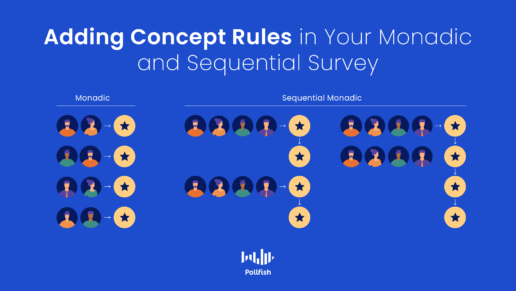
How to Use Concept Rules in Your Monadic and Sequential Survey
How to Use Concept Rules in Your Monadic and Sequential Survey

What can I achieve with concept rules?
With concept rules, you can differentiate the follow-up questions a respondent gets and obtain better insights from the test. The evaluation questions of the test will remain the same for all concepts, no logic can be applied within the questions of the test.
By using concept rules in your monadic or sequential test, you can direct the respondent - after he finishes with the evaluation questions, to follow-up questions curated specifically for the concept or concepts he got.
For example, for a monadic test, you can make follow-up comparison questions that test how a respondent perceives the product he saw in comparison to another one.
How do concept rules work?
You can apply concept rules at the AB group, so that when the respondent finishes with the questions of the AB, to be redirected to a specific question outside of the group based on the concept they got.

You can also apply complex rules containing concept rules, in the case you want to combine specific answers from regular questions with concepts shown.
- Add a monadic or sequential test to your survey
- Open the logic page
A. For simple rules:
- Select the question or the ab test group, you want to apply the rules
- In the rule, you can select the “if concept at” and pick the concept you want to apply the rule
- You can add rules for all concepts or for some of the concepts
For example, let’s assume that you want to conduct a monadic test for 3 soft drinks, and have the respondents compare 2 out of these 3 in the case they got one of these 2 in their monadic.
B. For complex rules, combining concepts with answer questions:
i. Select the question or the ab test group, you want to apply the rules
ii. In the rule, you can select the “if concept at” to pick the concept you want to apply the rule, click “Add” and select “if answer at” to pick the question’s answer you want to add.
For example, let’s assume that you want to conduct a monadic test for 2 soft drinks, and drive the respondent to answer a specific follow up question provided that he has also given a specific answer to a regular question (outside of the A/B)
What is the mobile flow a respondent gets with concept rules applied?
For the first case of rules(2a), the respondent will follow the following flow: Pollfish Survey
For the second case of rules(2b), the respondent will follow the following flow:
Or this: Pollfish Survey
Can I combine a sequential test with concept rules?

Yes, for a sequential test, you can apply concept rules with complex logic if needed. For example, you can conduct a sequential test for a respondent to view 2 out of 3 concepts, and based on the concepts he got, make a comparison after the sequential questions finish.
Here you can find how to set up such a sequential test with a follow-up comparison question:
Here you will preview what the respondent gets: Pollfish Survey
Understanding the Customer Acquisition Cost (CAC) and How Surveys Lower It
Understanding the Customer Acquisition Cost (CAC) and How Surveys Lower It

Acquiring new customers can be costly, making it imperative for businesses to understand their customer acquisition cost or CAC. It is especially important to attempt to reduce this cost, given that acquiring a new customer costs five times more than retaining an existing customer.
Companies also need to contend with balancing their CAC with the worth that a new customer brings to their business.
While customer retention carries a larger value, as existing customers are 50% more likely to buy a new product from a business and 31% more likely to spend more per order, attracting new customers still carries weight in sustaining a business.
That is because in order to retain customers, a business must first gain customers in the first place. Additionally, not all customers will become repeat buyers. Thus, acquiring new customers is generally favorable.
This article explains the customer acquisition cost, how to calculate it, its role in a customer’s overall worth, or customer lifetime value (CLV) and how surveys can help minimize the cost.
Understanding the Customer Acquisition Cost (CAC)
Businesses funnel most of their budgets into their target market, whether it is to understand it via market research techniques, cater to it to boost customer satisfaction or make potential customers aware of it through brand awareness campaigns — all in the name of maintaining a steady flow of customers.
As such, businesses work to acquire new customers and the customer acquisition cost measures the monetary value of acquiring them.
The customer acquisition cost is a metric that dictates the total cost of gaining a new customer, taking into account the expenses incurred from sales and marketing.
Essentially, this metric keeps track of all the money that a company has spent attempting to convince a non-customer into becoming a customer — but only when the targeted individual makes a purchase, thus becoming a customer.
The CAC can also refer to the cost of gaining new leads or a new subscriber.
The objective goal of any business is to keep the CAC at a minimum, as a lower customer acquisition cost entails less labor and resources to convert a potential buyer. Additionally, a low CAC creates a quicker gateway to higher profits and revenue.
The Importance of the Customer Acquisition Cost
The customer acquisition cost is critical to track in a business’s marketing budget — but it carries much more importance than just another logistics matter.
Firstly, the CAC is one of the most expensive investments a company can make, as it incorporates a variety of practices and disciplines to reel in new customers. It relies on the following, all of which requires channeling monies:
- advertising
- SEM
- SEO
- content marketing
- event marketing
- social media
- PR
- branding
In addition to the cost of these activities, companies also invest in human capital, many of which are full-time employees, to carry out these activities. Thus, the most expensive aspect of the CAC is employee salaries. On top of that, some employees are also paid a commission.
The CAC is therefore a major investment and businesses must keep continuous track of it. Only by doing so can they optimize it, therefore lowering it, saving money for the business and obtaining leads quicker.
Businesses should also be wary about their cost of acquisition in order to fuel growth. After all, in order to retain customers, you need to have a steady pool of them.
When businesses neglect to calculate their CAC, they aren’t gauging how effective their marketing and sales campaigns are, whether they are gaining more customers and how valuable those customers are for the long term.
Thus, many key aspects of the business follow suit to this kind of negligence, such as ROIs decreasing. A high CAC can also lead to declining revenue, directly impacting a business’s sustainability for the worse. When the revenue continues to decline with no assessments on the CAC and therefore no plans at curbing it, a business becomes at great risk for going out of business.
When and How to Calculate Customer Acquisition Value
Businesses have the option of examining their customer acquisition value within different timeframes. This involves calculating the CAC once a year to understand it on an annual basis, as well as reviewing it at regular intervals.
It is apt for businesses to measure their CAC on a quarterly basis, given the significance of the quarter and that businesses tend to measure the performance of other business activities, such as brand tracking.
Businesses can also calculate their CAC on a campaign-specific basis, should they seek to understand how a specific campaign affects their CAC.

To calculate your customer acquisition cost: first, you must determine the time period to evaluate such as a month, quarter, year, etc. This will allow you to focus your analysis. Then, gather your marketing, sales and all the other expenses used to acquire new customers.
Plug those variables into the following formula:
CAC = (add all costs of acquiring new customers) / the total number of new customers gained during a time period
For example, a jewelry company that spent a total of $3,500 on marketing collateral and mini-campaigns to draw more customers to its online store and gained 100 new customers would have the following CAC.
CAC = $3,500 / 100
CAC = $35
How to Determine a Customer’s Worth with the CAC
Businesses should never analyze their customer acquisition cost on its own. Instead, they must examine it in relation to another critical metric: customer lifetime value (CLV). This indicates the revenue that a customer will generate throughout their entire relationship with a company.
It’s important to weigh the CAC against the customer lifetime value, given that not all acquired customers bring the same value to a company.
The CLV divulges two key aspects of a customer’s value: their revenue value, along with their anticipated lifespan doing business with a company. Thus, the longer a customer purchases products and services from a business, the greater their CLV becomes.
The CLV allows businesses to discover the most significant customer segments in their target market. This is because even a small portion of these kinds of customers add the greatest value to the revenue.
The CAC depends on a decent CLV. This is because the CLV shows whether a business is sustaining an ROI or losing money. For example, if the CLV of your customers is $300 and it costs roughly $900 to acquire them, that means your business is losing money, with a net loss of $600.
For example, if the CLV of your average customer is only $500 and it costs close to $1,000 to acquire them (advertising, marketing, special offers, labor), then could severely be losing money if you’re not able to pare back your acquisition costs and/or increase CLV through other products and services.
It can be difficult to calculate the CLV for a fledgling business, as it does not have a large amount of historical data. However, it is vital to monitor this metric and compare it with the customer acquisition cost.
Businesses can calculate their CLV on a 1, 3 or 5-year basis. If a company is relatively new, it can compute its CLV via subscription renewal rates (in a subscription model) or repurchase rates.
The most important kind of business acumen that examining the CAC against the CLV brings is whether the customers that businesses acquire yield more revenue than they cost.
Customer Lifetime Value to Customer Acquisition Cost Ratio
When a business compares its CAC with its CLV, it must do so via the customer lifetime value to customer acquisition cost ratio, or CLV: CAC, also expressed as LTV: CAC. This ratio reveals a customer’s value, relative to how much it costs to earn the customer.
It helps businesses adjust various expenditures, such as marketing, sales, advertising, UX and more. Additionally, it illustrates whether a business is slated for sustainable growth and can stay ahead of its competition..
A suitable CLV: CAC is 3:1, as it shows the value of customers is three times as much as its costs to acquire them. When this ratio nears 1:1, it indicates that a business is spending the same amount of money to obtain customers as the customers are spending on a business.
A business with a higher ratio, such as 6:1, signifies that a business is not spending as much as it should on sales, marketing and other means of customer acquisition. This can mean that it is losing opportunities to gain more customers.
For example, if a company has a CLV of $4,000 and a CAC of $1,000, the CLV:CAC = 4,000:1,000 or 4:1.
How Surveys Help Lower the CAC
Surveys can help reduce the customer acquisition cost in a number of ways. This is because surveys can get to the heart of who your customers are, thereby allowing your business to better serve them.
Surveys also allow you to better understand your customers in relation to your overall industry. In this way, businesses can then tweak their offerings, experiences and services to your customer’s liking. They also help you avoid the things that repel them, whether it is a specific topic, messaging or price point.

The following enumerates the other key ways the surveys reduce the cost of customer acquisition.
- They help glean a clear understanding of your customer segments via market segmentation. Without understanding the makeup of your target market, you won’t be able to serve your customers or market to them.
- They allow businesses to implement proven marketing/advertising methods via experimental research.
- They track brand awareness and brand equity, as these aspects contribute to customer acquisition.
- They optimize advertising campaigns, so that customers will gravitate towards a business, thereby lowering costs.
- Surveys help you augment your content marketing strategy to draw in customers across the digital space and increase your site traffic.
- They remove any hesitation or guesswork around any marketing campaign or business campaign at large.
- They foster customer development to ensure a product is needed prior to launching.
- They prevent businesses from spending on wasted efforts or unsatisfactory methods of drawing in new buyers.
- For those with lower budgets, they help businesses settle on one marketing effort over another, rather than spending money on both.
- They gauge the customer satisfaction of existing customers, so that businesses understand how to better reach and serve new customers.
Rounding off Any Acquisition Campaign
As the above section expounds upon, surveys help lower the CAC in several ways, in turn allowing a business to save money on acquisition. However, there is far more to a survey campaign than the surveys themselves.
In order to round off any customer acquisition campaign or market research campaign at large, businesses need the power of a potent online survey platform. Such a platform provides all the necessary software to run a quick and efficient survey campaign.
There are various capabilities that businesses must look for in an online survey tool, such as artificial intelligence and machine learning to ensure relentless quality, an automated checking system that disqualifies low-quality answers, survey fraud and survey bias, along with one that offers mobile-first quality in mobile experiences.
A survey platform that offers all of these functionalities and more will set up a business to lower its CAC and excel at all marketing and research efforts.
Increasing the Customer Retention Rate with Surveys
Increasing the Customer Retention Rate with Surveys

The customer retention rate (CRR) is a crucial metric for virtually all industries. As its name suggests, it measures the percentage of customers that a business has retained over a given period of time.
This rate essentially spells out how successful companies are at satisfying and keeping their existing customers. It is therefore a measure of customer loyalty, helping businesses better understand why customers stay with a company.
In turn, businesses can improve their offerings and experiences to increase their customer retention. Retention is a key business concept to uphold, as increasing customer retention by just 5% can increase company revenue by 25-95%.
This article explains the customer retention rate, how to calculate it, its importance, the CRR across industries, and how surveys help increase it.
Understanding the Customer Retention Rate
Customer retention rate (CRR) is a metric that measures a company’s ability to retain its customers over time. A percentage-based metric, it measures how many customers a business retains at the end of a given time period.
For example, if a business has 100 customers at the beginning of the year and has 70 at the end of the year, its retention rate is 70%. (See the section on its calculator for the breakdown of its formula).
This rate is the opposite of churn rate, which gauges the percentage of customers that a business loses over a period of time.
The importance of the customer retention rate will vary based on its industry. For example, businesses that provide subscription-based services (from B2B SaaS to B2C magazine subscriptions) depend on higher customer retention, as it directly affects the profitability of the business.
However, a high customer retention rate is still crucial for all sorts of businesses, as existing customers are 31% more likely to spend more on their average order than new customers. Additionally, retained customers are 51% more likely to try a business’s new offerings.
Thus, maintaining a high customer retention rate should be a top business priority. This involves going beyond measuring the rate alone, but establishing customer satisfaction.
The Importance of the Customer Retention Rate
This metric is important to calculate, keep track of and most importantly, use to raise customer retention. It provides a simple data point for determining how many customers a business retains over time.
It also carries considerable weight in other business matters.
Firstly, studying this rate is important given that it is a major KPI, but unlike many KPIs, this metric relays one of the most sought-after aspects for a business, that of customer retention, as its name implies.
Customer retention, as explained above with statistical figures, offers a wealth of benefits. These include those of relationship-building with customers, forging loyalty and gaining more profits.
Another such benefit is the affordability factor. Given that customer retention is far more valuable for a business than acquisition, one would think it is more expensive to achieve. However, it is anywhere from five to 25 times cheaper to retain an existing customer than it is to acquire a new one. Thus, it is financially more practical and viable to implement customer retention methods.
In order to form such methods, a business must know its standing when it comes to its customer retention, and that is the exact data point that this rate provides.
Additionally, studying this rate, businesses can increase customer lifetime value (CLV), which relays the total monetary value a customer brings to a business throughout the entirety of their relationship with the business. This helps businesses understand which customers and customer segments are the most useful for their business.
By studying your customer retention rate, businesses can improve their ROI and grow revenue, as retaining customers, as laid out in the above figures, is healthy and profitable for businesses. When customers trust a business with their patronage, they provide value, be it with regular purchases or online interactions, such as with social media posts and contributing their own positive reviews.
How to Calculate the Customer Retention Rate

There are several formulas to calculate customer retention rate or CRR, but businesses only need to choose one to narrow down their retention rate. One of the most commonly used formulas uses the following variables and equations:
CRR Variables:
EC - number of customers at the end of a given period
NC - number of new customers during that period
SC - number of customers at the start of that period
Customer Retention Rate Formula
CRR = ((EC-NC)/SC) x 100,
CRR Formula Example:
Let's assume that a business released a new product. At the beginning of Q1, it had 1,200 customers and at the end of Q1, it had 1,400 customers, having acquired 300 new customers within Q1. The CRR is thus calculated as:
CRR= ((1,400- 300) / 1,200)) x 100
CRR= ((1,100) / 1,200)) x 100
CRR= 0.91666 x 100
CRR= 91.67%
Although this is a strong CRR, businesses should remember that it also signifies a percentage of customers lost (normal in business). In this case, the business lost close to 100 customers.
The Customer Retention Rate Across Industries
The average customer retention rate varies across industries. As such, there is no hard and fast rule designating a good or bad rate.
A 100% retention rate is a patently good rate, as it is the highest possible one. Meanwhile, a rate closer to 0%, such as 20%, can objectively be determined as poor. Percentages that run in between these numbers will have different attitudes towards acceptability across industries.
What may work for one industry or niche may be deemed poor for another, and vice versa.
The following provides a rundown of the average customer retention rate across industries:
- Retail: 63%
- Telecom: 75%
- Banking: 78%
- IT Services: 81%
- Insurance: 83%
- Professional services: 84%
- Media: 84%
How Surveys Can Increase Customer Retention Rate

Surveys, especially the online variety, provide a quick and practical means of conducting primary research. While market research techniques include a host of other primary and secondary research techniques, surveys are by every measure, the most proper tools for not simply conducting market research, but to be used as vehicles for increasing the CRR.
Although conducting secondary research is a useful practice, secondary sources do not address specific topics, issues and least of all, inquiries that businesses have about their subjects. Therefore, conducting secondary research alone is insufficient for market research, let alone increasing the CRR.
Companies must incorporate primary research into their market research campaigns, as this method allows businesses to scope out their particular topics and most importantly, their own target market.
To reiterate, survey research is the solution for virtually any market research campaign. Surveys open up the minds of customers’ to market researchers and their respective businesses.
As such, when survey research is carefully conducted and on a potent online survey platform, researchers gain a wealth of customer insights, the kinds that help brands improve their customer experience and overall standing in the eyes of their customers.
When businesses understand their customers on an in-depth level, they can thereby market to and serve them more effectively. Customers appreciate when brands understand their unique grievances and needs, along with the marketing personalization efforts used to better cater to them.
When businesses develop strong relationships with their customers, they build and reinforce customer loyalty, a major component of customer retention. But businesses can only build these kinds of relationships when they understand their customers on a deeper level.
Surveys provide a feasible solution for reaching these kinds of customer insights, allowing businesses to better understand and serve their customers, therefore raising the customer retention rate.
Making Strides in Retaining Customers
A high customer retention rate is an integral ingredient for business success. Businesses must prioritize their CRR over customer acquisition, as customer retention is more beneficial and practical for businesses.
Survey research, as explained above, helps increase the customer retention rate; however, not all surveys are viable for this pursuit. Businesses must choose their online survey platform wisely, in order to ensure they are extracting optimal data and using an agile platform.
A strong online survey platform uses the random device engagement sampling method (RDE) to ensure randomization and obtain respondents in their natural digital environments, along with AI and machine learning for data quality checks, a vast system of survey employment and more. The Pollfish platform offers all of these abilities and far more.