
2026 Airport Consumer Report: Pollfish Survey Data Shows 91% Resist Terminal Markups
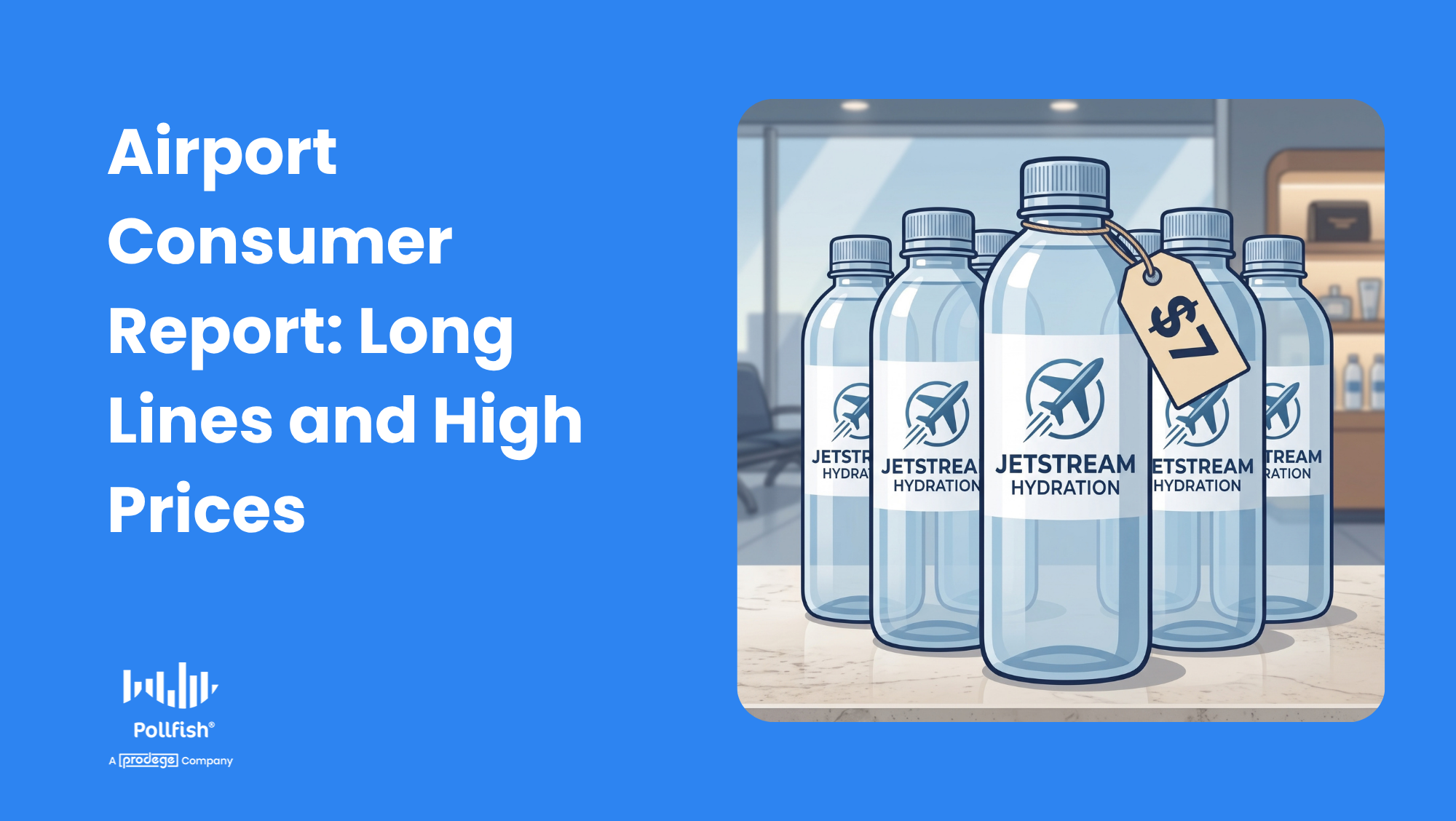 While 74% of air travelers report high frustration with terminal food pricing, 2026 research by Pollfish reveals that stressful lines and rising prices are altering consumer spending behavior at the gate.
When travelers step into an airport terminal, they enter a captive market where a standard bottled water costs $6 and a pre-packaged sandwich regularly costs over $17. While concessionaires historically relied on captive demand to justify steep markups, rising travel costs and fees have pushed consumer tolerance to a breaking point.
To determine whether high terminal prices are simply an accepted cost of travel or a driver of widespread consumer adaptation, Pollfish surveyed air travelers across the United States. The research evaluated spending behavior, operational frustrations, in-flight etiquette, and consumer priorities from gate to arrival.
The data reveals a clear shift in traveler behavior: Consumers are actively opting out of airport retail, prioritizing operational efficiency over material convenience, as well as enforcing strict courtesy norms among passengers.
Key Survey Findings: Airport Pricing and Traveler Insights
- Price Resistance: Only 9% of travelers willingly pay full price for terminal food and drinks. 50% now pack their own food and water from home, while 21% choose to fast until reaching their destination and 20% use on lounge access
- $5 Maximum for Water: Over 64% of consumers set their absolute spending limit for a bottle of water at $5.00 or less, with 7% refusing to buy water inside terminals under any circumstances.
- Checked Bags Lead Fee Frustration: 37% of respondents cite checked bag fees ($35–$50) as the single biggest travel rip-off, outranking pre-packaged food (24%) and in-flight Wi-Fi (22%).
- Speed Over Luxury: When ranking airport improvements, faster security screening emerged as the #1 priority (mean rank 2.3), far outranking comfort features like sleeping pods or quiet rest zones.
- Courtesy Rules the Cabin: 91% of passengers practice courteous seat-reclining behavior (checking behind them or limiting recline), while only 9% recline immediately without warning.
- Direct Intervention: When etiquette is broken, 58% of travelers take active steps to address it, with 37% choosing to speak directly and politely to the offending passenger.
Prefer to Watch? Watch a 60-Second Video Breakdown of this study recorded live at the gate.
Airport Food Pricing Trends: Why 50% of Travelers Pack Food From Home
Prices for food at the airport have increased heavily over the last 25 years due to the shift from airports being simple destinations to essentially large shopping malls with captive audiences that need a ticket to be there who can’t leave until their plane does. The idea of the captive audience has allowed retailers to steadily raise prices, however, Pollfish data shows that price sensitivity inside the terminal has reached a tipping point.
High terminal food and beverage prices are rated as extremely frustrating by 41% of travelers, functioning as a persistent background complaint across every income bracket and demographic.
| Money-Saving Strategy | Share of Travelers |
| Pack snacks and an empty water bottle from home | 50% |
| Wait to eat/drink until reaching final destination | 21% |
| Rely on credit card perks, status, or lounge access | 20% |
| Pay full terminal retail prices for convenience | 9% |
With fewer than 1 in 10 passengers paying full price without taking preventative action, airport concessionaires are losing more than half of their potential customers before travelers even reach the gate.
This resistance extends directly to basic necessities like water. When asked for the maximum price they would pay for a standard 16 oz bottle of water before walking away:
- 22% cap their spending at $3.00 or less
- 35% set their limit between $4.00 and $5.00
- 21% will pay $6.00 to $7.00
- 15% will pay $8.00+ regardless of cost
When prices exceed $5.00, demand drops sharply. Rather than generating higher per-unit margins. Extreme markups are actively pushing travelers toward refillable water stations and self-packing.
Airport Upgrades and Operations: Travelers Prioritize Security Speed Over Amenities
Beyond pricing, this study evaluated where the travel journey breaks down most severely. The data shows that traveler stress clusters around time-sensitive operational slowdowns that threaten a passenger’s schedule.
Security screening lines are the leading source of airport stress, cited by 58% of respondents, followed closely by boarding processes (42%) and finding transit or parking (40%).
When asked to rank potential airport service upgrades in order of priority, operational fixes decisively beat out lifestyle and comfort enhancements:
- Faster, more efficient security lanes (Mean Rank: 2.3)
- More affordable dining options (Mean Rank: 2.9)
- More charging stations and power outlets (Mean Rank: 3.2)
- Cleaner, more frequent restroom maintenance (Mean Rank: 3.3)
- Quieter rest zones and sleeping pods (Mean Rank: 3.3)
While luxury amenities like sleeping pods and premium lounges dominate travel industry headlines, the average consumer overwhelmingly prioritizes basic operational reliability. Travelers want airports to eliminate process friction first before investing in passive waiting environment enhancements.
In-Flight Passenger Etiquette: Seat Reclining Rules and Cabin Pet Peeves
Once on board, passenger frustration shifts from airport operations to personal space violations. The leading in-flight pet peeves center on direct physical disruptions:
- Seat kicking or pushing: 34%
- Rushing the aisle immediately on landing: 21%
- Immediate, full seat reclines: 20%
- Bare feet or shoe removal: 13%
- Armrest hogging: 12%
Despite viral social media debates regarding seat reclining, our data reveals a strong consensus around cabin courtesy.
A striking 91% of travelers abide by context-sensitive reclining norms. Nearly half (47%) check behind them for laptops or limited space before reclining slowly, 23% refrain from reclining out of courtesy, and 21% reserve reclining strictly for long or overnight flights. Only 9% hold the entitlement mindset of reclining immediately after takeoff.
When these shared norms are broken, passengers do not simply endure the discomfort. 58% favor active intervention, with 37% addressing the passenger directly and politely, while 21% ask a flight attendant to step in. Only 19% report suffering in silence.
3 Market Research Insights for Airlines, Travel Brands and Concessionaires
This study offers several actionable takeaways for brand managers, airport operators, and travel marketers:
1. Captive Pricing Strategies Are Limiting
Relying on captive demand to drive revenue inside terminals is actively pushing consumers into avoidance strategies. Offering value-focused meal tiers or transparent pricing structures below key thresholds (like $5 water) can recapture the 50% of travelers who currently bring food from home.
2. Operational Efficiency Is the Ultimate Value Metric
Consumers do not view travel upgrades through a luxury lens; they view them through a time-saved lens. Marketing campaigns and infrastructure investments that highlight reduced queue times, streamlined boarding, and transparent fee structures will resonate far more than passive comfort add-ons.
3. Rapid Agile Research Captures Real-Time Sentiment
Consumer sentiment changes rapidly, especially in high-stress environments like travel hubs. By deploying agile surveys via Pollfish, brand teams can capture authentic, context-driven consumer insights in the exact moments decisions are being made.
Survey Methodology
This study was conducted on September 16, 2026, using the Pollfish online survey platform. The survey target audience sample comprised 300 adult respondents residing in the United States who have flown commercially at least 6 times within the last 12 months. Results were representative across age, gender, and geographic region.
About Pollfish
Pollfish is a consumer insights platform that delivers real-time survey responses from over 100 million consumers worldwide via the Prodege audience network. By pairing agile methodology with advanced demographic targeting, Pollfish helps marketers, researchers, and brands validate concepts, track sentiment, and make data-driven decisions in minutes, not weeks.
