
Guide to CPG Market Research (Benefits, Use Cases & Tools)

Consumer packaged goods brands operate in highly competitive categories where decisions around pricing, packaging, and positioning can have a major impact on performance.
This means that understanding consumer opinions and decision-making through CPG market research is essential to staying ahead of the competition.
In this comprehensive guide, we answer common questions about CPG market research, including:
- What is CPG market research?
- What are the benefits of conducting CPG market research?
- What are the different types of CPG market research?
- What are the best full-service providers for CPG market research?
- What are the top DIY survey tools on the market?
Note: Pollfish (our DIY survey tool) is renowned for high-quality data, transparent pay-per-response pricing, and quick turnaround times. Also, through our parent company Prodege, we offer end-to-end market research services and can handle the entire process for you. Our team brings decades of experience in CPG market research, including multiple former Nielsen employees. Click here to schedule an intro call.
What Is CPG Market Research?
Researchers rely on CPG market research to determine how to grow sales by aligning products, pricing, and messaging with consumer expectations.
Market research helps CPG brands answer questions like:
- How do consumers perceive specific products and brands?
- Which product attributes most influence purchase decisions?
- What is the optimal price point that aligns with consumer expectations?
- How should packaging look, and what claims should it communicate?
- Which consumer segments are most likely to buy a given product?
- What factors shape decision-making when shoppers compare options at the shelf or online?
Benefits of CPG Market Research & Common Applications
CPG market research helps brands make evidence-based decisions, increasing their chances of success while reducing costly trial-and-error.
Let’s break down some of the most common applications:
❇️ Pricing
Market research helps CPG brands find price points that align with consumer preferences and drive more sales.
Example: A snack brand could test several price points to see which would make shoppers most likely to purchase without questioning quality or value.
One common type of pricing research model is the Van Westendorp method, which asks consumers a series of questions, such as:
- At what price would a product feel so cheap that its quality is questionable?
- At what price does it feel like a good value?
- At what price does it start to feel expensive but still worth considering?
- At what price does it become too expensive to consider purchasing?
Pollfish supports Van Westendorp as well as 15 other question types:
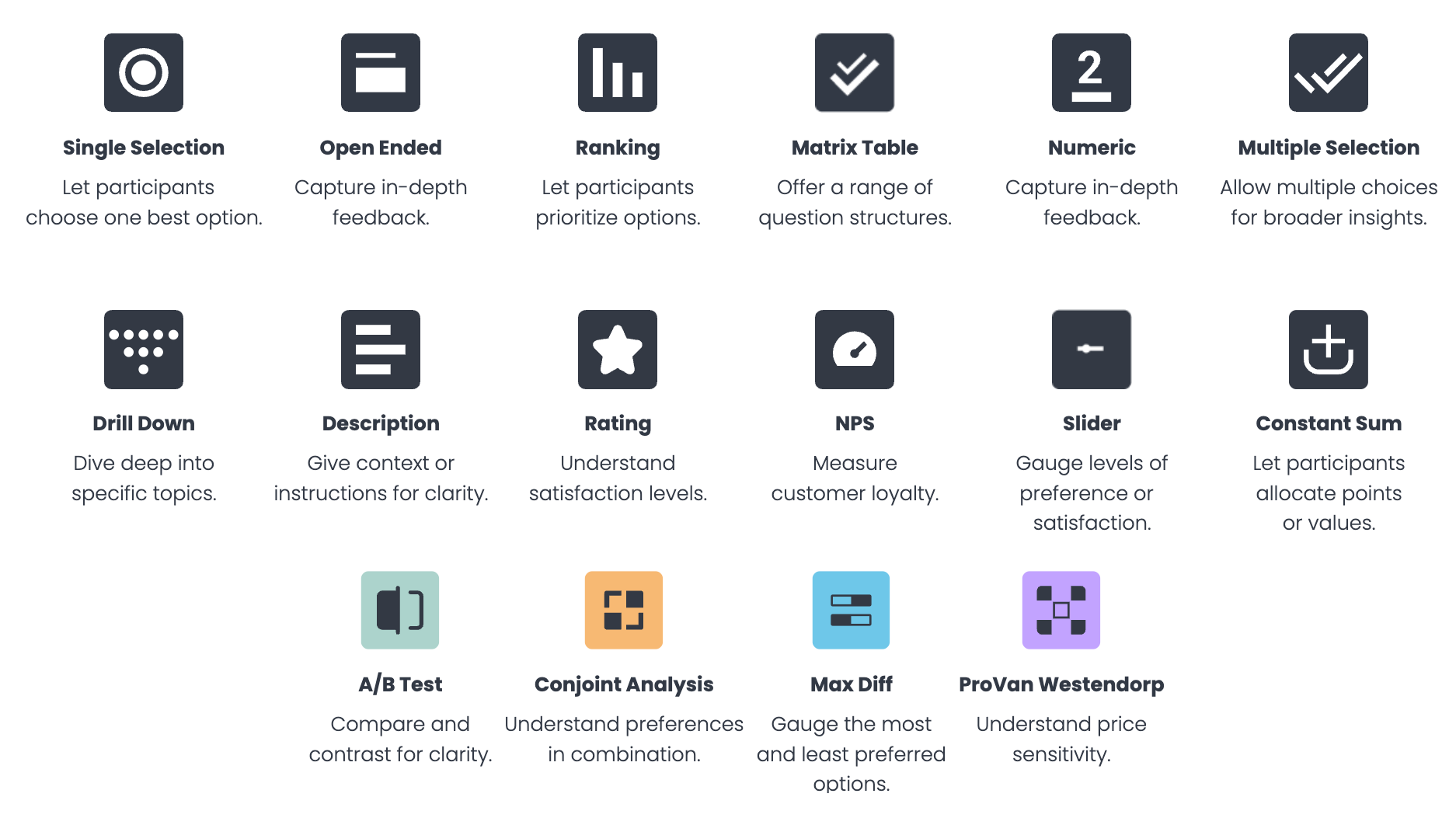
Click here to learn more about each question type and when to use them.
❇️ Innovation
Market research helps CPG brands identify unmet needs and uncover opportunities for new products or existing product innovation.
Example: A beverage brand could survey consumers to learn what they feel is missing from existing options, such as lower sugar, functional benefits, or new flavors. These actionable insights can help optimize product development.
❇️ Concept testing
CPG brands can present consumers with product concepts (e.g., descriptions, key benefits, pricing, packaging) to measure purchase intent and performance on important attributes.
Example: A personal care brand could show shoppers two different product concepts, each with a unique description, price, and package image, and measure which one feels more appealing and more likely to be purchased.
Note: Watch the testimonial from Jason Walter, Product Developer at bevCacao, on how concept testing surveys with Pollfish helped them save thousands of dollars.
❇️ Brand health tracking
CPG brands can conduct brand health tracking surveys on a regular basis (e.g., monthly, quarterly) to measure key indicators of a brand’s health. The KPIs often include awareness, consideration, and consumer sentiment of a brand over time.
Example: A household goods company could run a quarterly brand tracking survey to identify whether unaided awareness and other key KPIs are improving after a new ad campaign.
Read our article on the 12 Best Brand Tracking Software tools.
❇️ Market analysis & consumer understanding
CPG companies can gain a broad view of category behavior, usage patterns, and decision drivers, often through attitudes and usage (A&U) studies.
Example: A food brand could conduct an A&U study to understand consumer insights, how often they buy products in the category, what triggers purchase, and which brands they consider first.
Note: Pollfish, our DIY survey tool, offers templates for many of the use cases above. Read more about Pollfish’s survey templates here.
What Are the Different Types of CPG Market Research?
There are two main types of CPG market research: primary and secondary.
Primary research gathers new, firsthand data from consumers. It can be either quantitative or qualitative.
❇️ Quantitative methods
Quantitative market research is used to collect data at scale. Types of quantitative research include:
- Surveys: A structured set of questions used to collect consistent feedback from a group of people. Surveys can be run online, by phone, in person, or at the point of purchase, and are used to understand attitudes, preferences, and behaviors. Pollfish is our DIY market research tool for running online surveys, offering rigorous data quality standards and transparent pay-per-response pricing.
- Point-of-sale data: Sales data collected at the retailer level that tracks sales trends, market share, and distribution, such as whether a product is in store or not. This data shows what was sold, but does not explain why consumers made those purchases.
- Panel data analysis: Consumer-level purchase data collected over time at the household level. This type of analysis helps show loyalty, switching behavior, and how products are purchased together, such as through market basket analysis.
- Shelf testing: Quantitative testing that simulates a retail shelf experience, allowing consumers to browse products virtually and make purchase decisions. It helps brands understand how packaging, placement, and pricing influence choice.
❇️ Qualitative methods
Qualitative research typically involves one-on-one conversations or small group discussions, such as a moderator interviewing a small number of participants.
While it’s difficult to conduct qualitative research at scale, it helps explain the why behind consumer behavior, rather than just the what.
Types of qualitative research include:
- IDIs (In-depth interviews): One-on-one conversations with consumers that explore their experiences, motivations, and opinions in detail.
- Focus groups: Moderated discussions with small groups of consumers, often ranging from four to eight participants, although it varies.
- Bulletin board studies: Moderated discussions where participants complete tasks asynchronously over several days.
- In-home usage tests (iHUTs): Studies where products are sent to consumers to use in their own environment, with feedback collected on real-world usage.
- Conversational AI questions: Pollfish’s Conversational AI survey question type enables respondents to have real-time, one-on-one conversations via AI, offering the depth of qualitative research at scale.
Secondary market research is typically collected from syndicated sources such as trade publications, journals, and providers like Mintel, Statista, Nielsen, and others. This type of research is often used to build a foundational understanding of a category, and can help align with consumer needs.
For example, a CPG brand entering a new category may turn to secondary market research to understand market size, consumer behaviors, and competitive landscape before deciding whether to launch a product.
What Are the Top CPG Market Research Full-Service Providers?
Prodege, Pollfish’s parent company, is our full-service CPG market research company known for exceptional survey data quality. Prodege is the world’s largest single-panel owner, with over 100 million respondents across 125+ countries, ensuring you can reach your exact target audience.
Below, we’ll cover the key benefits of working with us. And if you’d like to compare options before deciding, check out our article on the Top 16 CPG Market Research Companies.
Note: If you’re interested in running CPG market research surveys yourself, we’ll discuss our DIY survey tool, Pollfish, in the next section. Pollfish offers outstanding data quality and a transparent pay-per-response pricing model that lets CPG companies scale research with their needs rather than being locked into a high subscription fee.
Here’s how Prodege’s end-to-end research process works, and what you can expect at each stage:
- Step 1: Talk to a Prodege sales director and explain your business goals and challenges.
- Step 2: The sales director and other consulting team members (as relevant) will probe to understand the decisions you’re trying to make and design custom research to address those issues.
- Step 3: Receive a proposal outlining the recommended research design, including whether the study will be quantitative or qualitative, an outline of what the survey might look like, the estimated sample size, how difficult it may be to find respondents, and the expected incidence rate.
- Step 4: Work with the consultant through a back-and-forth process to make sure both sides agree on the research design.
- Step 5: Once approved, the consultant writes the survey and shares it with you for feedback. Together, you fine-tune the questionnaire.
- Step 6: Prodege’s team programs and launches the survey.
- Step 7: Prodege finds high-quality respondents, fields the study, processes the data, and creates cross-tabs.
- Step 8: Your data is made available in Insights Builder, Prodege’s data visualization platform, where you can create charts and graphs and explore the findings in depth.
- Step 9: The consultant prepares a report summarizing key insights and can also present the findings to your stakeholders.
Both quantitative methods (e.g., surveys) and qualitative services (e.g., IDIs, focus groups) are available. Whatever your needs, our team can help you determine the best research approach.
Here’s what Remesh had to say about working with Prodege:
“Working with Prodege has allowed us to provide quality sample and a smooth recruitment process from beginning to end for our large-scale qual sessions. We can always count on the team for fast recruitment programming, excellent screening and quota delivery, low incidence rate audiences, and timely turnaround for all our projects. The customer service of their project management team is unmatched.”
Prodege offers CPG companies several key advantages, including:
❇️ Experienced team with decades of collective expertise working on CPG market research
Nearly everyone on Prodege’s consulting team brings 20+ years of experience in market research, with deep specialization in the CPG industry.
Our team includes former Nielsen professionals, as well as researchers who have worked directly on the brand side at CPG companies such as Nestlé and Monster Energy.
This background helps us understand both the research and the real business decisions our clients need to make.
❇️ Exceptional white glove service & responsiveness
We consistently hear from clients that our high level of service stands out. When we attend industry conferences, people often stop us to comment on how responsive and supportive our team is.
In one case, a client even asked whether we have a rule to respond to emails within an hour because of how quickly we communicate. That level of responsiveness is central to how we work with our clients.
❇️ Intuitive, sophisticated data analysis and visualization tools
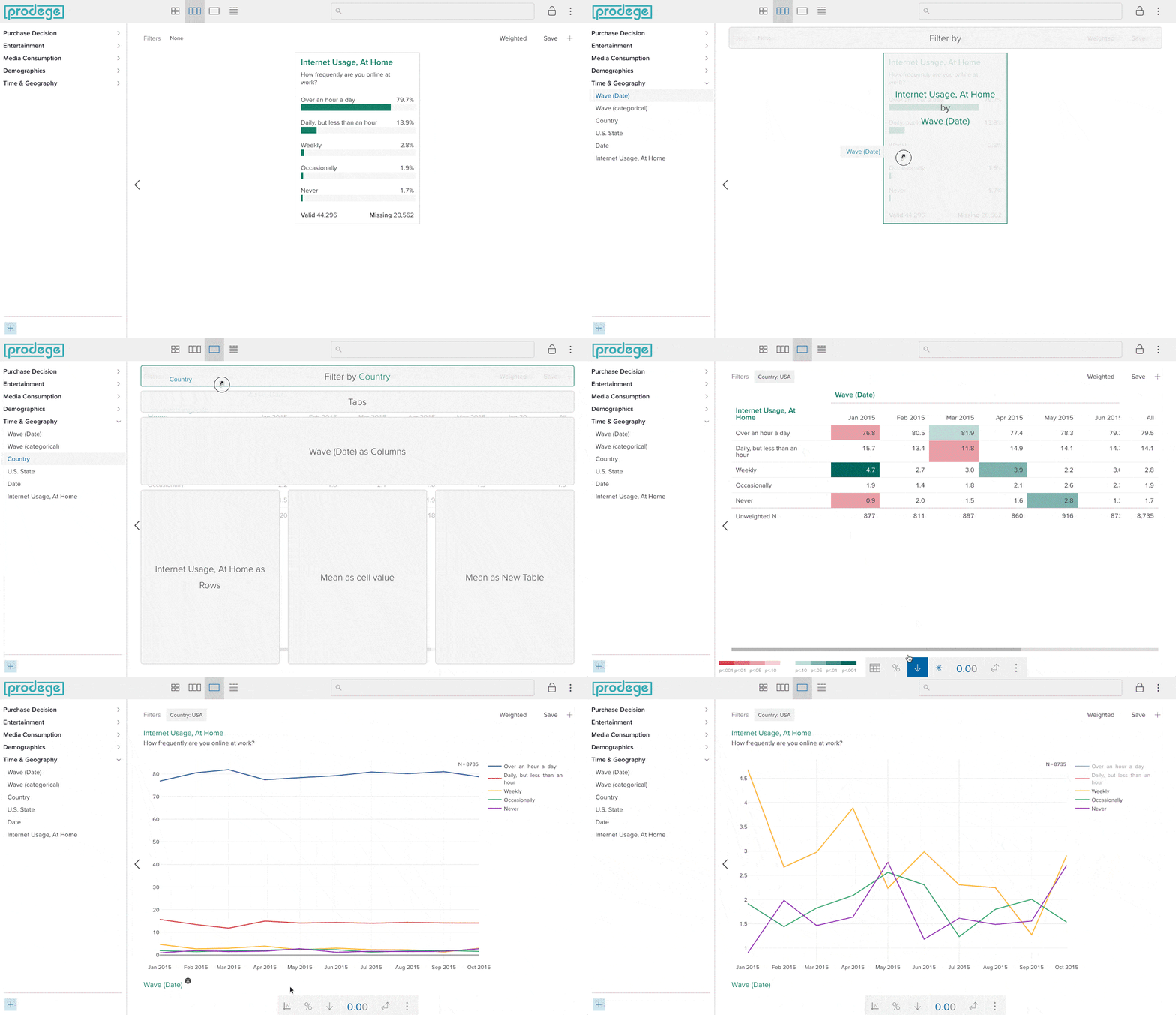
Insights Builder is our data visualization platform built specifically for market research. It’s designed to make it easy to explore results using a drag-and-drop interface, without having to manually build charts in Excel or struggle with general-purpose tools like Tableau.
CPG teams can export editable visuals directly into PowerPoint using their own templates and color schemes, helping you move faster from data to insights.
As BuzzFeed has noted:
Interested in learning more about Prodege?
We invite you to:
What Are the Top DIY Survey Tools for CPG Market Research?
DIY survey tools let you quickly and easily run your own online surveys.
Our platform, Pollfish, offers an intuitive, easy-to-use interface, and it’s especially popular among CPG brands. Here’s a testimonial from Jason Walter, Product Developer at bevCacao, on how Pollfish saved them thousands of dollars:
Up next, we’ll share a quick overview of how to use Pollfish for CPG market research:
Step 1: Design your questionnaire
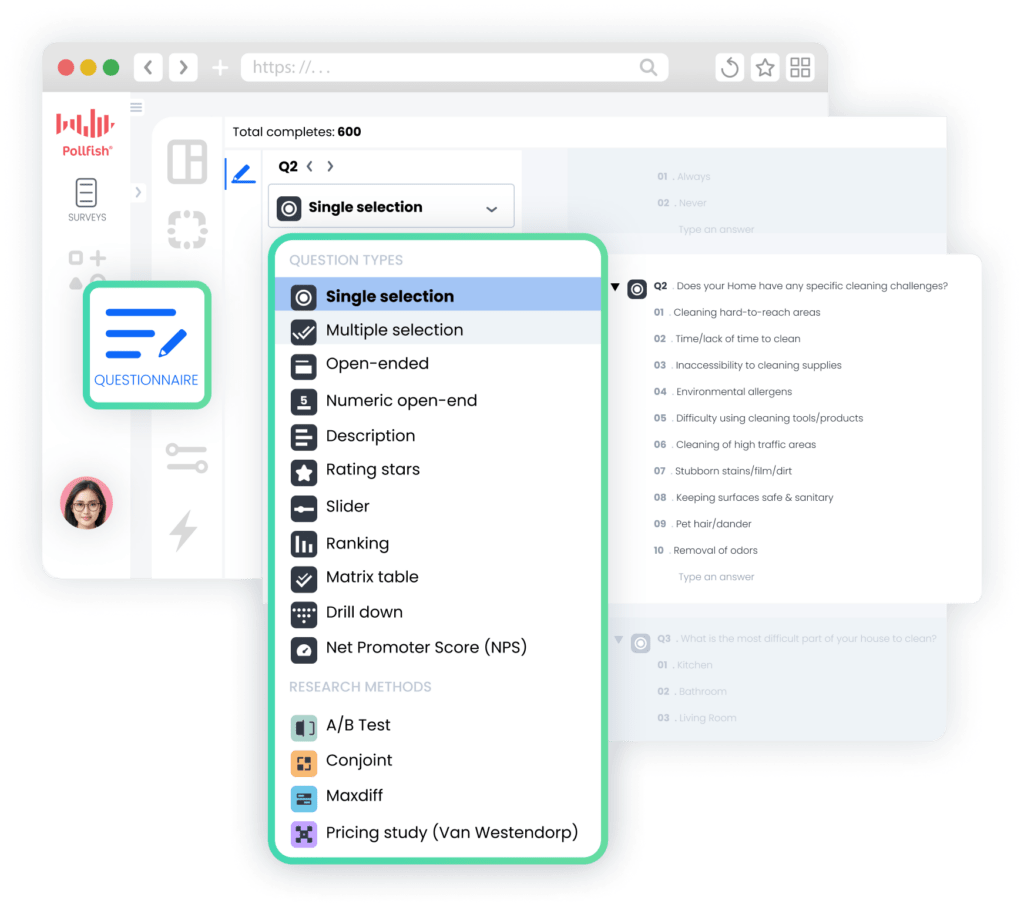
Pollfish offers a variety of CPG market research templates, including:
- CPG Brand Awareness and Perceptions
- CPG Store Choice Drivers
- CPG Path to Purchase
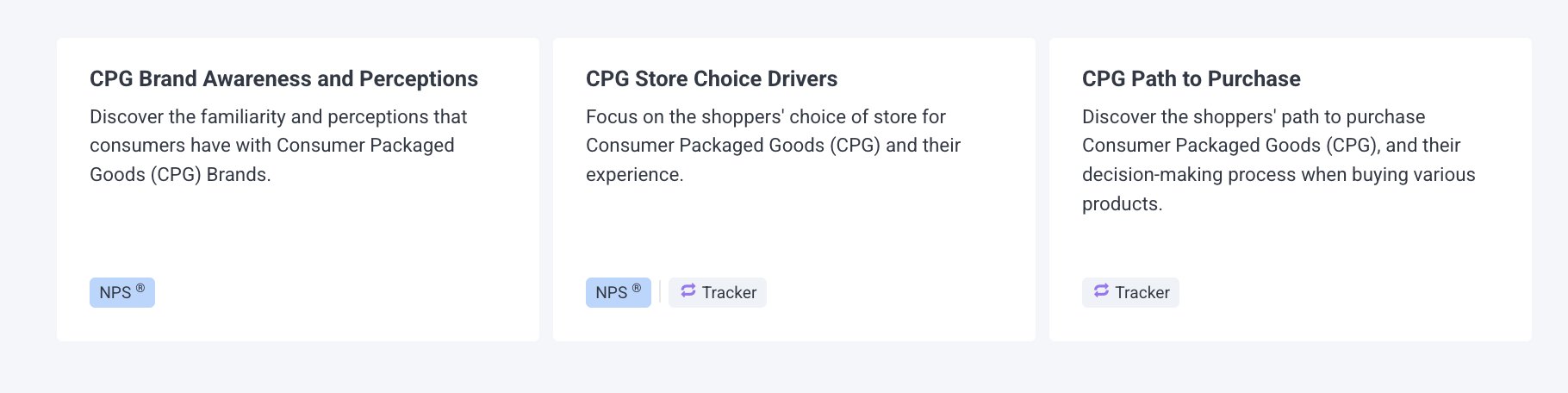
This gives you a head start on survey creation and suggests questions you might not have considered otherwise. We also offer many other survey templates to meet your CPG research needs.
We offer 16 question types, from basic formats to advanced methodologies like Van Westendorp, A/B testing, conjoint analysis, and MaxDiff.
Our AI Survey Builder has already been used over 40,000 times, and it’s one of our most popular features. It can help you put your survey together in just minutes. Instead of manually adjusting questions and logic, simply chat with the AI to implement changes more quickly.
We offer 19+ advanced survey design features, including:
- Skip logic branching
- Screening questions
- Answer and question shuffling
- Multimedia questions
The features list goes on.
No matter how complex your CPG survey design goals are, Pollfish offers the tools to get it done.
Step 2: Select your target audience

Pollfish lets you define a target audience as general or niche as your survey requires.
We offer over 50+ targeting filters across 6 categories, as well as the option to set audience quotas to ensure balanced representation across audience segments.
In addition, Pollfish offers CPG-specific behavioral targeting based on verified purchase data.
Our panel members can upload purchase receipts to earn rewards, which lets you filter audiences precisely by:
- Products purchased (e.g., Ruffles, Dr. Pepper, Angel Soft, Tabasco)
- Retail stores visited (e.g., Target, Costco, 7-Eleven, Papa John’s)
- Websites visited (e.g., BuyBuyBaby, CNN, Reddit)
This verified purchase targeting is unique to Pollfish, and it can dramatically improve the precision and quality of your CPG survey results.
Step 3: Analyze results
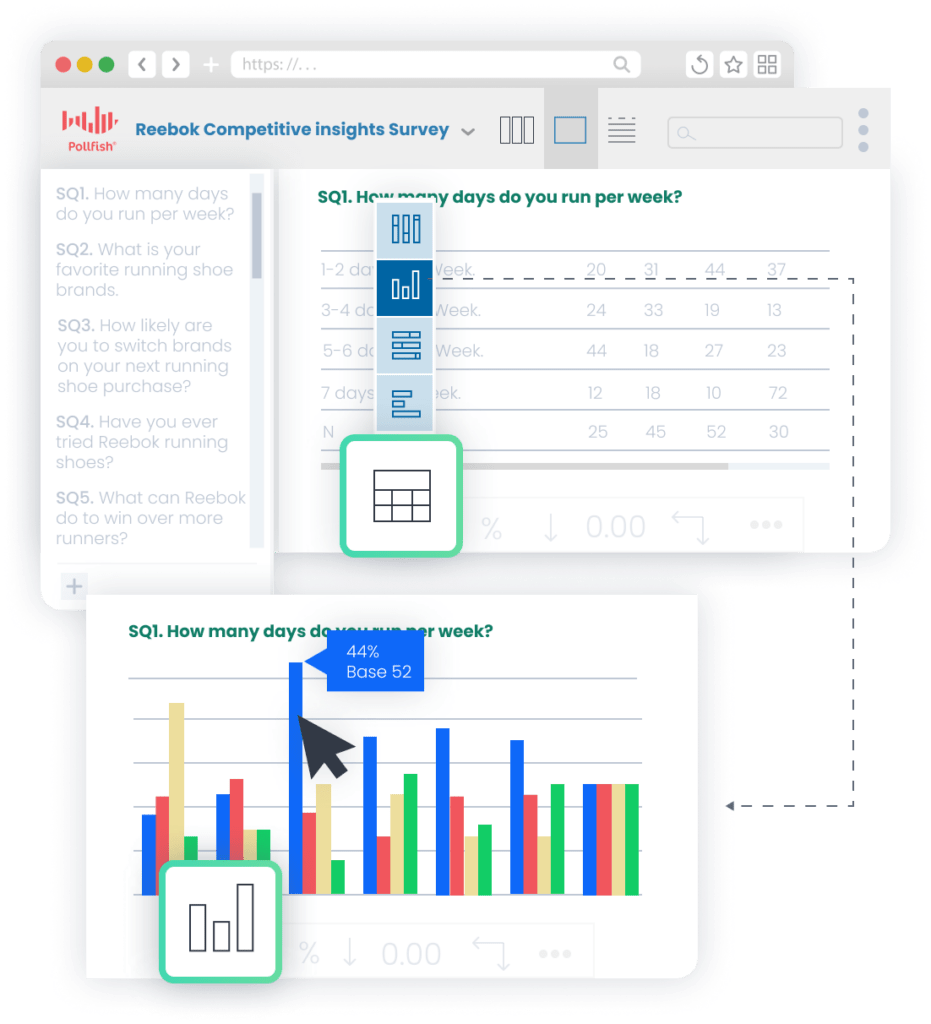
Most survey software requires you to export data to Excel or other tools for manual analysis.
Pollfish is different. With built-in analysis features, you can create visualizations, filter results, and build multi-variable charts directly within the platform — no external tools required.
We also offer a powerful AI Survey Analysis tool, which generates stakeholder‑ready insights and reports, saving you significant time.
To learn more about Pollfish’s data analysis capabilities, read our article on the 7 Best Survey Software with Data Analysis Tools.
Additional Key Benefits and Differentiators of Pollfish
As we’ve covered above, we offer powerful functionality for whatever your survey needs may be. Now we’ll cover some other key reasons why CPG companies choose Pollfish for their market research.
❇️ Rigorous data quality measures, ensuring reliable results you can confidently base decisions on.
We explore this topic in detail in our article on the 3 Survey Data Quality Issues Sabotaging Your Research (& How We Fix Them). Some of the data quality measures we implement include a 14-day evaluation period for new survey takers, dynamic trust scores, verifying respondent identities through purchase receipt uploads, and more.
As several customers shared on Trustpilot:
“The most important point to make is that I trust the responses of my survey. My target audience was very specific and I could tell that the responses were legitimately coming [from] subjects in my target audience.”
– Read the full review here
“Each time I use this service I am blown away by the speed with which the responses come in and with the detail which most of them include. You can tell that the respondents take this very seriously. They must really enjoy doing it.”
– Read the full review here
❇️ Transparent pay-per-response pricing starting at $0.95 per response, with no subscriptions, no long-term commitments, and no hidden fees.
As several customers shared on Trustpilot:
“They charge based on the completed response. It is very fair and transparent. As a researcher, I have used many survey platforms, but they are the best so far.”
– Read the full review here
“The dollar amount they quote you in their cost calculator tool, and the number they show when you’re developing the survey, is the number you pay. I was burned multiple times by [competitor] charging me unexpected amounts and making it difficult to quit an expensive subscription. I’m so happy to have found Pollfish as an alternative. Their support team also responds VERY quickly to chat messages and has been tremendously helpful the few times I had questions.”
– Read the full review here
“The pricing is clear and transparent from the beginning. The results come quickly and can be downloaded in different formats and with different filters. What we like most is the ability to filter the results and analyze them separately for each segment. We highly recommend this platform.”
– Read the full review here
❇️ Quick turnaround time, from a few hours for general population audiences (e.g., U.S. adults over 18) to a few days or longer for specialized niches (e.g., small business owners in California with a college education).
As several customers shared on Trustpilot:
Review for a general population survey:
“I needed a 25 question survey answered, and was able to get 500 completed surveys in 8 hours with Pollfish. The presentation of the results is very impressive and the demographics information Pollfish provided is invaluable.”
– Read the full review here
Review for a specialized niche:
“I’m amazed at how quickly the platform was able to deliver rich, segmentable data from over 500 respondents. I had feature-ready insights in only 3 days.”
– Read the full review here
❇️ Complimentary advanced support from seasoned market research experts available 24/7 at no extra cost. We can help with questions related to survey design, audience targeting, and data analysis, not just basic technical support.
As several customers shared:
“The customer support agents were awesome. They responded to every question I had in a timely manner. (And before we even paid a cent!)”
– Read the full review here
“The customer service I received was fantastic. Brilliant guidance that helped get high-quality results. I was really pleased with the outcome and highly recommend using them.”
– Read the full review here
“The customer service team is super responsive too for those more complex enquiries about the tool and criteria. All in all this experience has been way easier (and cheaper) than any other ‘big players’ out there”
– Read the full review here
“I love this product. I feel like it gives me enterprise grade market survey tech at a consumer price. Highly recommend. I love how responsive the customer support team is.”
– Read the full review here
Interested in learning more about Pollfish?
- Create a free account (no credit card required).
- Inquire about our full-service offering, fulfilled through our parent company, Prodege.
