
Loop and Merge: Dynamic surveys without complex, manual survey programming.
Survey research works best when questions feel relevant to each respondent. But building personalized surveys manually can quickly become time-consuming and difficult to manage, especially when you’re comparing multiple products, brands, concepts, or experiences.
That’s where Loop & Merge in Pollfish comes in.
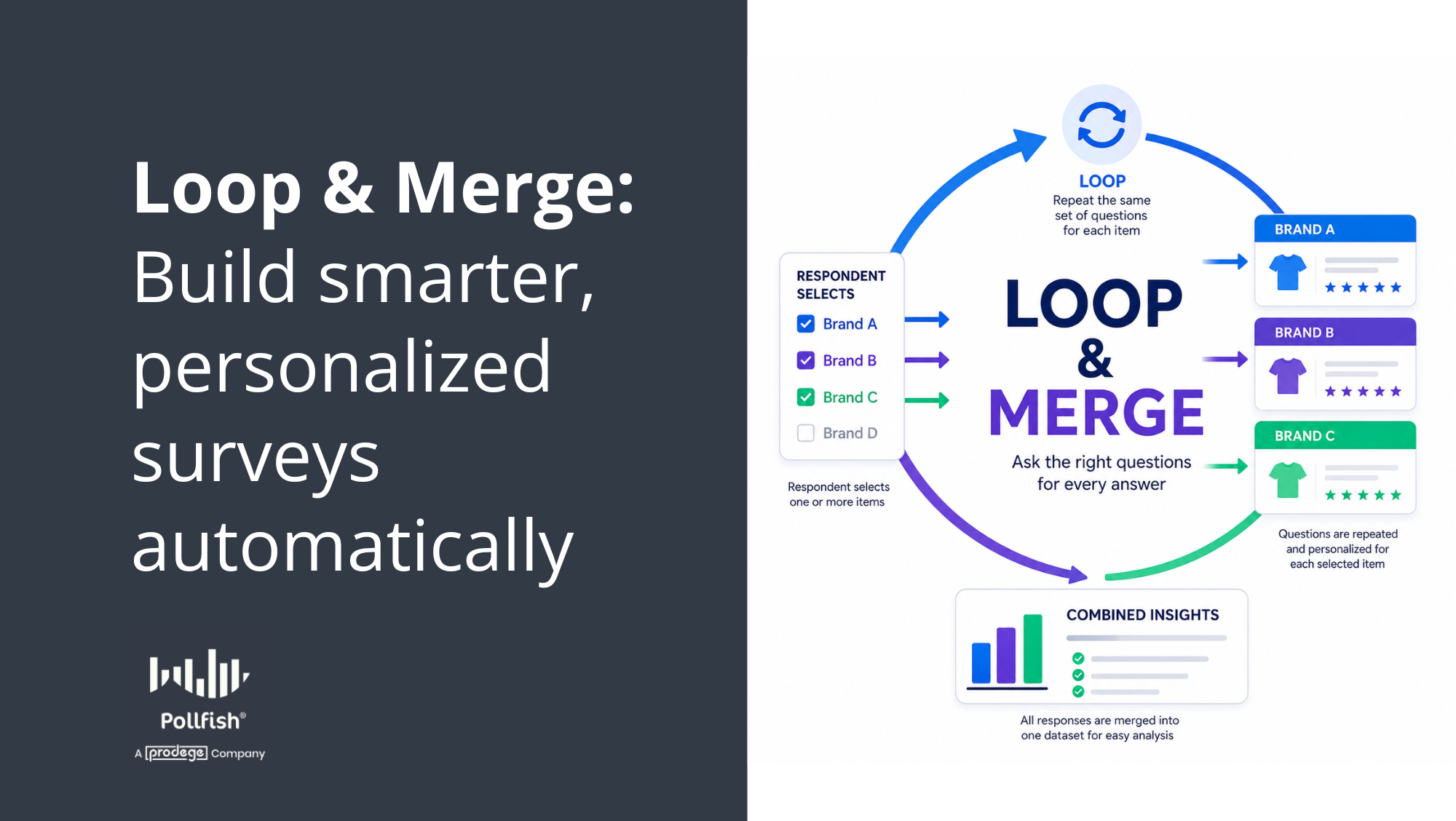
Loop & Merge helps you dynamically repeat groups of questions using answers from previous questions, demographic data, or custom variables. Instead of manually duplicating question blocks over and over, Pollfish automatically generates tailored follow-up questions for each respondent.
The result:
- More personalized surveys
- Faster survey setup
- Cleaner logic
- Better respondent engagement
- More scalable research designs
Whether you’re running brand tracking, product evaluations, course feedback surveys, or concept testing, Loop & Merge can dramatically simplify advanced survey workflows.
What Is Loop & Merge?
Loop & Merge is a survey logic feature that repeats a group of questions multiple times while dynamically replacing variables within those questions.
In simple terms:
- A respondent selects or qualifies for certain items
- Pollfish creates a repeated question block (“loop”) for each item
- Variables inside the questions automatically update for each loop
Instead of building separate question sets manually, you build the question group once and Pollfish handles the repetition automatically.
A Simple Example
Imagine you’re conducting apparel brand research.
You first ask respondents:
Which clothing brands do you regularly purchase from?
- Nike
- Adidas
- Levi’s
- H&M
If a respondent selects:
- Nike
- Levi’s
Pollfish can automatically repeat the same follow-up questions twice:
Loop 1
- How satisfied are you with Nike’s quality?
- How likely are you to recommend Nike?
Loop 2
- How satisfied are you with Levi’s quality?
- How likely are you to recommend Levi’s?
Without Loop & Merge, you’d need to manually build separate question blocks for every possible brand combination. With Loop & Merge, the survey adapts automatically.
Why Use Loop & Merge?
Loop & Merge is especially valuable when respondents may evaluate:
- Multiple brands
- Multiple products
- Multiple services
- Multiple experiences
- Multiple concepts
- Multiple locations
- Multiple courses or classes
Instead of asking generic questions, you can personalize follow-ups for each selected item.
This often improves:
- Survey relevance
- Completion rates
- Data quality
- Respondent engagement
It also significantly reduces survey programming time for researchers.
Common Research Use Cases
✅Brand Tracking & Competitive Analysis
Ask respondents which brands they use, then dynamically evaluate each selected brand individually.
Example:
- Brand satisfaction
- Purchase frequency
- Brand perception
- Net Promoter Score (NPS)
- Likelihood to switch
✅Product Testing
Allow respondents to review multiple products they’ve tried.
Example:
- Product quality
- Ease of use
- Value for money
- Purchase intent
✅Concept Testing
Present several concepts or ad creatives and repeat evaluation questions for each one.
Example:
- Appeal
- Relevance
- Uniqueness
- Purchase likelihood
✅Educational & Course Feedback
Perfect for academic or training surveys.
Example:
- Course satisfaction
- Instructor feedback
- Learning effectiveness
✅Customer Experience Research
Ask respondents about multiple stores, services, or locations they interacted with.
How Loop & Merge Works
Loop & Merge is built around two key components:
1. Loops
Loops define how many times the question group repeats.
Each loop represents one item being evaluated.
For example:
| Loop | Product |
|---|---|
| 1 | Nike |
| 2 | Levi’s |
| 3 | Adidas |
2. Variables
Variables are placeholders dynamically inserted into questions.
For example:
How satisfied are you with [Brand]?
Pollfish replaces [Brand] automatically during each loop.
Result:
- How satisfied are you with Nike?
- How satisfied are you with Levi’s?
- How satisfied are you with Adidas?
Where to Find Loop & Merge in Pollfish
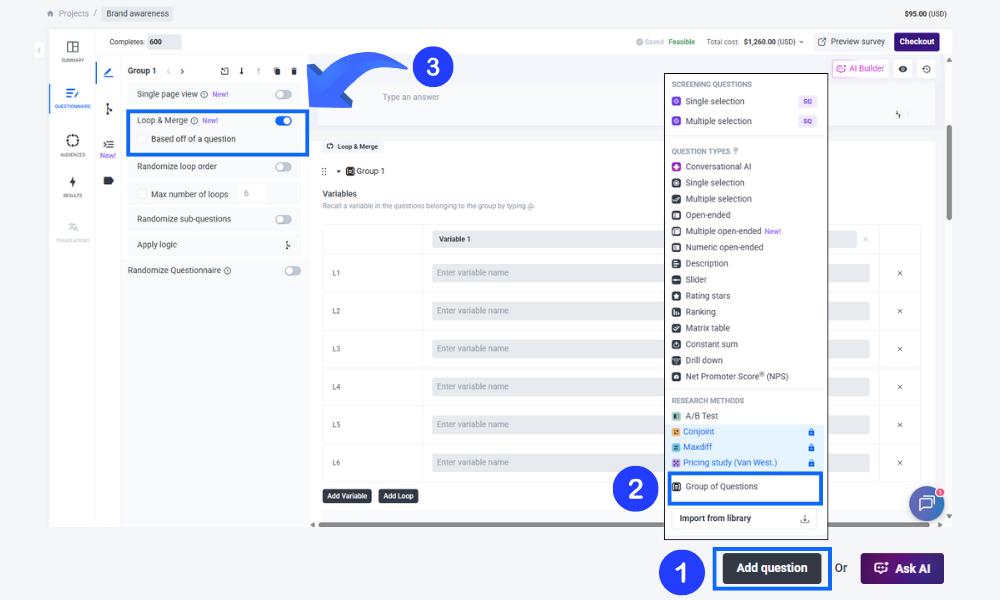
You can access Loop & Merge while building your survey:
- Create or edit a survey
- Click Add Question
- Select Group of Questions
- Enable Loop & Merge in the group settings panel
Once enabled, you can configure:
- Variables
- Loop sources
- Randomization
- Loop limits
- Logic behavior
Variable Sources Supported
Loop & Merge supports several types of dynamic variables.
Manual Variables
You manually define values inside the loop table.
Example:
| Loop | Product |
|---|---|
| 1 | Coffee |
| 2 | Tea |
| 3 | Juice |
Useful for:
- Controlled concept tests
- Structured comparisons
- Fixed product sets
Previous Question Answers
Variables can come directly from respondent selections.
Example:
- Selected brands
- Purchased products
- Preferred services
This is one of the most powerful use cases because surveys adapt uniquely for every respondent.
Demographic Variables
You can also personalize loops using demographic criteria.
Examples:
- Region
- Household type
- Pet ownership
- Age groups
Combined Variables
Loop & Merge also supports combinations of:
- Previous answers
- Manual entries
- Demographic data
This enables highly customized survey flows while maintaining clean logic.
Advanced Loop & Merge Features
Randomize Loop Order
You can randomize the sequence of loops to reduce order bias.
Example:
- Respondents see brands in a different order
This helps improve data quality in comparative studies.
Limit Number of Loops
You can cap the maximum loops shown.
Example:
- Respondent selects 10 brands
- Survey only evaluates 3 randomly selected brands
This helps control survey length and fatigue.
Multiple Question Type Support
Loop & Merge supports many Pollfish question types, including:
- Single select
- Multi select
- Ranking
- Open-ended
- Rating scales
- Matrix questions
This allows flexible and sophisticated research designs.
Intelligent Validations
Pollfish automatically checks configurations and alerts you if:
- Variables are missing
- Logic may break
- Combinations are invalid
- Data consistency could be affected
These safeguards help reduce programming errors.
Understanding Maxpath & Survey Flow
Because Loop & Merge dynamically repeats questions, the number of questions shown to each respondent can vary.
Pollfish automatically adjusts the survey maxpath accordingly.
For example:
- A respondent selects 3 brands
- Your Loop & Merge block contains 4 questions
The respondent will answer:
- 12 loop-generated questions total
Pollfish handles this automatically to ensure:
- Accurate survey flow
- Proper routing
- Correct reporting behavior
No manual calculations are required.
Data Exports & Reporting
Loop & Merge data exports work similarly to Pollfish’s sequential A/B structures.
This means:
- Results remain organized
- Responses stay tied to each loop
- Analysis remains scalable
You can still:
- Export data normally
- Use integrations
- Segment responses
- Analyze loop-level results
This makes Loop & Merge practical for both simple and advanced reporting workflows.
Best Practices for Loop & Merge Surveys
Keep Loop Groups Focused
Avoid overly large repeated blocks. Shorter loops typically maintain better respondent engagement.
Use Loop Limits Strategically
If respondents may select many items, consider limiting loops to avoid survey fatigue.
Randomize When Comparing Items
Randomization helps reduce positional bias when evaluating brands, products, or concepts.
Test Your Survey Thoroughly
Preview multiple respondent paths to ensure:
- Variables populate correctly
- Logic behaves as expected
- Loop counts remain manageable
When Should You Use Loop & Merge?
Loop & Merge is ideal when:
- The same question set applies to multiple items
- Personalization improves response quality
- Manual duplication would be inefficient
- You want scalable survey logic
It may be unnecessary for very short or simple surveys with only one evaluation target.
Final Thoughts
Loop & Merge makes advanced survey personalization far more accessible.
Instead of manually building repetitive logic structures, researchers can create dynamic, respondent-specific experiences with significantly less effort.
For experienced researchers, it unlocks scalable advanced survey designs.
For newer researchers, it simplifies workflows that would otherwise require complex manual programming.
Whether you’re comparing brands, testing concepts, evaluating products, or collecting detailed feedback, Loop & Merge helps you build smarter surveys that feel more relevant to every respondent.
Ready to try it?
