
Survey Minimum Quotas: Guarantee Survey Responses for Niche Audiences
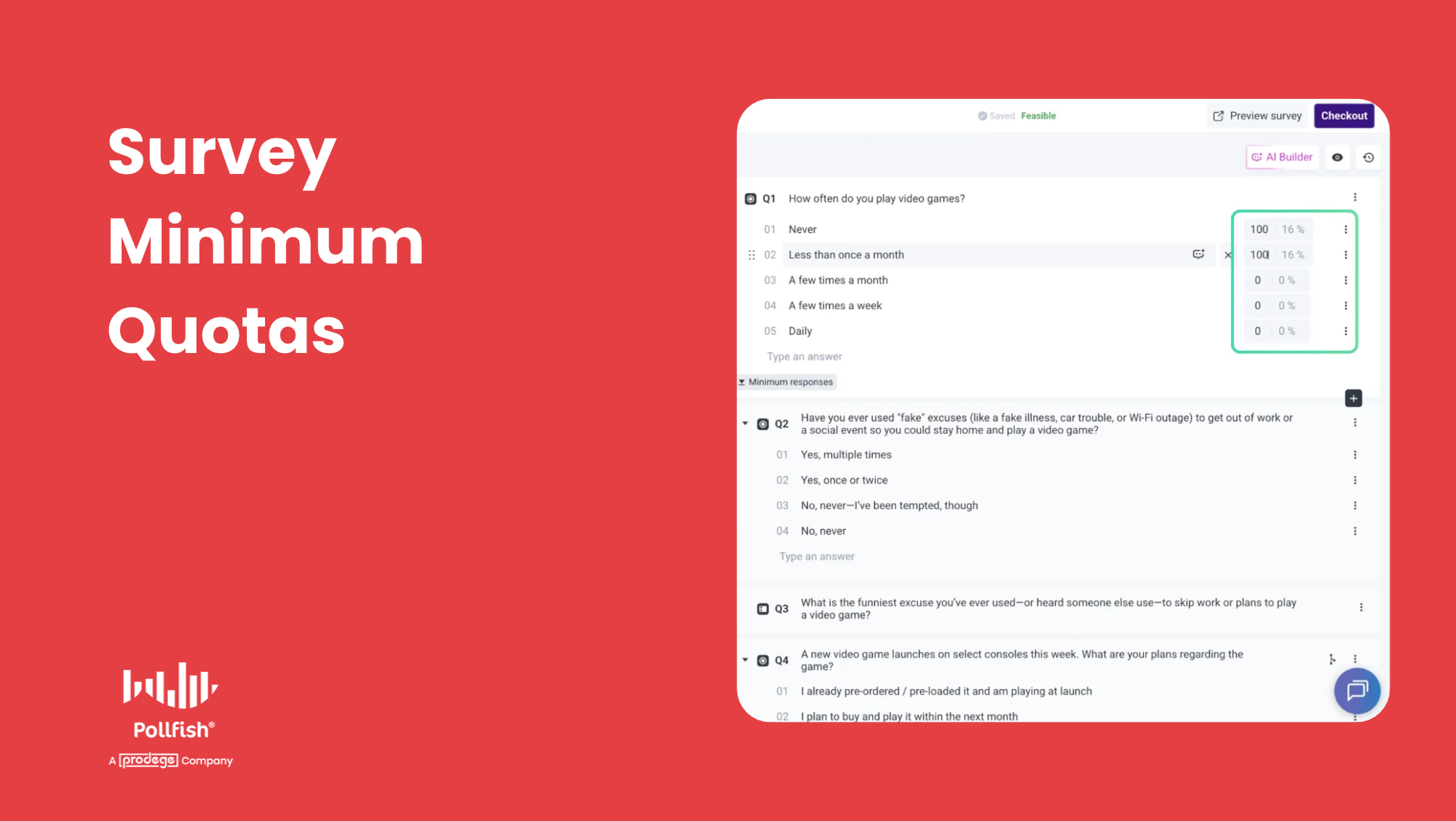 Getting enough survey responses overall is essential for accurate sample balancing. But what happens when crucial answers or niche audience groups get buried by dominant choices before you reach your survey response limits?
That’s where Minimum Quotas come in.
What Are Minimum Quotas?
Minimum Quotas allow market researchers to set a minimum number of respondents who must select a specific answer before their survey finishes. This ensures low-incidence targeting profiles, niche brands, or minority behaviors receive a guaranteed baseline of responses without requiring you to run separate targeted studies.
Whether you’re conducting brand tracking, usage studies, or concept tests, survey minimum quotas give you full control over answer floors so every category achieves statistical significance.
Unlike standard maximum quotas, which screen respondents out once an upper cap is reached, minimum quotas reserve survey slots specifically for respondents who select underrepresented answers.
Pollfish provides complete flexibility:
- Set Minimum Quotas Only: Guarantee baseline counts for rare choices.
- Set Maximum Quotas Only: Cap overrepresented choices to prevent sample skew.
- Set Both (Min + Max): Lock in precise ranges for maximum control over response distributions.
Why Use Minimum Quotas?
Without minimum thresholds, high-frequency answers quickly dominate your total sample allocation.
Common Challenges that Minimum Quotas Solve:
- A major market leader captures 80% of responses, leaving niche competitors with too few data points to analyze.
- A minor feature or product variant doesn’t reach a statistically valid sample size.
- Surveys fill up fast with mainstream users that niche audience groups are locked out before they even see the survey.
Minimum Quotas help researchers:
- Protect niche categories: Guarantee enough responses for low-incidence answers.
- Improve tracking studies: Ensure smaller brands reach threshold requirements in brand health trackers.
- Save budget: Collect balanced data in a single survey rather than running secondary targeted studies.
- Prevent incomplete data: Automate final respondent allocation so key subgroups aren’t missed.
Real-World Example of Minimum Quotas in Surveys: Smartphone Brand Trackers
Imagine launching a brand tracking survey aiming for 500 total completes. You ask respondents:
“Which brand of smartphone do you currently own?”
- Apple (Min Quota: 100)
- Samsung (Min Quota: 100)
- Google (Min Quota: 100)
- Other (No Min Quota)
In a typical study, Apple and Samsung users might claim 450 of the 500 responses within hours, leaving you with only a handful of responses from Google users. This would not be enough data for reliable crosstabulation or sentiment analysis.
By setting a minimum quota of 100 on Google, Pollfish automatically monitors collection progress. Instead of letting those mainstream brands consume 450 slots, the platform reserves the remaining completes exclusively for respondents who own Google devices the moment the survey approaches capacity, holding those slots until the 100-response floor is satisfied.
How Minimum Quotas Work
To ensure your minimum goals are met without unnecessarily screening out early respondents, Pollfish uses a dynamic allocation process.
- Natural Collection: In the beginning, your survey collects responses organically for all answer choices, counting every qualified response toward your minimum.
- Automated Priority Reservation: As the survey approaches its final completes, Pollfish checks unfulfilled minimum quotas against remaining survey capacity. The exact moment the remaining slots equal the unfulfilled minimum targets, Pollfish automatically reserves those final spots exclusively for the unfulfilled answers.
This means mainstream respondents aren’t screened out prematurely, and your low-incidence targets are guaranteed to finish before the survey closes.
How to Set Up Minimum Quotas in Pollfish
- Select a Supported Question: Add any supported question type (Single Selection, Multiple Selection, Matrix Single, or Matrix Multiple Selection).
- Toggle on Minimum Responses: From the left-hand question sub-menu, toggle on Minimum Responses.
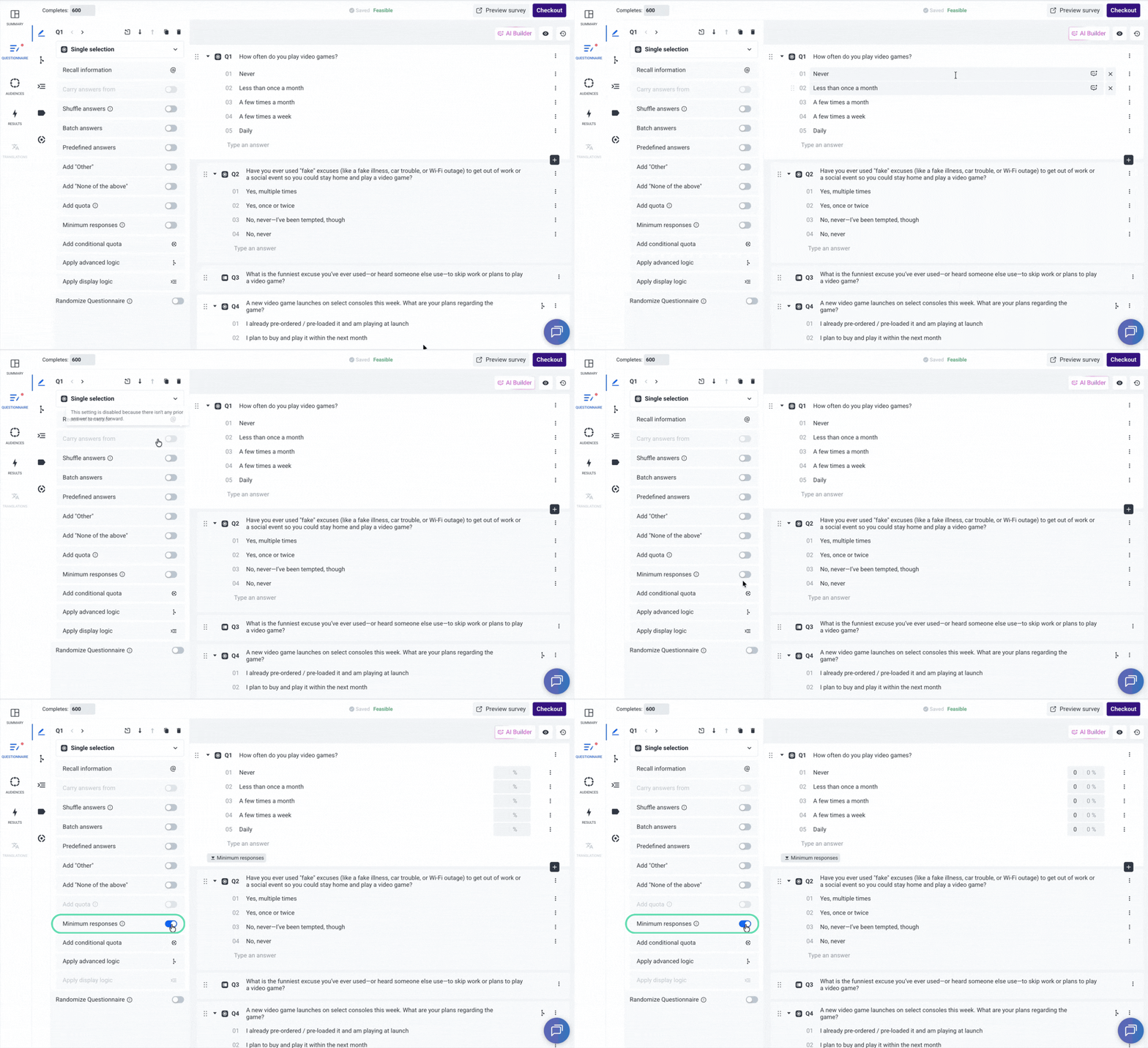
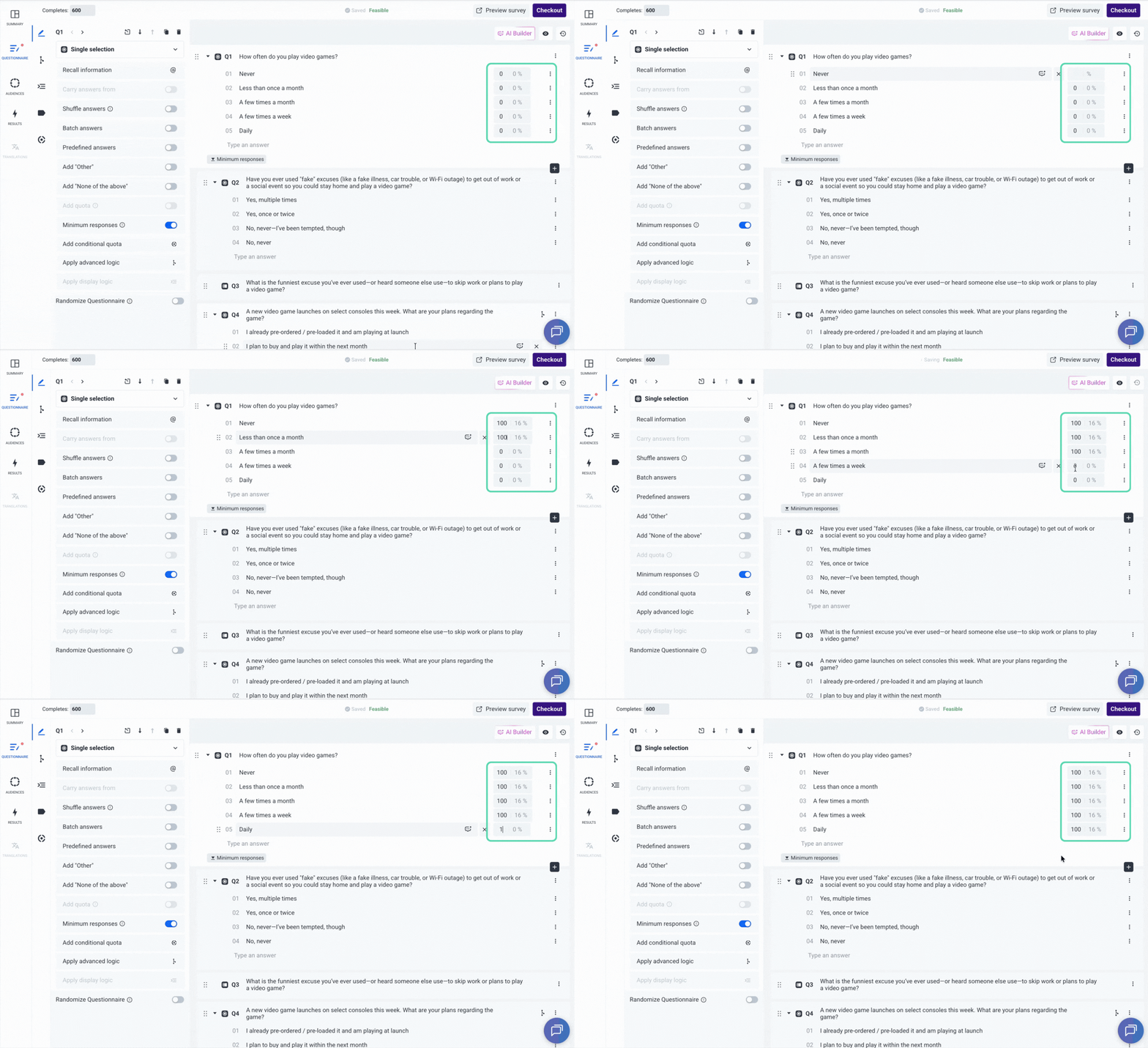
- Define Your Minimum Quotas: Enter the minimum number of respondents required for your critical answer choices.
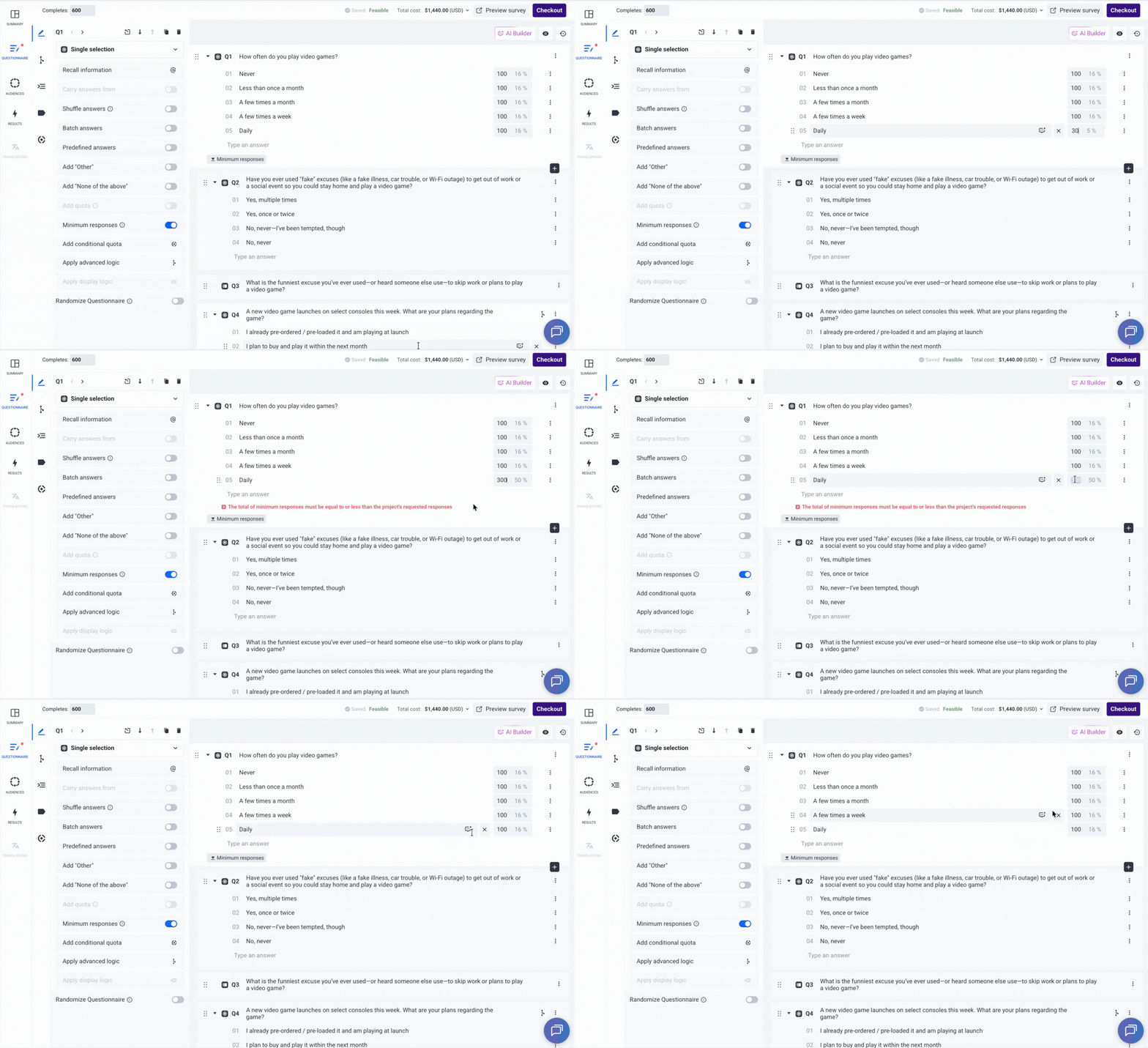
- Confirm Sample Feasibility: Ensure the sum of your minimum quotas does not exceed your survey’s total target completes.
- Launch: Pollfish handles the reservation logic automatically throughout fieldwork.
Supported Question Types & Availability
Minimum quotas are available across all Pollfish survey types for the following question formats:
- Single selection
- Multiple selection
- Matrix single selection
- Matrix multiple selection
Note: Minimum quotas require setting a total number of completes during study setup. Pricing follows standard Pollfish quota pricing rules.
Best Practices for Setting Minimum Quotas
- Keep Questions Early: Place minimum-quota questions within the first 8 questions of your survey to optimize incidence rates and maintain a smooth respondent experience.
- Check Mathematical Feasibility: Ensure the sum of all answer minimum quotas across a single question does not exceed your total survey sample size.
- Combine with Maximums Wisely: If you need exact counts for every answer choice, set both Min and Max quotas to enforce precise distribution bounds.
- Balance Incidence Rates (IR): Keep your target minimum quotas realistic based on audience incidence to prevent slow fieldwork during the final reservation phase.
Deliver Higher Quality Market Research
Minimum quotas remove the guesswork from niche data collection. By pairing automated reservation logic with flexible quota settings, researchers can run complex brand trackers, multi-brand studies, and segmentation projects with complete confidence in their final data sample.
Ready to start building more reliable surveys? Log in to Pollfish today to configure minimum quotas on your next study.
