

Accomplishing all Your Research Goals with Self-Service Market Research
Accomplishing All Your Research Goals with Self-Service Market Research

Self-service market research has been gaining ground in the research industry, putting traditional market research methods on the verge of becoming obsolete.
The self-service technology market is undergoing exponential growth, across various subsectors. The self-service technology market is projected to reach $72.51 billion by 2030, with a compound annual growth rate of 11.27%.
Naturally, it traversed to the market research industry as well, as self-service technology is dominating this industry. There are 39,815 market research companies in the United States as of 2022, a 0.5% increase from 2021.
As self-serve market research businesses are rising in growth and popularity, researchers across industries and businesses are abandoning traditional market research methods wholesale.
But what exactly does this form of research entail and what is it capable of?
This article explores self-service market research, its importance and all that you can achieve with it.
Understanding Self-Service Market Research
This is a modern form of market research, in which researchers conduct all research activities themselves, whether or not they are professionals.
Self-Service Vs Syndicated Market Research
In this kind of research, it is the researchers themselves who have ultimate control over their entire research campaign, not their market research platform provider. In this way, it is the opposite of syndicated research, which involves using a research firm that conducts the entirety of your research campaigns.
Aside from conducting the research campaigns, the research firm has full ownership over the direction of the research and all the resulting data, which they can then sell to those who are interested.
Thus, in syndicated research, not only do researchers have no say over the direction of the market research campaign, but the data they purchase is not proprietary to them.
Self-Service Market Research in Full Depth
Because of this, self-service is not just a technological method of conducting research; it is a means of dealing with and owning all of the research you conduct.
This is made possible through certain market research companies — the kinds that provide market research software, specifically polling software. Polling software allows researchers across businesses to create and distribute surveys.
A strong platform is optimized to carry out the entire survey process. This includes facilitating the following aspects:
- Audience targeting
- Questionnaire building
- A survey distribution service
- Different options for survey deployment
- A dashboard for analyzing your survey data collection
These are the main aspects of a self-service research platform, but there are many others that an ideal platform would provide (more on this in the following sections).
Essentially, a self-service platform allows you to conduct DIY market research, a method that permits you to take the do-it-yourself approach to market research campaigns. This means you have all the say on the ins and outs of the research study.
As such, a DIY survey is a tool that grants researchers ultimate control over their survey.
A DIY survey platform offers various capabilities that facilitate the survey creation and distribution processes. With this survey approach, the end-user (the researcher) is at the helm of the study.
That means you get to dictate its overall theme, objectives, target market, design, quotas and everything else in the survey study.
However, not all self-service market research platforms offer the same functionalities. Therefore, some will have more limitations than others, others will have completely different survey sampling methods and these platforms will also offer different levels of audience reach.
The Importance of Self-Service Market Research
This form of research carries a plethora of value in today’s digital age.
First off, this kind of research allows you to gain relatively inexpensive and timely results, the kinds you wouldn’t get elsewhere and through other methods.
You can use the self-service approach to market research to quickly get your questions answered and your problems solved. At the very least, you’ll get insights from your intended audience, the kind that you can use to take critical actions in your business.

Secondly, being able to access data on consumer preferences and needs is more important than ever, as the customers of the present expect fast response times. One of the quickest ways to address your customers’ concerns and needs is via survey research.
Given that a self-service platform gives you timely survey results, you’ll have the speedy insights you need to take action quickly or answer questions that suit customers. Thus, you’ll be able to delight customers at speed.
You wouldn’t want to upset your customers, as not only will they abandon your business, but are likely to share their discontent about your business with others.
In addition, self-service research is critical, given the higher demand for insights. 40% of businesses aim to increase data-driven marketing budgets. When it comes to being data-driven, market research is a must, as it provides invaluable data about your customers.
Moreover, self-service platforms are the most ideal in market research, as they grant you full autonomy over your survey campaign. You there get to target respondents as you see fit, come up with your own set of questions and pause/edit the survey when it’s running.
This wouldn’t be possible in syndicated forms of market research.
Thus, the self-serve model is critical, as it allows businesses to gain the crucial insights they need, all under one platform, which they can use to their advantage.
The key is to find the proper self-service market research platform that you can trust to conduct all your research with all the capabilities you seek. That’s where finding the right platform comes into play.
What You Can Do with Self-Service Market Research
Part of the large appeal of self-service market research is its many capabilities. These enable you to conduct any research campaign on virtually any survey target audience in the world. In addition, the functionalities of this kind of research are far-spanning.
These allow you to conduct various market research activities, not just survey campaigns. These activities will, again, depend on the market research platform you use.
You can use these activities to aid larger campaigns, such as advertising projects, testing of marketing messaging, product pricing campaigns, etc.
The following enumerates some of the capabilities you can count on with a self-service research platform:
- Thorough audience targeting:

- Target respondents beyond age and gender, with extensive qualifications you can filter.
- A screening section that you use to qualify respondents based on their answers to specific questions.
- Survey deployment:
- Various survey deployment methods:
- Random Device Engagement (RDE): A method that randomly distributes surveys across the internet, prompting random online users to partake.
- Pollfish operates via a digital polling mechanism that uses advertising networks and other digital portals on different devices, (mobile phones), to engage random netizens where they are, voluntarily.
- With RDE, there is no need to be wary of the survey bias that arises from professional survey takers and panelists.
- Specific Online Channels and Respondents: A method in which you send surveys your way.
- You can send surveys to the specific digital spaces you choose, such as your website, partner sites and social media with the Distribution Link feature.
- You can also send surveys to specific people via email through this link.
- Questionnaire setup:
- Choose from a wide range of survey question types, from single selection multiple choice questions to Matrix questions, Drill down questions and many more.
- Use survey templates in different business campaigns, such as logo testing, brand awareness, brand perceptions and more.
- Using the Advanced skip logic feature, which routes respondents to specific follow-up questions based on how they answered a prior question.
- Thus, you can use it to create question paths for relevant questions to direct respondents in a more customized way.
- Mobile-first surveys:
- Mobile-first surveys ensure that surveys conducted on mobile devices are optimized for smaller screens and other mobile limitations so respondents can comfortably use them.
- Many companies claim to be mobile-first, but most survey software is not ideal for mobile usage, as some question formats are not designed for the mobile experience (such as Matrix tables, for example).
- AI and machine learning:
- This provides automated surveys and all of their technical features.
- This includes deploying quality checks on survey data, so no post-survey manual labor is required.
- Quality checks remove survey fraud, such as gibberish answers, bots, VPN users, those who aren’t paying attention and other low-quality data indicators.
- This way, your resultant data is of the highest quality.
- A global support network:
- Some self-service survey software providers have global tech support employees working 24 hours so that researchers are never left without a helping hand.
- This means you can conduct surveys at any time of the day (or night) and reach out to the support team if you need assistance.
- Conducive to global market research:
- On Pollfish specifically, your surveys will reach 160 countries and are available to conduct in 46 languages.
- We also offer a survey translation feature, which allows you to translate surveys in all the languages supported by Google Translate.
- Various Market Research Functionalities:
- A strong platform will offer various market research functionalities, those that go beyond simple survey creation.
- This includes the following features:
- Monadic A/B testing and sequential A/B testing.

- A/B tests are used to compare product concepts, communication ideas, or ads using equally structured groups of participants.
- With Monadic A/B testing, respondents claim their preferences for one concept that they get randomly. This is one of the many that the researcher wants to test and compare, instead of being exposed to two or more concepts at once.
- In sequential A/B testing, researchers can test multiple concepts at once, as opposed to just one with the monadic version. All possible combinations are used from the selected concepts shown to the participants.
- Maxdiff Analysis:
- Also called the Best-Worst Scale; this feature allows researchers to prioritize new product ideas and tailor them to consumer preferences, needs and desires.
- Respondents choose what they consider the best and the worst option from a given set of options that relate to a product and its features.
- This mechanism allows you to identify what your target market values and what it detests.
- The Van Westendorp Pricing Model:
- This is a pricing model providing data on product pricing based on consumer price preferences.
- It is used to unearth customers’ willingness to pay a scope of prices.
- It helps determine the prices that your target market holds to be acceptable, too high, too low and optimal.
- Conjoint Analysis:
- This allows researchers to assess the value that customers place on different parts of a product or service.
- It also reveals the distinct advantages and imperfections of your product features.
- Post-Survey Collection Analysis:
- This is available through a dashboard, which hosts all your survey data per campaign and survey.
- It includes a variety of data visualizations such as tables, graphs and charts.
- You can import the data via PDFs, Excel, CSV and Crosstabs.
- You can also view data granularly, by filtering the resulting data, which allows you to view how each demographic answered questions.
- Integrations:
- This will enrich any market research campaign, as it involves using other platforms in conjunction with your main self-service provider.
- SaaS integrations are especially important, as they maximize the capabilities of your software, so you can create an exhaustive research campaign.
Making the Most of Your Research Projects
Self-service market research is possible with many companies on offer in the research sphere. However, they are not all the same; they have different capabilities and different reaches.
As such, you ought to select your platform carefully.
We suggest using a survey platform that offers all of the capabilities and functionalities discussed in this article. This will ensure a valuable campaign that is rich in insights, as well as ease of deployment and analysis.
A strong market research company will allow you to easily carry out and fulfill all of your market research activities.
Pollfish survey software allows you to create a thorough survey data collection, one you can customize to your liking, view however you choose and organize to the max.
In addition, with our vast array of question types, you can create virtually any type of online market research survey to support your research campaigns.
Researchers can leverage a wide range of information on their respondents by accessing a wide pool of data in their survey results dashboard.
With our advanced self-serve market research platform, you can form and excel at any market research campaign, no matter how difficult it may first appear.

What is Product-Market Fit and How You Can Earn it Via Market Research
What is Product-Market Fit and How You Can Earn it Via Market Research

In an ever-competitive startup world, you need to be able to identify your product-market fit. This concept dictates how well a particular market will respond to your product or service, thus predicting its success.
After all, it would be costly and useless for businesses to launch a product that doesn’t align with current market dynamics and demands.
Marc Andreessen, co-founder and general partner of Andreessen Horowitz, who popularized product-market fit, described the term as “being in a good market with a product that can satisfy that market.”
Moreover, this concept is important to measure and achieve, as a lack of a product-market fit is one of the top reasons why businesses fail. In fact, 35% of new businesses fail due to the lack of product-market fit. On the contrary, a strong fit leads to a high-performing product among its target market.
However, a hefty 80% of SaaS companies never make product-market fit. As such, reaching and measuring this concept for your business can be challenging, but market research helps you both gauge and earn it.
This article examines the concept of product-market fit, its importance, how to measure it and how to obtain and increase it for your business.
What is Product-Market Fit?
Product-market fit, also known as product/market fit, denotes the extent to which a product satisfies a strong market demand. It is typically used to describe startup companies, as long-established businesses have some degree of it — otherwise, they wouldn’t be in business.
In laymen’s terms, product/market fit means being in a good market with a product that can satisfy that market.
This concept describes the stage of a startup company in which it has successfully identified a target market — it therefore also involves the process of first finding a market that will become consumers of your product. This way, the company can serve its members with the right product or service.
When brands achieve a strong product-market fit, they can then work towards scaling; they do so by attracting more customers, usually through market research techniques.
There may be multiple market segments in your product-market fit. It’s important to ascertain at least one when establishing a business or creating a new product.
If you don’t ensure that the product you’re developing aligns with the needs of customer personas, scaling will be difficult.
This concept is also used to depict a scenario in which a company’s target market members are not solely desiring the company’s product or service, but are buying, using, and telling others about the company’s offerings. This phenomenon involves the customers doing this in large numbers, the kind that sustains a product’s growth and profitability.
As such, product-market fit is designed, intended for and is often manifested as something that critically affects customer behavior, mainly in a way that benefits a company.
The occurrence (and maintenance) of a product-market fit exists as a conjunction of three critical aspects:
- Customers recognize your product’s value.
- They tell others about their great customer experience with your product.
- Your business continues to provide an excellent customer experience for new customers.
Although this concept is usually associated with marketing and product management, achieving it is a shared responsibility across the company. This means that sales, business development, support, finance and all other departments can help a company reach this important milestone.
The Importance of Product-Market Fit
Product-market fit is important on several counts.
First off, before you create a product that you confirm enough consumers are willing to use and pay for, your business cannot afford to plan or work on any other strategic objectives. This is because it is impossible to focus on growth if you do not have a customer base or a product deemed viable by your would-be target market.

After all, how can a business cross or upsell if they haven’t sold anything to begin with? Or, even if you had sold some products early on, if you failed to sustain a product-market fit, your chances of sustaining both a customer retention rate and customer acquisition are slim.
As such, any initiatives you take before establishing a product-market fit are counterproductive, as you don’t have enough demand to generate a profit. As such, if you continue working on something with a low product-market fit, or one you haven’t measured, you’re essentially risking investing in something with no commercial value.
In addition, you won’t be able to raise enough seed money, let alone further funding rounds without a sound product-market fit.
Venture capitalists and other debt lenders take a risk on the companies they fund; they will not invest in a company with a low product-market fit. This is because they expect a return on the investment they input into a business. Evidently, there will be no such return if your products don’t yield high enough demand.
When fledgling businesses struggle to raise venture capital, they end up in a startup graveyard, unable to launch their business, all due to the market for a product not being big enough, also known as a low product-market fit. Even the “good” entrepreneurs can wind up on this graveyard when they unintentionally chose to create products for small, crowded, or shrinking markets.
A product-market fit is especially important for B2B SaaS startups, as there is much they contend with, such as educating their markets on the benefits of their products — which takes time and money. They also face the pressure of accelerating their sales from venture capitalists.
It is therefore par for the course that startups need 2-3 times longer to validate their product-market fit than their founders expect.
How to Measure Product-Market Fit
You can determine your product-market fit in a number of ways. Determining your product-market fit involves the process of adjusting the product in your market based on consumer feedback, and using that feedback to evaluate its profitability.
This process verifies that you have established a group of potential customers that react positively to your service or product. This ensures that it is auspicious enough for you to sell it.
As such, product-market fit is less concerned with crunching numbers and more focused on understanding who your customers are in-depth and how they feel about you and your offerings.
Measuring product-market fit therefore involves gauging the following:
- The need for your product or service
- The level of satisfaction of your customers (and those of competitors)
- The level of engagement with your products and services
- How often your customers use your product and services
- How many new users (or customers) you get through word of mouth
- The purchase frequency of your products or those in your niche
In all of these cases, market research can provide accurate answers from your target market or your market under study.
To measure your product-market fit, use the 40% rule, made popular by Sean Ellis. This is a conventional metric for making sense of product-market fit survey results.
This rule dictates that a business holds an adequate amount of product-market fit if at least 40% of customers surveyed say they would be “very disappointed” if they no longer had access to a product or service — or if 40% consider the product/service a “must-have,” meaning, they wouldn’t use an alternative.
You can also apply this rule to the above aspects of measuring product-market fit (in the numbered list). To measure these aspects, you’ll need to conduct primary market research, also through conducting surveys. You can begin by analyzing secondary market research, but the most relevant and up-to-date information you’ll be able to extract on your product-market fit is by surveying potential (and current ) customers yourself.
Do not run this test on just any suspected member of your target market. According to Sean Ellis, the participants of this product-market test must have the following qualifications:
- Consumers who have experienced the core product or the service.
- Consumers who have experienced the product or the service at least twice.
- Consumers who have experienced the product or the service in the past two weeks.
How to Obtain a Product-Market Fit with Market Research
As the previous section explained, the core aspects of a product-market fit can be measured via using surveys and analyzing the responses via the 40% rule. You can also aid your market research with secondary sources.
However, to gain demand and increase your product-market fit, you must constantly listen to the needs, desires, problems and aversions of your target market.
This way, you’ll understand the kinds of products that solve their issues and adapt to their needs, thereby reeling in a high product-market fit.
With this information in tow, you can then confidently and successfully launch your product(s) and even base your business around them.

Surveys allow you to question your target market on virtually anything, along with segmenting it via market segmentation and developing customer personas.
As such, using surveys is a solid market research strategy, giving you speedy insights you can use to make informed decisions. Surveys allow you to not merely gain in-depth data on your consumers, but also allow you to monitor your customers over time — this enables you to measure whether your product-market fit can withstand the test of time.
You can also use survey results to justify your product-market fit to venture capitalists and other lenders. These results provide the definitive proof they would need on the viability of your product.
By regularly conducting survey research on your target market, you’ll be able to better innovate on your products so that they continue driving demand, therefore increasing your product-market fit.
By understanding your target market at a deep level with market research, you’ll also be able to serve it better, therefore pulling demand from your customer experience aside from the product alone.
Targeting Your Most Valuable Consumers
In order for startups and long-standing businesses to survive, they need to have a high product-market fit, which dictates how well a product is in demand in a certain market. Luckily for business owners and market researchers, you can measure and even grow your product-market fit with an online survey platform.
To do so, you’ll need a strong online survey platform to carry out your market research and present it in a way that’s most convenient for you.
You should use an online survey platform that makes it easy to create and deploy consumer surveys. It should offer random device engagement (RDE) sampling to reach customers in their natural digital environments, as opposed to pre-recruiting them.
You should also use a mobile-first platform since mobile dominates the digital space and no one wants to take surveys in a mobile environment that’s not adept for mobile devices.
Your online survey platform should also offer artificial intelligence and machine learning to disqualify low-quality data and offer a broad range of survey and question types.
Additionally, it should also allow you to survey anyone. As such, you’ll need a platform with a reach to millions of consumers, along with one that offers the Distribution Link feature. This feature will allow you to send your survey to specific customers, instead of only deploying them across a vast network.
With an online survey platform that offers all of these capabilities, you’ll be able to quickly extract consumer data and evaluate your product-market fit.
Grouping, Shuffling and Randomization in the Pollfish Questionnaire (2022 Update)
Grouping, Shuffling and Randomization in the Pollfish Questionnaire (2022 Update)
As many researchers learn early on, it can be hard to limit bias in surveys which has negative consequences on the quality of data.

Some best practices for minimizing bias include randomization of questions and the distribution of the questionnaires themselves to reach a diverse audience. Shuffling unordered answers or reversing the order of a scale has also been shown to reduce bias by displaying clear, but differentiated answer options to respondents.

Although Pollfish has supported shuffling and grouping within individual questions, we have recently released the ability to fully randomize your questionnaire. You can shuffle groups of questions and even shuffle the questions within the group for even more randomized survey opportunities.
Here’s how to apply it in your next survey.
Grouping Questions in Pollfish
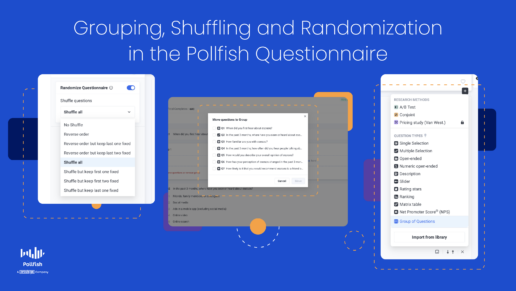
When you visit the questionnaire section of your Pollfish dashboard, you'll see we offer new randomization capabilities. Here, you’ll be able to assign questions into groups on the questionnaire.
This can be helpful for managing your survey in specific sections, for example, if you wanted to first investigate behavior before diving into specific interests.

There is no need for a group to contain any certain number of questions. A “group” can contain a single question if needed, however if Grouping is applied to the questionnaire, every question will need to be assigned to a group.
You can manually re-order the groups or the questions within the groups by dragging and dropping, adding or deleting questions as you would in a regular Pollfish survey.
Keep in mind that when you delete a group, you may also delete the questions within the group by selecting “Delete All.” If you’d like to remove the grouping feature but keep your questions, make choose the option that says “Delete Group Only.”
Shuffling and Randomizing Questions in Groups
The groups themselves and the questions within the group can be shuffled randomly or reversed in order to reduce bias without disrupting the logical flow of the questionnaire.
However, there is no ''Grouping and Shuffling'' as an aggregate option anymore. Instead the option has been divided into ''Randomize Questionnaire'' (located on the left side) and Group of Questions (located at the bottom of the Question type drop-down menu).

A group can also be “fixed” while other groups are shuffled. For example, perhaps you want to provide a description before a group of questions that will provide context. In this case, you can choose to put a description question-type in a group and shuffle the remaining groups in your questionnaire.
Don’t forget that you can (and should) include shuffling and reverse order options on your individual questions as well, adding to even more randomization and cleaner data.
Originally, we had 3 main ways to shuffle:
- Shuffle the answers in an individual question
- Shuffle groups of questions in your questionnaire
- Shuffle the questions within a group
But now, there are more options for randomizing questions.
You can enable Randomize Questionnaire and select Shuffle All, to shuffle a group of questions with the rest of the questions. If you select the group, you have an additional option; you can randomize the questions within the group. When you turn off the Randomize Questionnaire toggle and shuffle the sub-questions, the platform only shuffles the questions within a particular group, the rest of the questions won't be shuffled.
Essentially, you can shuffle anything you choose while leaving certain questions fixed.
Here's how else you can shuffle on Pollfish:
- Shuffle but keep first one fixed
- Shuffle but keep first two fixed
- Shuffle but keep last one fixed
- And many other ways!
Pollfish Question Randomization Capabilities
Now, it's time to see exactly what our question randomization options look like on the Pollfish platform. To get a visual representation of the functions mentioned in the previous section, look no further.
The following images show how we're offering randomization capabilities on our platform:
Randomize Questions

Randomize Question Options

Randomize Sub-Questions

Groups of Questions

Adding logic to groups: The Van Wesendorp Pricing Meter and A/B testing (2022 update)
Although grouped questions didn't originally include skip logic, the product team has been hard at work to include this feature. Thus, advanced skip logic will support grouped and shuffled questions, as well as allow for A/B testing, a critical and useful feature in advertising effectiveness surveys and more.
You can now use advanced skip logic when a respondent exits a group or an A/B test. You can also use it with the Van Westendorp Price Sensitivity Meter. This is a pricing model that provides data in regard to consumer price preferences. It is used to determine customers’ willingness to pay a range of prices.
This meter takes the form of a graph, which visualizes ratings on price and value from respondents. This data is presented as responses to survey questions that focus on the prices of different products and services.
Thus, when a user exits a group via the A/B testing or Van Westendorp features, you can route them to a specific question.

Closed-Ended Vs Open-Ended Questions: Everything You Need to Know (2022 Update)
Closed-Ended Vs Open-Ended Questions: Everything You Need to Know (2022 Update)
In a survey, information is collected from respondents using closed-ended or open-ended question types, which can present themselves in a variety of different ways. Oftentimes questionnaires include a healthy mix of both.

What are closed-ended and open-ended survey questions?
Closed-ended questions are those that offer a limited selection of answers to choose from, such as a single or multiple-selection question, matrix, or scaling question type.
Open-ended questions are questions that allow a freely-written response to be added. This can be anything from a single word to a short answer. Sometimes they exist within a closed-ended question as a way to provide supplemental text to an answer that doesn’t fit the given options.
Typically, closed-ended questions are used to answer “what” questions whereas open-ended survey questions are used to answer “why” questions.

What to Look for In All Kinds of Market Research Companies
What to Look for In All Kinds of Market Research Companies

Understanding the different kinds of market research companies out there is a must for any serious researcher.
This includes businesses as well, as market research provides critical information about your target market and the landscape of your industry.
It reveals how your company is perceived by your current and potential customers, how you can improve your offerings, how you stand up to competition and much more. Thus, it is clear why the market research industry has been rising, having recently surpassed $76.4 billion in revenue.
Given that market research companies are the foremost providers of this information, understanding the different kinds available and what they offer is essential.
That way, you can compare which is most suitable for your business needs, as all are different, therefore they all present different capabilities, functionalities and features.
Most importantly, you should know what it is you need to be on the lookout for in these companies.
This article provides a rundown on what you should look for when seeking out market research companies.
The Importance of Market Research Companies
These companies are invaluable to the market research industry — and for good reason.
According to Forbes, businesses can't afford to skip market research. That’s because it gains you critical insights into your target market, along with the market trends in your industry. You can’t miss these insights; doing so will harm your business.
That’s because there’s plenty of competition, even if your brand has plenty of brand awareness. As such, if you’re not paying enough attention to your customers, that doesn’t mean your competitors aren’t.
By skipping market research, you are not solely giving up key information on your customers, but are also losing your customers to your competitors, as they’re reaping crucial information about your shared target market. Thus, they’ll be able to foster better marketing campaigns and build stronger relationships with your customers.
To succeed in business, you need to understand your customer base from the outset and throughout. That’s because acquiring new customers isn’t sustainable for business success and there are many stats that back this up.
For example, acquiring a new customer can cost five times more than retaining an existing one. In addition, increasing the customer retention rate by just 5% increases profits anywhere from 25-95%. Moreover, the success rate of selling to an existing customer is 60-70%, while the success rate of selling to a new customer is 5-20%.
In order to retain customers, you need to understand them to a T, especially when it comes to their views on your business and niche. You’ll need to know what they like about your business, what they feel is lacking, their problems (especially if your business can resolve them) and much more.
Market research companies allow you to understand all of these customer concerns simply by using their services. A strong market research company will therefore allow you to easily conduct both a demographic analysis and psychographic analysis of your target market.
These companies allow you to reduce risks in all areas of your business, as you can conduct research into virtually every subject — with the right research company, that is. As such, a strong research company will enable you to embark on any research project, whether it is for market segmentation, product development and anything else.
In these ways, market research companies act as the conduit between businesses and customers.
Although these companies don’t sell to your customers, they allow you to understand all their wants, needs, behaviors and a heap of other concerns, so that you can properly cater to them and retain them for years to come.
The Two Main Types of Market Research Companies
Market research brands fit in more than just the category of their name. That’s because there are different types of research companies. However, most can be categorized into two main types of companies: syndicated research and custom research.
Regardless of which type you choose, you should know how they differ, as they involve completely different research campaigns, require different kinds of participation from you, yield different resulting data and more.
- Syndicated research:
- Syndicated research involves using a research firm that conducts the entirety of your research campaigns.
- The research firm you use has complete ownership of all the resultant data, which they can sell to whoever is interested.
- The firm can offer a survey distribution service, which is industry-specific and can be funded by several companies within a particular industry or niche.
- Although you have the option of purchasing survey data through syndicated research, it is ultimately the firm and its partners who have full control over the direction of the survey study.
- Thus, the survey data is proprietary to them, not your business.
- Custom research:
- This research is completely customizable by a business (or whichever entity decides to conduct research).
- This is because it is conducted by and for one company — the client, aka, the researcher.
- Presently, there are various software companies that allow you to perform market research via polling software.
- A potent polling service is an online survey platform, which administers custom research, from targeting, to questionnaire setup to survey distribution and more.
- The client that uses this kind of platform typically has full control of the survey campaign, including the resulting data.
- That’s because they are in charge of setting the respondent qualifications, the questionnaire, the quotas and all else.
What to Look for In Market Research Companies
The type of research company you leverage is ultimately up to you and the needs and preferences of your business.
Some businesses will prefer using a syndicated research company to lessen their involvement in a research campaign, while others may choose a custom research company, as they prefer to be in full control of their survey study and be the sole owners of their survey data.
Regardless of the type of company you choose, you should assure it has the most potent qualities to perform your research and assist you in the process.

The following explores the key facets you should look for in market research companies before you select one for all your research needs.
Global Market Research
Many businesses seek to expand their reach by extending their services globally. Whether you provide products/services abroad or are thinking about making this move, it is key to find a company that allows you to conduct global market research.
That’s because, although your target market may be the same age and gender across countries, it is completely different in terms of consumer preferences, expectations, values and more. Many of these differences can be attributed to different cultures across different countries.
Not to mention, the different currencies, methods of purchasing, holidays, typical store hours and more that get added to the mix when dealing with international customers. Thus, a powerful research company will make all of these nuances attainable to research.
Thus, the company you select for your market research endeavors should facilitate global research campaigns. But there’s more to this. A truly convenient company will allow you to conduct global surveys without paying a premium amount or incurring extra fees.
Not all companies offer this convenience, but Pollfish does not charge you extra for global market research.
Organic Sampling and Random Device Engagement
One of the strongest methods of distributing surveys and gathering quality survey data is via the survey distribution model known as organic sampling, a method in which surveys are randomly distributed across the internet, coming upon random users online.
Pollfish specifically operates via Random Device Engagement (RDE), a kind of digital polling mechanism that relies on advertising networks and other digital portals on different devices, such as mobile phones, to engage random netizens where they are, voluntarily.
With RDE, there is no need to be wary of the survey bias that arises from professional survey takers and panelists. Many of these individuals aren’t fully anonymized or have their identities hidden (from the researchers) at all. Thus, they are under more pressure to answer questions in a particular way.
You don’t have to contend with this problem in organic sampling, as non-professional survey takers do not simply exist where they are online on their own will, but their identities are completely private. Thus, they are free to answer questions truthfully.
What’s also highly beneficial in Random Device Engagement, is that it is capable of reaching people by the millions. Thus, it is sure to capture the people that have all the required qualifications to take your survey.
The Pollfish RDE network reaches over 250 million customers worldwide. Thus, there will always be the respondents you seek to qualify for your surveys.
Our extensive sampling method reaches a network of 140,000 app partners, in over 160 countries.
A Variety of Question Types, Templates and Functions
The next incredibly important aspect of a strong survey campaign is its questionnaire. Thus, the market research company you choose should allow you to get as creative as you wish with your questionnaire.
To build a strong questionnaire, you’ll need to have all the necessary tools to form all the questions you seek. Luckily, Pollfish offers a wide range of question types that you can use in your questionnaire.
Here are just a few of the types of survey questions that Pollfish offers:
- Single Selection
- Multiple Selection
- Matrix Question
- Drill down question
- Open-ended
- Slider
- Ranking
Aside from a wide variety of question types, a strong market research company will allow you to perform any campaign with templates. We currently offer 20 survey templates that you can edit to your liking and needs.
Our templates deal with all kinds of market research campaigns, such as brand perception, product concept testing, customer loyalty and more. While each template has a particular set of questions, you can add and remove as many as you need.
Aside from survey templates, our survey platform also enables you to add advanced functions to your survey questionnaires. These include the following capabilities native to the Pollfish platform:
- Advanced skip logic feature
- This routes respondents to specific follow-up questions based on how they answered a prior question.
- Thus, it allows you to create question paths for specific answers to guide respondents to the most relevant questions.
- Carry forward
- This is an attribute that provides advanced piping capabilities to optimize your questionnaire experience.
- Piping works by taking the answer(s) from the sender question and inserting them into the receiver question.
- In the first piping iteration, researchers were able to funnel answer choices from one question to another based on respondents’ selections. The next question respondents would get would carry forward answers from previously piped answers.
- The new Carry Forward feature allows you to pipe questions on more question and answer types, along with other capabilities.
- Multiple audiences
- This function allows you to form multiple audiences per survey, as opposed to just one.
- Thus, you can create groups of audience in one survey alone, thus creating a hyper-targetted survey audience.
Customer Support
A valuable and reliable market research company is one that offers first-rate customer support. While this may sound to be subjective, there are certain key elements to particularly be on the lookout for.
Opt for a company with round-the-clock customer support. This means 24/7 support. Nothing comes close to this kind of convenience, as it empowers you to create surveys whenever and wherever you please.
In Pollfish, our customer support representatives are available 24/7, regardless of where in the world you reside. Thus, our platform is truly conducive to global market research, and we don’t only serve the English-speaking world.
 We have a full team ready to support you and answer all your questions at any time of the day (or night). Thus, you’ll never worry about making a mistake on our platform, as someone will always be there to help you.
But there’s more. Our customer support team isn’t just there to answer questions or help with a roadblock. Instead, we have a team of experts that routinely checks surveys before they’re launched, ensuring you get the most quality results and don’t run into any technical hiccups.
A Multitude of Market Research Functionalities
A strong online market research platform provides more than just survey creation and a survey distribution service. It also goes beyond offering a robust set of templates and question types. At least that’s what you can expect with Pollfish.
We’re not just a survey platform. We offer a full scope of market research functionalities
Pollfish provides a diverse suite of market research products all under one platform. While we’re generally most known for surveys, we also provide other market research methods and campaign types.
We offer the following market research methods on the Pollfish market research platform:
- Monadic A/B testing and sequential A/B testing.
- A/B tests can be used to compare product concepts, communication ideas, or specific ads using equally structured groups of participants.
- With Monadic A/B testing, your respondents will claim their preferences for one concept that they will get randomly. This is just one of the many that the researcher wants to test and compare, instead of being exposed to two or more concepts at once.
- In sequential A/B testing, researchers can test multiple concepts at once, as opposed to just one with the monadic version.
- Maxdiff Analysis
- This is also called the Best-Worst Scale; a Maxdiff Analysis is a means for prioritizing new product ideas and tailoring them to consumer preferences.
- Respondents choose the best and the worst option from a given set of options, which relate to a product and its features.
- Respondents rate a list of items by selecting only two of them — the complete opposite of each other, labeling one as the best of the list and one as the worst.
- This technique allows you to identify what your target market values and what it detests.
- The Van Westendorp Pricing Model
- The Van Westendorp Price Sensitivity Meter is a pricing model that provides data to make decisions on product pricing, based on consumer price preferences.
- It is used to determine customers’ willingness to pay a range of prices.
- In doing so, it helps conclude the prices that your target market deems acceptable, too high, too low and optimal.
- Conjoint Analysis
- A conjoint analysis allows researchers to measure the value that consumers place on various aspects of a product or service.
- It shows exactly how your customers perceive the makeup of your offerings.
- It also reveals the distinct advantages and imperfections of your product features.
- This method breaks a product or service down by its components, called attributes and levels. Researchers can test different combinations of the components to identify consumer preferences.
Satisfying All Your Research Endeavors
A strong market research company will allow you to easily carry out and fulfill your market research goals. That’s why we suggest using a strong online survey platform, one that is capable of all the functions and services discussed in this article.
Remember, an online market research campaign is only as effective as the platform you use to operate it and not all market research platforms offer the same capabilities and customer support.
We advise you to use a trustworthy online survey platform, one that is rich in functions and features, along with a trusted survey distribution method like RDE.
You should therefore select your survey platform carefully.
Pollfish survey software allows you to create a thorough survey data collection, one you can customize to your liking, view however you please and organize to the max.
In addition, with our vast array of question types, you can create virtually any type of online market research survey to support your research campaigns.
Researchers can leverage a wide range of information on their respondents by accessing a wide pool of insights in their survey results dashboard.
Thanks to our advanced market research platform, you can form and excel at any market research campaign, no matter how difficult it may seem at first glance.
Automating Text Insertion in Pollfish Surveys with the Recall Information & Carry Answers From Features
Automating Text Insertion: Using the Pollfish Recall Information & Carry Answers From Features

Pollfish offers powerful automation features that allow you to dynamically insert text into survey questions and answers.
These features help personalize surveys, improve respondent experience, and streamline survey creation.
This guide covers the two primary methods for automating text insertion: Recall Information and Carry Answers From.
1. Recall Information Feature
The Recall Information feature allows you to reference a respondent's previous answer within a later question. This helps create a more seamless survey experience by making questions feel more tailored and relevant.
How It Works:
- This feature pulls responses from an earlier question and dynamically inserts them into subsequent questions.
- The recalled text appears in brackets
{}where it will be inserted. - You can recall text from all question types, including:
- Open-ended questions
- Multiple-choice and single-choice questions
- Matrices such as:
- Single Matrix
- Multiple Matrix
- BiPolar Matrix
- Van Westendorp Pricing Meter
Example:
- Q1: What is your favorite beverage? (Open-ended)
- Q2: You mentioned
{Q1}as your favorite beverage. How often do you drink it?
If the respondent answered "Coffee" in Q1, the follow-up question would appear as:
You mentioned Coffee as your favorite beverage. How often do you drink it?
2. Carry Answers From Feature
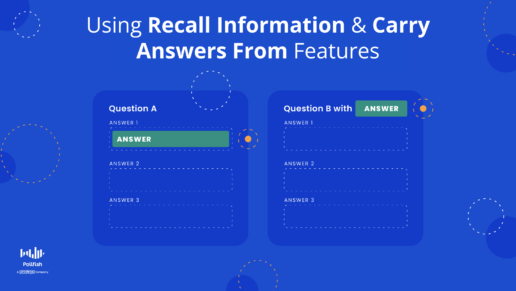
The Carry Answers From feature allows you to pipe selected answers, unselected answers, or all answers from a previous question into a following question. This makes it highly flexible for customizing follow-up questions based on user selections.
How It Works:
- You can choose to carry over only selected answers, unselected answers, or all answers.
- These answers will be displayed dynamically in the follow-up question.
- This works best for single-choice or multiple-choice questions.
Example:
- Q1: Which of these snacks do you like? (Multiple-choice: Chips, Popcorn, Pretzels, Cookies)
- Q2: You liked
{selected from Q1}. Which is your favorite?
If the respondent selected "Chips" and "Popcorn" in Q1, Q2 would be displayed as:
You liked Chips and Popcorn. Which is your favorite?
Alternatively, if using {unselected from Q1}, it would display:
You didn’t choose Pretzels and Cookies. Would you consider them?
Key Benefits of These Features
- Personalization: Makes surveys feel more conversational and engaging.
- Efficiency: Reduces the need for redundant questions and manual survey customization.
- Flexibility: Supports different response types and conditions to tailor survey flows.
Where to Find These Features

- While designing your survey, navigate to the question where you want to insert dynamic text.
- Click on the "Recall Information" or "Carry Answers From" option in the left menu bar
- Select the relevant previous question.
- Choose whether to recall specific responses or pipe selected/unselected/all answers.
- Preview your survey to ensure the logic flows correctly.
By leveraging Recall Information and Carry Answers From, you can create more interactive and customized surveys, enhancing both respondent engagement and data quality.
Related Reading
We also offer another critical feature for building your surveys: the advanced skip logic feature, which routes respondents to relevant follow-up questions based on their previous answers.

Creating Employee Retention Survey Questions to Improve Your Workplace
Creating Employee Retention Survey Questions to Improve Your Workplace

You’ll need to have a set of pertinent employee retention survey questions to create the necessary insights for your employee retention survey and overall campaign. This will help you take solid action against employee turnover and solidify a good reputation for your business.
While many employees stay at their jobs for a year and more, a considerable portion of them still leave. 31% of employees have quit their job within the first 6 months of working; that’s practically one-third of the workforce.
Employee retention is clearly a prominent challenge that employers and HR departments have to crack; there are a few silver linings, however. For example, 80% of employees feel more engaged when their work is consistent with the core values and mission of their company.
Most importantly, listening to your employees’ concerns plays an influential role in employee retention, that is why it is critical to survey your employees. In fact, 90% of workers are more likely to stay at a company that takes and acts on feedback.
Hence, you’ll need to form relevant questions to power your employee retention survey.
This article contextualizes and provides key examples of employee retention survey questions so that you can reap all the needed insights for retaining your employees.
How to Approach Employee Retention Survey Questions
To approach ideating these questions, you must first put your own employee retention survey and campaign at large into perspective. This means you need to mull over why you are conducting this survey, taking aspects such as the year’s quarter, time and main issues you’d like to address.
This is because the employee retention survey is a kind of employee feedback survey; it can also be labeled as an employee satisfaction survey, as the point of it is to make your employees happy in order to keep them. As such, you’ll need to first identify the priorities of your employees and your HR department.
The Aspects of Employee Retention

There are several key drivers of employee retention that you can prioritize, or at least keep in mind for the future. These include:
- Growth opportunities
- Employees will be hard-pressed to leave if they can grow professionally in your company.
- If employees don’t see a future with your company, they’ll look for opportunities elsewhere.
- Employee fulfillment
- Employees stay in job positions and environments that they love, rather than solely in those that earn them money.
- Employees need to feel that their individual skills are valued.
- Employee trust
- Employees seek to be trusted enough to be autonomous in their tasks.
- They seek to be trusted enough to handle their responsibilities without being micromanaged.
- Ease of collaboration
- A non-hostile workplace is a necessity; such an environment not only decreases employee attrition but stimulates collaboration.
- As humans, employees need some degree of socialization; collaboration provides this, along with helping the company.
- Supporting processes and workflows
- Expectations and processes need to be well-structured and clearly defined so that employees operate correctly and with confidence.
- Employees need to know that their efforts are aligned with their teams’ goals so that they can accomplish their tasks without worry.
As you plan these survey questions and contemplate their priorities, you may come across several issues that need to be addressed. There are two ways to approach this scenario; you can ask questions on multiple topics in each survey, or you can divide the questions into multiple surveys.
In the former approach, your employee retention survey is going to be longer, so you’ll need to provide employees with the approximate time it will take to complete it.
The latter approach involves examining your employees by each survey they take. Given that these will be divided based on the main concern they address, they will be short. Since they all deal with employee retention, you’ll need to send them out in close proximity of each other.
Contextualizing Employee Retention Survey Questions
After you find the main needs and concerns of your survey — or— if you don’t know where to become in terms of ideating, the below list will guide you. This list addresses various key question topics to aid your employee retention survey.
By considering each topic, you’ll be able to contextualize the point of your survey and which survey approach is best for your team.
To approach this survey, consider asking questions in relation to the following concerns:
- Pinpointing the company culture
- Learning how to respond to employee needs in a timely fashion
- Discovering the biggest employee pain points
- Finding whether employees understand the larger goals/roadmap of the company
- Gathering insight into whether there is conflict among team members
- Taking the proper action to make sure everyone is treated well
- Understanding employees’ professional growth goals
- Seeking employees’ issues and desires in terms of their pay
- Detecting instances of burnout or those that lead to employee burnout
- Rewarding employees with employee recognition and acknowledgments of good work
- Identifying the common threads of those who leave the company
- Assuring that all employees understand their goals and objectives
- Minimizing any stress employees may experience
- Allowing employees to feel fulfilled, trust and appreciated
- Understanding general thoughts about the work environment
Discuss these ideas with your HR and/or people team. Some topics will carry much more weight than others, depending on your employee turnover rate, your company’s trajectory, its employee retention issues and more.
Key Examples of Employee Retention Survey Questions
Now that we’ve covered the approach to this survey and prived various topics for formulating your questions, it’s time to focus on the questions themselves.

The following lays out various employee retention question examples (along with follow-up questions) that you can use to fill your survey:
- On the scale of “extremely agree” to “extremely disagree,” how would you rate the following: I have a clear understanding of my objectives and requirements?
- Question Type: Likert scale question
- Employee Retention Survey Topic: Assuring all employees understand their goals and objectives
- On the scale of “extremely agree” to “extremely disagree,” how much do you agree with the following: I feel like I am able to reach my full potential at [company name]?
- Question Type: Likert scale question
- Topic(s): Allowing employees to feel fulfilled, trust and appreciated
- Do you have any thoughts or suggestions about the company culture?
- Question Type: Multiple-selection, multiple-choice and open-ended answer options
- Topic(s): Pinpointing the company culture
- What has been the most difficult aspect of your position?
- Question Type: Multiple-choice and an open-ended answer option
- Topic(s): Discovering the biggest employee pain points
- How can [company name] or your manager minimize any stress you have from your job?
- Question Type: Multiple-selection, multiple-choice and open-ended answer options
- Topic(s): Minimizing any stress employees may experience
- On a scale of 1-10, how would you rate the following?: “I understand the direction and goals this company has in the near future.”
- Question Type: Scaled question
- Finding whether employees understand the larger goals/roadmap of the company
- Have you ever experienced conflict between you and another team member?
- Question Type: Yes or no
- Topic(s): Gathering insight into whether there is conflict among team members
- Follow-up questions:
- Describe the issue. (Open-ended question)
- How did you handle it? (Open-ended question)
- How often have you had this issue? (Numeric answers)
- Do you have everything you need to succeed in your position?
- Question Type: Yes or no
- Topic(s): Learning how to respond to employee needs in a timely fashion
- Follow-up question:
- If no, which of the following do you need most urgently? (Multiple-selection, multiple-choice listing supplies, technical courses, work-life balance, hours, clear expectations, etc.)
- What can [company name] or your manager do to assure you are treated with respect?
- Question Type: Multiple-selection, multiple-choice and open-ended answer options
- Topic(s): Taking the proper action to make sure everyone is treated well
- How satisfied are you with the following?: I am satisfied with my career path and promotion plan.
- Question Type: Matrix question (from very unsatisfied to very satisfied)
- Topic(s): Understanding employees’ professional growth goals
- How satisfied are you with the following?: I am satisfied with my salary/commission/other earnings.
- Question Type: Matrix question (from very unsatisfied to very satisfied)
- Topic(s): Seeking employees’ issues and desires in terms of their pay
- Are you easily irritable or constantly exhausted?
- Question Type: Scaled from “not at all,” to “very much so”
- Topic(s): Detecting instances of burnout or those that lead to employee burnout
- Follow-up question: If answers on the higher portion of the scale are provided, ask: “What would make you less exhausted?” (Multiple-selection, multiple-choice and open-ended answer options)
- Do you feel that you are recognized when going above and beyond?
- Question Type: Yes or no
- Topic(s): Rewarding employees with employee recognition and acknowledgments of good work
- Follow-up question: If “no,” ask: “What can [company] or your manager do to grant you recognition and appreciation?” (Multiple-selection, multiple-choice and open-ended answer options)
- Based on your knowledge and intuition why did past employees leave the company?
- Question Type: Multiple-selection, multiple-choice and open-ended answer options
- Topic(s): Identifying the common threads of those who leave the company
- If you had to do it all over again, would you apply to this position?
- Question Type: Yes or no
- Topic(s): Understanding general thoughts about the work environment
- Follow-up question: Why? (open-ended question)
Avoiding Employee Turnover
It is an absolute necessity to gather employee feedback, as these critical insights help you run your business in a way that’s conducive to employee retention. The more survey research you conduct, the more you’ll be attuned to the needs, desires, pain points and thoughts of your employees.
That way, you can retain your talent, while strengthening the reputation of your business. After all, happy employees who choose to stay at your company are far more likely to give you a high eNPS score on the eNPS survey. In order to collect employee feedback and carry out the eNPS and employee retention survey, you’ll need a strong online survey platform.
Such a platform should make it easy to create and deploy employee surveys. It should offer a mobile-first platform since mobile dominates the digital space and no one wants to take surveys in a poor mobile environment.
The survey platform should also feature advanced skip logic to route respondents to relevant follow-up questions based on their previous answers.
Additionally, it should also allow you to survey anyone. As such, you’ll need a platform with a reach to millions of consumers, along with one that offers the Distribution Link feature. This feature will allow you to send your survey to specific respondents, instead of only deploying them across a vast network.
When you use a survey platform that offers all of these capabilities, you’ll be able to make good use of your employee retention survey questions and foster a positive work environment.
Everything You Can Do with Market Research Online Surveys
Everything You Can Do with Market Research Online Surveys

If you’ve ever begged the question, what can you do with market research online surveys? — we’ve got but one key response:
More like, what can’t you do with online market research surveys?
These digital tools gain you a wide range of insights into virtually anything about your target market or any target audience you intend to study.
You can apply them to any research project, as they grant you data on past campaigns (think existing ads, products or service sessions), as well as prepare you before you take any new action for your business.
Given that market research surveys have so many purposes, survey data remains important for both small and large businesses.
It is thus hardly surprising that the market research industry has grown 3.6% per year between 2017 and 2022 in the US on average. After all, it wouldn’t grow if businesses stopped relying on it.
This article gives you a deep dive into market research online surveys, what they entail, their importance and all of their applications.
Understanding Market Research Online Surveys
An online market research survey is both a major method and tool for conducting market research, which is the practice of studying your target market, the group of customers most likely to buy from your business.
Market research entails researching your target market and other customer segments in full depth, thereby understanding who they are, their needs, desires, preferences, aversions and more.
There are various forms of research, such as scientific, medical, socioeconomic, etc. A market research survey is a tool designed specifically for conducting market research, as its name suggests.
As such, it should include all the features necessary for researchers to learn what’s driving customer sentiment, market demand and a slew of other customer concerns.
An online market research survey is the modern form of a market research survey and market research at large. That’s because it is conducted online in an automated way, completes all quotas and grants you the swiftest and most accurate way to pull customer data.
Unlike other forms of conducting market research, online surveys allow you to get to the heart of the matter on virtually any topic. But there’s much more they can do, provided you use a strong survey platform.
When it comes to these surveys, the possibilities are endless.
What You Can Do with a Market Research Online Survey Platform
Most online market research surveys are conducted through an online survey platform. Such a platform allows researchers to partake in every part of the survey process.
However, keep in mind that all survey platforms are built differently, with different features and levels of respondent outreach.
The following outlines what you can do with an online survey platform:
- Target your respondents.
- Set all respondent qualifications.
- Create screening questions to further determine eligibility.
- Set quotas, the number of completed surveys and multiple audiences per survey.
- Create the survey questions, i.e., the questionnaire.
- Offer a variety of survey templates to align with various market research campaigns.
- Create disclaimers, introductions and thank you pages.
- Allow you to use a variety of question types.
- Send your survey to a vast network of digital publishers randomly.
- Allow you to send your survey to specific digital spaces and people.
In all, an online survey platform allows you to create and administer surveys, thus also working as a survey distribution service.
A powerful survey platform enables your online survey to perform a variety of tasks, which we cover further down this article. But first, let’s learn about the importance of these surveys.
The Importance of Market Research Online Surveys
Given all that we’ve already discussed that these surveys are capable of, you’ve probably caught on to their importance.
However, there are so many other reasons why market research online surveys are a must for your business, regardless of its stage, its brand reputation and other factors.

Firstly, these surveys form a critical aspect of your business strategy. This involves strategizing all things business-related, from understanding the reception to a new product, to how a support session was perceived.
With this knowledge in tow, you’ll be informed on how to make further business decisions and run different campaigns. Thus, you’ll be less likely to make major mistakes that will affect your bottom line, while delighting your customers.
Online market research surveys allow you to remain competitive, no matter how many players are in your industry, and how big (or small) your market share is. In fact, conducting these surveys is the answer to how to increase market share, as it helps you carry out productive campaigns.
These surveys are not just tools for gathering data, instead, they are also data visualizers, presenting your data in a variety of formats. This is especially important when you need to analyze survey data and use it to create a report, a whitepaper or any other type of research asset.
As data visualization tools, they also reduce and organize large amounts of information allowing you to easily compare two or more sets of data. This will depend on the data filtering capabilities of your online survey.
In addition, these surveys also allow you to uncover things not only in relation to your customers but your own business. You’ll therefore be able to learn things you would never have otherwise without this survey type.
That’s because this survey allows you to understand exactly how your customer base views your brand, how often they think about it, what they’d like to improve, what they dislike and so much more.
By understanding your customers in great depth, you won’t simply form better marketing, advertising and other business campaigns. You’ll also build stronger relationships with your customers, which fosters consumer loyalty.
Loyalty is the bedrock of customer retention, which is more important than customer acquisition. There are many reasons behind this, including the fact that the chances of converting existing customers are 60 -70%. The probability of converting a new customer is only 5- 20%.
Thus, by studying your customers with this survey, you’ll be able to understand them well, thus better appealing and catering to customers, strengthening your relationship. In turn, you’re building loyalty, allowing you to increase your customer retention rate.
Market research online surveys don’t merely allow you to understand how customers view your business, but your competitors as well. In this way, you can obtain all the competitive research you need simply by conducting such a survey.
All in all, these surveys are extremely important for all business affairs, as they help measure the representativeness of customer views and needs. The intelligence you gain from them allows you to make crucial decisions.
What You Can Study with Market Research Online Surveys
As mentioned, there are a myriad of things you can study with these surveys. As such, you can apply them to specific areas of business, including specific campaigns and macro applications.
As such, here we lay out several main purposes of conducting online market research surveys. As you can see, these are high-level and have many sub-methods and applications.
- General Marketing: Marketing involves all the activities performed to aid a business sell its products/services, which includes educating customers, interacting with them and more. Marketing market research exists to help businesses gauge their campaign efficacy and better understand how their customers view various campaigns.
- Advertising: Used to deploy sponsored messages to grow demand and elicit purchases, advertising, you can leverage it to influence customer behavior. This involves prompting existing customers to make more purchases or to gain new customers. Surveys can be used to determine which advertising messages are the most resonant and which ads elicit the most interest. You can ask questions to compare ads and their different parts.
- Branding: This discipline involves creating a reputation, an image and a set of associations around a brand. Branding market research helps brands differentiate themselves from one another and form a style unique to a company. Businesses can tie these surveys to branding by using them to test new logos, slogans, value propositions, content ideas and more.
- Market Segmentation: Market segmentation is a macro-application that refers to dividing a target market into smaller segments and assigning certain values to each segment to better understand all your customers. That’s because a target market includes all the customers most likely to buy from a particular business and is not solely defined by one group. Researchers can create questions about their target market’s habits, lifestyles, preferences and more to distill them into several segments. From there, marketers can adopt different marketing campaigns for each segment.
- PR: Public Relations, or PR, as it is commonly referred to, aims to control the distribution and spread of information about a company (or individual) and the public. Its goal is to control the narrative of a business or organization to gain positive public perception. These surveys can help by asking questions on how well respondents know a business and their general thoughts on its operations, products, experiences, performance, etc. Researchers can also test out press release ideas and pitches through these surveys.
- Brand Tracking: Brand tracking refers to continuously measuring or tracking, as its name suggests, your brand's health. This involves analyzing how your customers buy and use your products and what they think and feel about the brand itself. These sentiments are subject to change, especially when things change at a business, whether they have a new ad campaign, have been acquired or are offering new products. You can keep watch of this with these surveys.

- Brand Awareness: This goes beyond whether or not your target market has heard of your brand. Brand awareness also deals with the extent to which customers are able to recall or recognize your brand under various conditions and circumstances. A strong brand awareness is necessary to build long-lasting relationships with existing customers, as well as draw in the interest of new and potential customers.
Specific Market Research Endeavors to Study with Market Research Online Surveys
In the previous section, we discussed several broad campaigns, macro-applications and business topics that this survey type can support. Now, let’s move on to more specific usages of these kinds of surveys.
Here are some of the more specific purposes a market research online survey campaign helps serve:
- Understand the makeup of your target market.
- You can use this survey to form a target market analysis.
- It will allow you to understand all the needs, concerns and behaviors of your target market and its segments.
- Obtain customer feedback and get a deep read of your target market.
- You can do so by centering the theme of this survey into that of a customer satisfaction survey.
- This includes forming it as the NPS, CSAT, CES, visual rating surveys & more
- Doing so allows you to understand your customers’ CLV (customer lifetime value).
- You can do so by centering the theme of this survey into that of a customer satisfaction survey.
- Excel in product campaigns.
- Use it to test product satisfaction.
- Innovate products with new features and upgrades.
- Understand how your product compares with competitors' offerings.
- Avoid negative publicity.
- Use it to perform regular checks on the opinions of your brand.
- Uncover customer aversions to avoid using in your messaging and brand image.
- Obtain employee feedback.
- Use it to run a pulse survey on your employees.
- Retain strong company morale by discovering your employees’ thoughts on their job training, roadmaps, pipelines, their boss and more.
- Improve your CX.
- Use it to learn about your customer experience (CX).
- This can involve all aspects of the customer buying journey.
- Drive Lead generation.
- Use this survey for B2B endeavors.
- This will help you learn about the specific needs and desires of your target market, specifically your B2B clients such as partners, vendors and other business entities.
- Acclimate with your niche.
- Use it to keep up with market and niche trends.
- Use it to produce a market trend analysis, so that you can analyze trends in an industry, including past and current market behavior, and dominant patterns of the market and its consumers.
- This makes it easier to change with the times.
- Complete a market analysis.
- Being able to compare your brand with others
- Getting a feel of the thoughts and attitudes in your overall space
- Understand customer behaviors.
- Use it to create a customer behavior analysis.
- Learn the motivations of customers, their lifestyles and how those affect their purchasing behavior.
- Create an RFM analysis to learn about your customers' recency and frequency of purchases, along with their monetary value.
- Understand your demographics.
- Use it to form a demographic analysis of your target market.
- This is one of the preliminary things you ought to know about your customers.
- Understand your psychographics.
- Use it to create a psychographic analysis of your target market.
- This allows you to understand your customers’ psychological characteristics, such as their values, desires, goals, interests, fears, aversions and lifestyle choices.
What You Can Set Up with Market Research Online Surveys
Now that you understand the various macro-campaigns and applications to use with these surveys, along with the specific tasks you can apply them to, let’s dive into this survey type itself.
There is plenty that you can set up with this survey type, along with key market research functions (more on the latter in the next section).
Thus, you’ll find several aspects of these surveys as you set them up. That’s because, as the previous section informed, you can use them to form specific market research survey types such as customer satisfaction surveys, etc.
Here is what you can set up within these surveys:
- The questionnaire
- This is the heart of any survey, as it contains all the questions.
- You can build sophisticated survey paths with advanced skip logic, depending on the survey platform you use. These route respondents to different follow-up questions based on their previous answers.
- Audience targeting
- This section involves adding all the respondent qualifications you seek to designate your survey audience.
- This section also contains your screener, to qualify people based on how they answer screening questions.
- Some platforms will allow you to create multiple audiences per survey.

- Distribution
- This dictates how you will distribute a survey to your target audience.
- There are two approaches to this on Pollfish:
- Random Device Engagement (RDE): A kind of organic sampling, RDE deploys surveys to a massive network of online sites, such as websites and apps. Respondents are targeted at random in their natural digital environments.
- Specific Online Channels and Respondents: You can also send surveys to the specific digital spaces you choose, such as your own website and social media with the Distribution Link feature. You can also send surveys to specific people via email with this link.
- Data visualizations
- There are various ways the survey can be presented. Within your survey results dashboard, you can view resultant data in the form of tables, graphs and charts.
- You can also view it via other visualizations, such as the kinds in imports like PDFs, Excel, CSV and Crosstabs.
- You can also view data granularly, viewing how each demographic answered questions by filtering the resulting data.
What Research Capabilities Online Market Research Surveys Include
Lastly, let’s touch upon the market research capabilities that these surveys can carry out. Not all market research surveys have these capabilities, as not all survey platforms offer them.
At Pollfish, we go beyond surveys.
That’s because Pollfish is not just a survey platform; it provides a full-scale market research experience. That’s because we offer a wide scope of functionalities that the average survey platform simply doesn’t have.
As such, you’ll find much more than merely survey creation on this platform.
You’ll find the following market research capabilities on the online market research survey on the Pollfish platform:
- A/B testing:
- You can conduct both Monadic A/B testing and sequential A/B testing.
- Monadic A/B testing lets respondents choose their preferences for one concept or product they randomly receive out of many. These are what the researcher wants to test and compare, exposing the respondents to one concept instead of two or more at once.
- Focusing participants’ attention on just one concept at a time grants researchers insights into making product, pricing and various marketing decisions.
- Monadic testing is commonly used for gathering independent data for each stimulus — a contrast to comparison testing, where several stimuli are tested side-by-side.
- Sequential A/B testing uses concepts with a specific distribution: all possible combinations are derived from the concepts that are selected to be shown.
- Thus, each concept is evenly distributed and presented to the respondents at equal times in the first position.
- This reduces biases that may occur from serving a concept always at the first position of a combination.
- Conjoint Analysis:
- A conjoint analysis allows researchers to gauge the value that customers place on different aspects of a product or service.
- It shows exactly how your customers perceive the makeup of your offerings.
- It unveils the distinct advantages and imperfections of your product features.
- This method breaks a product or service down by its components, called attributes and levels. Researchers can test different combinations of the components to identify consumer preferences.
- You’ll get a rich evaluation of how your customers rate the unique features of a product, rather than passing a general judgment on it.
- Maxdiff Analysis:
- Also called the Best-Worst Scale, a Maxdiff Analysis is a system for prioritizing new product ideas and customizing them to consumer preferences.
- Respondents choose the best and the worst option from a given set of options, which relate to a product and its features.
- Respondents rate a list of items by selecting only two of them — the complete opposite of each other, labeling one as the best of the list and one as the worst.
- This technique helps to identify what your target market values and what it despises.

- The Van Westendorp Pricing Model:
- The Van Westendorp Price Sensitivity Meter is a pricing framework that provides data for decision-making in regard to consumer preferences on price.
- The meter exists in the form of a graph, with ratings on price and value, presented as responses to survey questions that focus on the prices of different products and services.
- It is used to determine customers’ willingness to pay a range of prices.
- It allows businesses of different sizes and industries to set the proper prices of their offerings so that they can be in line with customer expectations.
- It helps conclude the prices that your target market deems acceptable, too high, too low and optimal.
Conducting Thorough Market Research
As you may have gathered, online market research surveys offer a vast amount of capabilities. As such, you can take on various macro-applications, specific tasks and projects by applying these kinds of surveys.
While these surveys offer a wide breadth of functionalities and insights, they are limited by the online survey platform that administers them. In essence, it is the survey platform that grants these surveys all their powers.
As aforementioned, not all survey platforms have the same features; thus, not all market research online surveys can offer all of the functionalities and features mentioned in this article.
Thus, you should select your survey platform carefully.
Pollfish survey software allows you to create a thorough survey data collection, one you can customize to your liking, view however you please and organize to the max.
In addition, with our vast array of question types, you can create virtually any type of online market research survey to support your research campaigns.
Researchers can leverage a wide range of information on their respondents by accessing a wide pool of insights in their survey results dashboard.
In addition, we also offer the advanced skip logic feature, which routes respondents to relevant follow-up questions based on their answers to a previous question.
Thanks to our advanced market research platform, you can leverage the maximum number of market research capabilities with our online surveys.
Understanding Offline Market Research and Determining if You Need It
Understanding Offline Market Research and Determining if You Need It

Have you ever considered using offline market research? Like its online counterpart, it too can be used to conduct both primary and secondary market research.
While we always tout market research online surveys, it is critical to understand all forms of market research. This way, you’ll always have various options on hand, which you can consider using when forming a major research campaign.
So how exactly is this industry faring in terms of revenue?
The market research industry has grown more than twofold since 2008, exceeding $76.4 billion in 2021 alone. Clearly, businesses are seeing the value in conducting this research for various business matters.
As such, we cannot stress the importance of market research enough. Again, studying just one facet of it is not enough. Thus, we suggest you get acclimated to offline methods of market research.
This article investigates offline market research, presenting the various methods used to carry it out, comparing it with the online variety, and ultimately, determining if you need to conduct it.
Understanding Offline Market Research
This is a kind of market research, except unlike most of the kinds of research performed in the current day, it is conducted entirely offline, as its name alludes.
Like its online counterpart, offline research has various methods that make it up. These methods can be far-ranging as well as of the subtype variety (for example, there are different types of ethnographic research or different types of surveys).
Offline research entails that the researcher has to do all the work to gather the research information, whereas, with online research, many of the tasks associated with obtaining the research are automated.
As such, offline research involves scouring through various sources and locations in order to find relevant information. This may include libraries, bookstores and newsagents. It may also require speaking with people with knowledge of particular subjects.
It, therefore, tends to be more time-consuming and may require traveling to come across the information.
Offline market research methods have been around for a long time, far exceeding the existence of online market research, for obvious reasons. Some of these methods are still in use to this day.
When used correctly, these offline methods are proven to yield results. As such, if you only use online market research methods, it may be worth considering offline strategies as well.
The Main Types and Methods of Offline Market Research
Offline research methods are a diverse mix and can thus cater to the needs and preferences of all researchers. Many of these methods are still around and can be used in tandem with online research methods.
Here are some of the most prominent offline methods for conducting market research:
In-Person Surveys
When surveys are conducted in person, they are considered to be interviews. Specifically, in market research, these are known as IDIs, or in-depth interviews. After all, when you speak with someone in person and face to face, there is a greater opportunity to collect as much information as possible.
This is due to the fact that such a setting allows for conversation, whereas written and online surveys are limited to the questions included in their questionnaire.
You can conduct in-person surveys in a twofold way: they can be preplanned or spontaneously / on the spot.
With the former approach, you would have to seek interview subjects and ask for their consent to participate in an interview. The interview would take place at a designated facility or a location most convenient for the participant.
With the latter approach, you can do so in public places that get plenty of traffic.
Many businesses prefer conducting these interviews in malls since their customers and target market members go there to browse products and shop. This method is advantageous, in that you can show your customers your products and have them form their opinions immediately.
As such, this method is especially useful for B2C businesses. However, it can also highly benefit B2B businesses, but these interviews would then be conducted at tradeshows or other events B2B companies frequent. They can also be conducted in-office or at your place of work (showrooms, stores, etc).
In IDIs specifically, a moderator spends between 30 minutes to over an hour having a comprehensive discussion with their participants one-on-one. IDIs are thus one of the most intimate and information-yielding approaches you can take with the survey route.
Snail-Mail Surveys
This is one of the oldest market research methods and though it may seem dated, it is still used in the present, especially to gain insights from older generations.
Snail-mail surveys are sent to respondents via the mail, for them to fill out the surveys and send them back to the researchers.
This approach can appease many older customers, especially if they aren’t physically capable of going to an in-person interview or aren’t adept at using computers to take an online survey.
These surveys are useful, as they show which customers are more likely to remain customers or buy from your business. Otherwise, why would they take the time to complete your survey, and then have to package it and send it back?
What’s best is that these provide you with a list of customers whose contact information you have. You can then cross-reference your list of contacts with the list of respondents who actually partook in your mailed surveys to have an understanding of those who are most serious about doing business with you.
Snail-mail surveys do have their share of downsides: they require far more time to fully conduct, as it takes more time to deliver them, have them filled out and finally, returned back. On the contrary, an online survey campaign can be completed in its entirety in a few hours.
In addition, if your survey includes open-ended questions, then your campaign is at the mercy of your respondents’ handwriting, which may not always be legible.
Phone Surveys
Yet another survey method, phone surveys are somewhere in between in-person survey interviews and snail-mail surveys, in terms of the time and effort required to complete them. They offer the same convenience as in-person surveys, as they too can become IDIs.
That’s because when you’re on the phone, you are free to ask and speak for however long you see fit (within reason). Unlike written surveys, phone surveys aren’t limited to the questions in a written survey’s questionnaire.
You can create new, follow-up questions as the phone conversation progresses. Thus, the data you extract from phone surveys is more comprehensive and may not require conducting any further primary research.
Phone surveys also have a major convenience over in-person surveys: the respondents don’t have to travel or even leave their homes to partake. This is especially critical during Covid and seasonal illnesses.
Additionally, some people prefer to stay home, and thus would much rather stay home for a survey session, rather than having to waste time getting to a certain location.
Phone surveys do have certain disadvantages. First off, not all will be willing to give up their spare time to talk with a stranger on the phone about a business or business-related manners.
Additionally, another major drawback of phone surveys is that many businesses don’t have enough contact information of their customers. They certainly don’t have the contact information for target market members who are not direct customers.
Thus, there are too many resources needed to dial respondents’ numbers and administer the surveys.
Focus Groups
A focus group is a small group of people who meet to informally discuss your topic of choice; this is usually business-related. However, it can also focus on the customers themselves, such as their lifestyles, buying patterns and more.
Focus groups are group sessions consisting of 5 to ten participants. They include a moderator, who leads the discussion using prearranged questions and topics.

A typical in-person focus group will consist of 4 to 12 participants, along with the moderator. A focus group session usually lasts a few hours and can require follow-up meetings.
The moderator leads the meeting with different topics and subtopics for roughly 60 minutes to two hours.
Aside from leading the discussion, the moderator must observe the group and take notes to record key moments in the session. Therefore, the focus group may also include using participant activity materials and audio/video recordings of the sessions.
Aside from taking part in a Q and A, a focus group can include other techniques to draw out insights from customers. These include doing role-playing exercises and more. As such, this method is more lively and interactive, as it includes more people than a one-on-one interview and more techniques aside from questioning.
Like in in-person and phone surveys, the resultant data from focus groups is more in-depth but it also tends to be more subjective. The output, therefore, involves more words, images, impressions and sentiments, rather than hard, statistical data.
In addition, some participants are more extroverted, leading them to dominate the discussion, while more demure participants remain quiet or answer fewer questions. This is where a one-on-one research method may be more useful, or easier to administer.
That’s because, technically, the discussion can be balanced, even with a mix of reserved and outspoken participants, but the moderator would have to step in so that the quieter participants can take part and the extroverted ones to allow others to speak. This would thus be more laborsome.
Observations
Like in-person interviews, observations typically occur in natural settings, that is, where people exist voluntarily.
Observations are part of ethnographic research, a qualitative research method that relies on entrenching yourself in various participant environments to extract challenges, goals, themes and more.
At times, it is best to observe customers in this way, noting where they choose to browse versus where they buy from, whether they’re looking for sales/promotions and more.
Thus, you can conduct observations to uncover real behaviors. This is a major advantage of this method, as people in surveys and focus groups may lie, as they are put on the spot (in offline surveys, that is, online surveys can be fully anonymized).
But when you discreetly observe shoppers in their natural habitats, they exist as themselves. They’ve got no one to impress or worry about judging their answers. Thus, you can learn a lot about customer buying behavior, customer motivations, needs and more, all by simply watching them covertly.
Some researchers observe shoppers and then use their findings to conduct follow-up interviews. Some research companies resort to using hidden cameras to record customers and gather information this way. Thus, some offline market research methods are also digital, even though they are not internet-based.
Like other methods, observations have some limitations as well. First off, you’ll need to find an ideal distance to observe customers discreetly, while being able to hear (and see) them. This can be difficult in crowded places, which tend to be loud and full of motion.
Most likely, in such scenarios, you won’t hear much of what your customers say to one another, unless you’re at a relatively quiet location.
In addition, while observing customers is useful, it won’t address your specific questions. Thus, observations are rarely a standalone affair.
Live Events
Using live events for market research is much like the above example of observation, except rather than observing people in basic, everyday settings, you’re going to observe them in special occurrences and planned events.
These can provide a mix of entertainment and research. The goal is to get the participants as engaged in the event as possible. This is typically a tactic of field marketing but can be applied to market research as well.
That’s because live events are a new type of market research called “engagement marketing,” which includes a mix of live elements, face-to-face discussions and even certain activities to enable customers to actively engage with your brand.
Conducting research at live events is crucial, as it can be more intimate than observations alone. Given that these are specialized events within your industry, you may set up a booth or nook with the intention of speaking with your potential customers.
With the customers’ consent, this can be treated as an interview, or at the very least, a time to pitch your product or service and get the opinions of it from your target market.
Thus, you can interview customers right then and there. This immediately transforms the event to be more than just a time for brand awareness, but to reap critical insights.
Live events have the disadvantage of the lack of time: both for you and your customers. That’s because many may attend such events without the desire to speak with businesses, let alone be interviewed by them.
As for you, you may be at the event with other tasks, such as making a presentation, pitching a product, handing out flyers, etc. Your business would need to dedicate a worker entirely for the purpose of research to actually get anything done on this front at a live event.
The Pros and Cons of Offline Market Research
As we’ve discussed in the prior sections with examples of offline research methods, we’ve alluded to both the positive and negative aspects of such methods.
You can draw your own conclusions, but to do so, it’s useful to have a concrete view of all the advantages and drawbacks of these methods.

The following does just that, listing all the pros and cons of offline market research methods:
The Advantages:
- Reaching participants who don’t have access to the internet.
- 6% of Americans don’t have adequate access to the internet at threshold speeds or with a fixed broadband service.
- Being able to reach participants who aren’t internet savvy, don’t have internet devices or simply prefer not to use the internet.
- Having wide-ranging approaches to conducting research if one doesn't garner enough data, whereas online research may only rely on one software, aka, one method.
- Not all participants spend a lot of time online; this is especially true of those with eye strain.
The Disadvantages:
- A much smaller reach to participants than in online research methods.
- Secondary online research methods are easier to come by, doing so offline requires finding and speaking with a knowledgeable source.
- They tend to all be time-consuming affairs.
- Lack of time for deep thoughts in all in-person and phone methods.
- It can be difficult to get people to answer all your questions, whether in written form or in person.
Offline Vs Online Market Research: The Verdict
Both offline and online market research methods have their advantages and pitfalls, but which is overall the best approach to take when conducting market research?
Offline market research provides many avenues that online research simply doesn’t, such as the personal touch of conducting in-person studies. That’s the major advantage of offline research over the online variety.
It is nearly impossible to create the same conversations and reap the same information digitally, or even over the phone. Thus, offline research methods are better for drawing out qualitative market research. That’s because they involve discussing thoughts, feelings and perceptions in full depth.
This can be limiting, however, as respondents may not remember or gather all of their thoughts on a subject right away, especially in an in-person setting, which puts more pressure on them. On the contrary, there is hardly any pressure in taking an online survey.
In addition, conducting offline research is much more difficult for obtaining quantitative market research. The reason behind this is twofold:
- Offline studies take much more time to conduct and complete.
- One focus group session alone can take hours.
- Mail-in surveys can take months, even years to complete, depending on the respondents.
- Calling people to ask for consent to a research project, as well as mailing them takes too long, and this is just to opt people in.
- Offline market research reaches fewer people.
- Many will ignore survey phone calls and snail mail surveys.
- There are only so many adequate observations you can make on a daily basis.
- A focus group itself only deals with 12 people at most.
Online market research solves both of these problems, as it can be deployed to the masses and completed within hours. This will, of course, depend on the market research platform you use.
Moreover, online research involves using polling software that targets the specific people you need for your research study. With offline market research, finding people who meet a variety of qualifications and who are also willing to take your survey is nearly impossible.
Online market research can also involve tactics that prevent poor-quality data and survey fraud by using AI to detect it and disqualify respondents who provide this data. This involves giving gibberish answers, skipping questions, and more. This is impossible to do in written, snail-mail surveys.
Thus, online research offers far more capabilities with survey software than does offline market research. Online market research can obtain both quantitative and qualitative research, reach the masses and do so in a timely manner.
However, it still is lacking in some regards, especially when compared with offline market research.
That’s because not all segments of the population spend much time online. Some segments do not have reliable internet access, as aforementioned, such as rural citizens. You may also have less tech-savvy, older customers.
You will therefore need to reach these segments offline.
In addition, offline market research gives you more access to primary sources of information and yields more comprehensive results.
Thus, it is often best to use both, specifically, whichever method is most suitable for your research needs. Using both will reveal different data about your target market.
Aiding All Your Market Research Projects
Although we suggested taking your market research endeavors both online and off, there’s more to this.
An online market research campaign is only as effective as the platform you use to administer it.
In essence, it is the survey platform that grants online surveys all their powers.
We therefore advise you to use a trustworthy online survey platform, one that is rich in functions and features.
Not all survey platforms have the same features; thus, not all market research online surveys can offer all of the functionalities and features mentioned in this article.
Thus, you should select your survey platform carefully.
Pollfish survey software allows you to create a thorough survey data collection, one you can customize to your liking, view however you please and organize to the max.
In addition, with our vast array of question types, you can create virtually any type of online market research survey to support your research campaigns.
Researchers can leverage a wide range of information on their respondents by accessing a wide pool of insights in their survey results dashboard.
In addition, we also offer the advanced skip logic feature, which routes respondents to relevant follow-up questions based on their answers to a previous question.
Thanks to our advanced market research platform, you can effectively pair online market research with offline market research campaigns.

How to Use Various Matrix Questions (Updated)
How to Use Various Matrix Questions (Updated)
A Matrix question is a group of multiple-choice questions displayed in a grid of rows and columns. The rows present the questions to the respondents, and the columns offer a set of predefined answer choices that apply to each question in the row. Very often the answer choices are on a scale.

When to use Matrix Questions
It is best to use Matrix questions when asking several questions in a scaled format about a similar idea. They can be applied either as a mini-survey on their own or as a single-question type within a larger questionnaire. The closed-ended, predefined answers that apply to a series of questions make Matrix questions great for:
- Customer experience/satisfaction surveys.
- Questions about a subtopic in a larger questionnaire.
- Combining many rating-scale questions in a more digestible format.
Customer experience surveys
Matrix questions are commonly used in customer experience surveys. For example, to ask a respondent about their experience on a flight, the rows might ask the respondent about the service, food, or entertainment while the columns ask them to choose a rating response.

Questions about a subtopic
Oftentimes a questionnaire includes many ideas, but some of them are specific to a subtopic within that survey. Matrix questions are an effective way to cluster these ideas into a format the respondent can easily understand.
For example, in a brand awareness survey, a customer might use a matrix to get more information on brand perception.

Benefits of Matrix Questions
The format and structure of Matrix question types supply some unique benefits. Because it is a series of questions presented as a single table, it appears as a single question on the survey. This has the benefit of saving space (both on paper and in a digital survey) as well as reducing drop-offs from respondents who do not want to answer five nearly identical questions back-to-back.
The grid is easy and intuitive for respondents to follow with closed-ended, predefined answer sets, which means quick responses and a clear, easy-to-analyze dataset as the outcome.
Drawbacks of Matrix Questions
While there are many benefits, there are a few things to keep in mind when using Matrix questions.
The table formatting, while easy for respondents to answer, can also result in activities such as “straight-lining” or other pattern-making within the table.
Another issue can be the addition of too many rows or columns, which may negatively affect the data quality. If there are too many choices, respondents might lose interest (and be more likely to enter insincere answers to move quickly through it). In some cases, this can affect formatting as well, particularly in a digital survey environment such as mobile. If the Matrix question is not designed for an optimal mobile user experience, it can be confusing or frustrating for respondents.

Some survey companies will also charge for each row in the Matrix, as though they are individual questions, which may change the cost of the overall survey. Keep this in mind when building your questionnaire. (Pollfish views Matrix questions as a single question type, so pricing does not vary based on the number of rows and columns included).
Types of Matrix Questions: Single- Selection vs Multiple-Selection & Multiple Matrices
Matrix questions, like regular multiple-choice questions, can be either single-selection or multiple-selection. This means that a respondent can choose either a single answer choice per row or they could choose multiple answer choices per row.
Competitive analysis surveys might include Matrix questions to better understand how a product or brand is measuring up against competitive offerings.

Exclusive Answers for Multiple Matrices
You can create exclusive answers from the scale points of multiple matrices.
As we realize the need to allow researchers to mark answers as exclusive in a Matrix table, you can do so by using the Multiple Selection question type.
Here's how it works: when a respondent selects a specific scale point as an answer to a statement, all the other scale points become de-selected, much like in the exclusive answers in the Multiple selection question type. Thus, the scale point marked as "exclusive" is an exclusive answer for every statement.
Keep the following in mind: after starting the survey, the respondents cannot modify any exclusive answer flag. You can make multiple scale points become exclusive.
https://www.loom.com/share/99bf9711898e495d88e9ad8da296324c
How Matrix questions differ from a Likert Scale
Many people believe that a matrix question is just a Likert scale, when in fact, it is the other way around.
A Likert Scale is a specific type of Matrix question designed to measure opinions linearly. Using a 5- or 7-point scale to collect user sentiments, a Likert Scale can be used to determine scaling attitudes such as:
- Agreement (Strongly Agree- Strongly Disagree)
- Likelihood (Very Likely- Not very likely)
- Importance (Very Important- Unimportant)
- Frequency (Always- Never)
- Quality (Excellent- Poor)
A Matrix question is a format for the question, meaning it is presented in a grid (or matrix). While Matrix questions often happen to be Likert Scales, Matrix questions can also be applied across a variety of use cases outside of attitudinal measurement, as shown above.
Best practices for writing a good Matrix question
Writing a good Matrix question follows many of the same best practices for writing good survey questions in general. However, due to the grid formatting, there are a few other things to be aware of.
- Limit the number of rows or columns. Keep it around five different options for questions and answers so as not to bore or overwhelm respondents.
- Give respondents a way to opt-out of things they are not familiar with, such as a “no opinion” or “neutral” answer choice.
- Do not make the questions too long. In the table format, long questions create a poor respondent experience.
- Try to group like-concepts. For example, if you want to know about brand perception, keep the questions related to that subtopic.
- As in any closed-ended scaling question type, keep scaling answer choices in order so as not to confuse the respondent.
Matrix question types are available in the "questionnaire" section of the Pollfish survey builder. Sign in or create an account to get started on your next survey.
[wp-faq-schema]
[wp-faq-schema accordion=1]