
New Question Type: Drill Down Questions to Improve Respondent Experience and Data Quality
New Question Type: Drill Down Questions to Improve Respondent Experience and Data Quality

Drill down questions are useful for instances in which you want to ask your target market or target population a question that includes multiple options. This does not necessarily entail a large number of multiple choice answers, but rather multiple prompts that relate to one question topic.
This allows you to include various inquiries into one question, without needing to worry about the relevance of the questions. As such, you can dig deeply into one topic with one question, by adding multiple relevant follow-up questions.
This method is not simply useful to collect better data, but to improve the survey respondent experience. 49% of consumers have left a brand in the past year due to poor customer experience. You should therefore always strive to provide a good CX for your customers.
Given that you’ll be largely studying your customers, surveys grant you an opportunity to give your customers a good CX on yet another touchpoint.
This article explains drill down questions, their importance, examples and how they appear on the Pollfish online survey platform.
Understanding the Drill Down Question
The drill down question is used to help respondents choose from a list of options, with each option existing as a kind of prompt. Usually, respondents answer the prompt by selecting from a drop-down menu.
That is to say that the drill-down is not a primary question with follow-up questions, but a set of dropdown selection menus hierarchically defined.
As such, the drill-down question is a question type used to narrow down a respondent’s choice from a broad to a specific answer. Therefore, it involves multiple prompts, which exist as relevant follow-up questions, each presented with its drop-down menu.
With each following question (or prompt), the topic under investigation, i.e., the one that is originally asked about, gets more and more narrow. In this way, the researcher gets to drill down on the topic, hence the name of this question type.
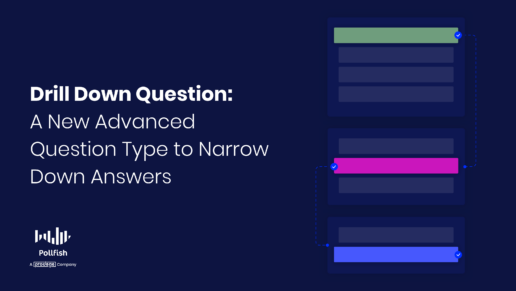
First, your respondents choose from a general drop-down list. Then, based on their answers, they are presented with specific follow-up prompts with lists as a means to “drill down” their answer. In this way, the respondent is providing data that starts at the general level and becomes more specific with each follow-up prompt or list.
For example, you could first have respondents select a car brand, then they would select a car model and finally, they would choose the year of the car’s manufacture.
The Importance of the Drill Down Question
This kind of question is important for a variety of reasons.
First off, the drill down question type should be used when you need your survey participants to respond to multiple interdependent questions. This is important as it not only organizes and sets up your questionnaire in a more logical (and relevant) way, but it also allows you to ask multiple relevant follow-up questions right under one question.
This will ward off boredom and frustration from repetition, as some respondents may grow tired of seeing what’s essentially the same topic being asked of them continually in the questionnaire.
Instead, you can group that topic under one question, by setting up different follow-up drop-down lists (or prompts) in it.
In addition, you’ll be able to evade different types of survey bias, namely the survey scope error. This bias arises when a survey does not include important items required to fully answer the topic of study. Failing to ask important questions on certain aspects or sub-topics will result in respondents giving incomplete or inaccurate answers.
This will tarnish your survey campaign and your overall research study. While the survey scope error may appear daunting to avoid, it can be done with drill down questions, as they allow you to include a variety of follow-up questions relevant to the main topic at hand and its various subtopics.
This makes it easy to include all essential survey questions while curbing the length of the survey. Regarding the latter, this is possible, as these follow-up prompts exist as drop-down lists, which are easy to select.
What’s more, is that these questions are essentially another major way to include relevant follow-up questions. Thus, they can be used as an alternative to advanced skip logic. This survey method routes respondents to proper follow-up questions, based on their answers to a previous question.
Drill down questions grant you the same capability, the only difference being adding follow-up lists per a single major question. Skip logic instead redirects respondents to new questions, those that are not bound under one main question.
The drill down questions also make for a more engaging survey experience for your respondents, who, as aforementioned, are usually going to be your customers.
Rather than setting up questions in a boring multiple-choice setup, drill down questions to create a more visual and simple way to answer a question.
They are also more inclusive in terms of answer options, as you can add a long list of answers per each drop-down menu in each follow-up prompt. Because of this, these questions help you build customer convenience while gathering critical data on consumer preferences.
All in all, this new question type will provide you with a strong means to collect relevant survey data and improve your survey respondent experience.
Drill Down Questions on Pollfish
This question type brings a new interface to the Pollfish platform. That’s where drill down questions can play a pivotal role.
To reiterate, the drill down question type helps you gain more in-depth data from your respondents. An advanced question type, it is powered with built-in logic to allow you to retrieve answers quickly.
Instead of presenting respondents with a long list of options, drill down questions include a functionality that lets you narrow down the options through a step-by-step way, or rather, by way of multiple prompts.
How to Use Drill Down Questions on the Pollfish Platform
To use this kind of question, you must first go to the questionnaire section of the dashboard. On the left-hand panel or by using the “Add new question” button, choose the Drill Down question option.
Pollfish offers 2 ways to add the drill down values, either by uploading from an Excel/CSV file or by adding the values manually. Pollfish demands the values to be added in a row-like format delimited by columns (in the Excel) or by commas (in CSV or manual).
Importing via Excel or a CSV file
- In the Excel editor, add a column for each dropdown to add to the question. The 1st row must contain the dropdown labels, which you can later edit if needed on the questionnaire page. In the following example, the drill down question will contain 3 dropdowns, narrowing down from the country level to the city one.

- Then, include rows that represent each possible combination of the dropdown values. Some of the values can be repeated, eg. in the following screenshot. For example, since we need to add different states and cities of France, the country category “France” is repeated 4 times.

- (Important) Consider checking the structure of the file before uploading, as any malformed rows (containing a fewer number of values than the number of labels) will result in an error.

- You can save the file as an Excel or CSV and then upload it to the Pollfish questionnaire. Click on the drill down question.

- Select to upload via the “Upload a file with pre-filled options of drill down” and proceed with uploading the file you previously created.

- Once uploaded you can both check the number of different unique values added per dropdown and preview the flow of the question.


- Once the survey has gone running, the drill down question dropdown values cannot be edited, only the labels are editable.
Manually adding values
You can also manually add all the possible combinations for the hierarchy of dropdown levels. In the screen opened you should enter the labels of the dropdowns and the values that they will contain.

Using logic and recall with the drill down question
Display logic based on a drill down question allows you to hide or display questions based on any level or combination of levels, for example, create a logic rule based on the exact car brand and model type to display a follow-up question, like in the example below.
You can also recall the drill down answer in a following question.

Drilldown results & exports
Once responses have been collected at the survey, the drill down question has the format of a single selection question, where the count and percentage of responses are displayed for each combination of levels provided. You can also switch between the tabular, bar chart view, or pie chart view for the answers.

Curious about how to build your ideal survey? You can learn how to make your own survey in just three easy steps on the Pollfish online survey platform.
The Benefits of Drill Down Questions
This new question type has various advantages along with their aforesaid importance. Take your survey to the next level by applying this question type to one or more questions. But first, let’s learn about its specific benefits.
The following lays out the advantages of using drill-down questions:
- Allows you to get very specific customer data under just one question
- This is because each follow-up prompt gets more specific, based on the answer to the previous one.
- Easy to answer
- It aids the respondents in selecting their answer option without going through a long list of answers.
- Great for those with short attention spans
- This question avoids using long and highly detailed answers.
- Garners highly refined responses
- It allows you to add multiple follow-up prompts, allowing you to get to the nitty-gritty of any subtopic or aspect you’d like to explore.
- As the respondents get to select every option based on previously listed questions, the drilled down answers come out to be highly refined.
- Creates an engaging survey experience
- This question provides more stimulation by getting respondents to answer in a kind of step-by-step way that’s slightly more visual.
- Uncovers more customer personas
- Given that interrelated questions occur at every level, you can use this question type to uncover your customer personas in further detail.
- Speeds up the survey process
- With built-in logic, this question type allows you to reap answers more quickly from respondents and avoid having to apply logic yourself.
Forming the Ideal Survey
Virtually no respondent wants to answer long and detailed questions. That’s where the drill down question comes in, allowing you to collect drilled down information without boring or tiring your respondents with long-winded questions.
Instead, you can quicken the process of answering surveys by helping respondents find the relevant answers they’re looking for, without going through a single endless list. As such, form your ideal survey by opting for an online survey platform that offers this question type.
But there’s more when it comes to choosing the right online survey provider. You should go for a platform that enables you to survey anyone. As such, you’ll need a platform with a reach to millions of consumers, along with one that offers the Distribution Link feature.
The former works by way of Random Device Engagement, which targets and gathers respondents where they voluntarily exist in different digital channels. It distributes surveys randomly, across a wide network of digital properties. This includes websites, mobile sites and mobile apps, making for a randomized survey deployment.
The latter feature (Distribution Link) empowers you to send your survey to specific customers, instead of only deploying them across a vast network. Thus, you can target respondents you know to be your customers via email and social media or drop your link across digital channels of your choosing, such as landing pages, homepages, etc.
It is also important to use a mobile-first platform, as mobile dominates the digital space and no one wants to take surveys in a shoddy mobile environment.
The online survey platform you opt for should also offer artificial intelligence and machine learning to remove low-quality data, offer a broad range of survey and question types and disqualify low-quality data.
With an online survey platform with all of these capabilities, you’ll be able to form your ideal survey, one that garners key customer data while providing a good CX.


Understanding User Research Methods to Improve Your UX and Usability
Understanding User Research Methods to Improve Your UX and Usability

There are all kinds of user research methods you can deploy to round out your user research campaigns. These methods open doors into the minds of your users along with potential customers.
UX is a major component of the overall customer experience, and with the expansion of the digital and mobile spaces, it is critical to create optimal user experiences.
However user research does not solely involve digital experiences; as such, it is crucial to both study and improve on various instances in the customer buying journey that involve UX.
On average, every $1 invested in UX brings $100 in return, which represents an ROI of 9,900%. Moreover, companies that lead in UX outperformed companies in the S&P by 228%.
However, despite the proven benefits of providing good UX, only 55% of companies are currently conducting any UX research methods. Neglecting user research incurs issues such as bad UX and much more.
This article explains user research methods, their importance, their variations and examples and how to use market research to complement them.
Understanding User Research Methods
Also called UX research and design research, user research, is a branch of research that studies target users, particularly their needs, pain points and other experiences while using a product or service, be it physical or digital.
To conduct user research, there are various user research methods available. These allow you to understand how your users explore and rate products, services and experiences, along with what they would change about them.
User research methods are used to expose design problems and opportunities, along with finding vital information for UX designers and web developers to use in their design process. As such, these methods provide sharp insights into the user experience, so that it is possible to optimize all design projects.
There is a wide range of user research methods, as effective usability is contextual and depends on a broad understanding of human behavior if it is going to work. The methods best suited for your UX research depend on the type of product, system, digital experience, or app you are developing, along with your timeline and your target market.
What all user research methods have in common is placing the users at the center of a design process and its products. Researchers can use these methods to inspire UX design, evaluate their solutions and measure impact.
The Three Main Types of UX Research Methods
User research methods can be organized into a framework of three main types, or dimensions:
- Attitudinal versus behavioral
- Quantitative versus qualitative
- The context of product use
Understanding all three UX research dimensions will allow you to be better acquainted with the various methods available, their associations, and which aspects of the UX they help improve.
Attitudinal Vs Behavioral
In attitudinal versus behavioral research methods, researchers study, compare and contrast what users say with what users do, respectively. Attitudinal research is used to understand and gauge the stated beliefs and opinions of your users. As such, attitudinal research is often the focus of marketing departments.
Behavioral research methods involve studying user behavior as a means of understanding what your users do with the product or service under examination. Behavioral research heavily informs UX designers and developers about the functionality of their products/services. It gives them a vicarious and sometimes firsthand view of how their offerings are experienced.
Quantitative Versus Qualitative
In quantitative versus qualitative research methods, UX is studied and compared by examining it by frequency and occurrence, along with deeper scrutiny that seeks to find the why behind the occurrences and their frequencies. But there’s a deeper distinction.
Traditionally, qualitative research has gathered data about behaviors or attitudes via direct observation, whereas quantitative research extracted this data indirectly, such as with an analytics or market research tool, such as polling software. However, such tools can be applied to both qualitative market research and quantitative market research, depending on their capabilities in targeting and extracting the data.
Qualitative research is usually not mathematical, whereas quantitative research methods rely on mathematical means and analysis. This is because quantitative data garners large amounts of data that is easy to record numerically and then parse based on the figures alone.
Qualitative methods are equipped to answer questions about why something occurs or how to fix a problem. On the contrary, quantitative methods answer how many and how much. Having such numbers helps prioritize resources, for example, to focus on issues with the biggest impact.
The Context of Product Use
The third dimension involves investigating whether the participants in your user research study are using the product or service, as well as how they are using it. This involves studying the following:
- Natural or near-natural use of the product
- The goal is to keep interference at a minimum so that you can study the behavior and attitudes of your users in a natural, nearly realistic setting.
- It involves less control but more validity over the topics being studied.
- This is common in ethnographic research and quantitative research.
- Scripted use of the product
- This focuses on a specific aspect of usage, such as a new or enhanced feature.
- The amount of scripting used tends to vary.
- For example, in a benchmark study, there is heavy scripting and quantitative analysis for trustworthy usability metrics.
- No use of the product during the study
- This kind of study is used to understand issues beyond usage and usability.
- This involves studying broader cultural behaviors and brand tracking.
- A hybrid of the above
- This involves dual or multiple approaches to the study, using a mix of the above study types.
- This kind of study is a more creative form of product usage.
- For example, some studies involve participants in the design process, such as rearranging elements that can later be used in a product experience.
The Importance of User Research Methods
User research methods are important to implement in all stages of the design process. This includes pre-production, preliminary innovation, early testing, customer development, launch and post-launch.

First off, user research methods help unearth significant insights about the end-users and their needs. You won’t be able to deliver a satisfying user experience until you understand your users and their unique needs, emotions, feelings, struggles, etc. You certainly won’t be able to optimize your UX without studying how your users interact with your products and services.
Next, these methods allow you to create relevant designs. When you understand your users, you can produce designs that are relevant to them for a variety of reasons and contexts. But if you don’t have a clear understanding of your user experience, then you won’t have any way of knowing if your designs will be relevant. An irrelevant design will disappoint your target market, leading them to bounce from your site and increase your bounce rate.
UX research methods also foster UX design that is easy and enjoyable to use. This is especially important for satisfying your customers. This involves creating products with a high level of usability (also called user-friendliness). This is where user tests and studying the context of product use is advantageous.
Additionally, products with a high level of usability make work processes faster, safer and more efficient.
User research methods also remove bias by learning about the users from their perspectives, experiences, knowledge and mindset. As such, it measures, proves, or disproves assumptions. As such, user research methods work to provide evidence for making design decisions based on an understanding of user needs.
Consumers expect products to be easy to learn and use. They don’t ever wish to think about how to use the products. If your products aren’t intuitive and easy to use, your customers will switch to your competitors. They will result in a reduction in commercial success, as well as damage customer happiness.
On the contrary, when your customers are consistently satisfied, they will commit to long-term relationships with your business, thus increasing their customer lifetime value (CLV). A high CLV is the desired end goal when it comes to amassing consumer loyalty.
Finally, user research methods help you understand the ROI of your UX design. A great UX forms emotional connections between users and products. As such, they will continue to use your products, thereby increasing your customer retention rate.
The Different UX Research Methods
The following provides examples of user research methods, along with where they fall under the three main categories, as discussed in a previous section.
- A/B Testing
-
-
- This presents changes to a site's design to a random sampling of site visitors while holding all else constant as a means to see the effect of different site-design choices on behavior.
- It can also show iterations of products and services.
- Type of method: Behavioral
- This includes monadic A/B testing and sequential A/B testing.
-
- Eye-tracking
-
-
- This method works to understand how users visually interact with interface designs.
- It can reveal how users sometimes only pay attention to a single element on a webpage, as it is all that interests them or all that they need.
- Type of method: Behavioral
- This can also give insight into cognitive processes that support various human behaviors.
-
- Usability Testing
-
-
- This is a method of testing the functionality of a website, app, or other digital property by observing users as they complete tasks on it.
- The users are regularly observed by market researchers.
- Type of method: Context of product — Natural/ near-natural use of the product
- The goal of usability testing is to determine areas of confusion and reveal opportunities to improve the UX.
-
- First Click Testing
-
-
- This technique analyzes what a test participant would click on first upon seeing a first interface, as part of completing an intended task.
- It can be performed on the front end of a website, a prototype, or a wireframe.
- Type of method: Context of product — Natural/ near-natural use of the product
- It seeks to find out how easy it is to complete a given task.

-
- Card Sorting
-
- This method provides insights into users' mental model of an information space.
- They help uncover the best information architecture for your product, service, application, website or other digital experience.
- Type of method: Attitudinal
- In a card sorting session, participants organize topics into categories that make sense to them and help you label these groups.
- You can use actual cards, pieces of paper, or online card-sorting software tools.
- Surveys
-
- The key tool for market research.
- Businesses can use a market research survey and a myriad of other types of surveys to glean user experience insights.
- These tools collect and help you make sense of a wide range of attitudes and opinions that consumers have about your UX.
- Type of method: Attitudinal, qualitative and quantitative
- You can apply user testing surveys to zero in on the UX aspect of any market research study.
Pleasing All Your Consumers
All businesses need to conduct user research methods to optimize the UX of all of their offerings, not just those of the digital variety.
It is key to carry out these methods at various stages of the UX design process, from pre-production to post-launch. This way, you can always keep an eye on your UX from the point of view of your end-users.
To comprehensively implement user research methods, you’ll need to use a strong market research tool, such as a survey platform, one that facilitates targeting a precise target market sample, an easy-to-use questionnaire and more.
Use an online survey platform that makes it easy to create and deploy consumer surveys. It should offer random device engagement (RDE) sampling to reach customers in their natural digital environments.
You should also use a mobile-first platform since mobile dominates the digital space and nobody wants to take surveys on a poorly-built mobile.
Your online survey platform should also offer artificial intelligence and machine learning to remove low-quality data, disqualify low-quality data and offer a broad range of survey and question types.
The survey platform should offer advanced skip logic to route respondents to relevant follow-up questions based on their previous answers. It should also make it easy to form a customer journey survey to survey your respondents across their customer journeys.
Additionally, it should also allow you to survey anyone. You’ll need a platform with a reach to millions of consumers, along with one that offers the Distribution Link feature. This feature will allow you to send your survey to specific customers, instead of only deploying them across a vast network.
With an online survey platform featuring all of these capabilities, you’ll be able to adequately deploy various user research methods.

What is a Focus Group and How to Use it in Your Market Research
What is a Focus Group and How to Use it in Your Market Research

Chances are, you’ve come across focus groups if you’ve looked into market research or other forms of research.
The term focus group is often used as one of the key methods to gather qualitative research, in the market research sphere. Although not quite an interview, this hands-on approach spurs discussions between research participants, which have the potential to go into great depth on a subject of study.
As such, using this technique allows businesses to gain critical insights into their target market, along with all of its segments.
These insights help you hone in on your marketing, branding, advertising and other business processes.
Focus groups can be conducted with other research methods, such as survey research and more.
That’s why you ought to familiarize yourself with this type of research technique. Luckily, this lengthy guide goes into the weeds of this form of research, allowing you to gain an exhaustive understanding and decide whether you should carry out this kind of research method.
This thorough guide explains what a focus group is, how to use it, how it works, its advantages and shortcomings, how it ranks against survey research and more.
Table of Contents: What is a Focus Group and How to Use it in Your Market Research
- Defining Focus Groups
- Post-Focus Group Research
- How Focus Groups Work
- The Pros and Cons of Focus Groups
- The Types of Questions Used in Focus Groups
- When to Use a Focus Group
- Focus Groups Vs Online Surveys
- Focus Groups vs. an Online Survey Platform: The Verdict
Defining Focus Groups
Let's begin with the heart of the matter: what is a focus group? A focus group is a small group of people selected based on their specific shared characteristics, to take part in a discussion for market research, or other types of research.
Focus groups are a kind of primary research. Unlike market research software, which is one of the most popular tools for conducting research in the present day, a focus group does not take place digitally—not before Covid, that is. Now, many events, whether they are research-related or otherwise, take place via online meetings.

At any rate, focus groups occur with all members in one conjoint session, whether it’s in-person or over the internet. Researchers can opt to include a single or multiple focus group sessions, should they require further studies on the same topic or group of participants.
Focus groups are one of the main techniques of qualitative research, which delves into a wide variety of phenomena. These include:
- Motivations
- Attitudes
- Reasoning behind actions
- Opinions
- Sentiments
- Beliefs
All of these aspects and topics of discussion can focus on the participants about various stimuli, such as current events, past events, plans, fears, culture, etc.
Unlike quantitative data, which works to find the “what” and generate statistics, qualitative data aims at understanding a topic in greater depth.
Focus groups are composed of a small number of people who take part in a studied conversation alongside a moderator. The moderator is one of the main researchers assigned to this kind of study.
The Role of the Moderator
The role of the moderator is to ask questions, manage the discussion, make sure everyone speaks up and take notes on the discourse, which are later used to analyze it. Essentially, the moderator is a kind of host in this scenario.

Their role is multi-pronged, as they wear different hats in the study. The degree of their involvement in the study may depend on the other actors involved, typically other researchers who are part of the focus group or the larger research study.
In addition, their roles may differ based on the other market research techniques their organization uses, whether it includes survey research, concept testing, experimental research, or others.
The following lists the different aspects of the role of the focus group moderator:
- Observer
- Recorder
- Discussion driver
- Interviewer
- Post-session and on-site analyst
Focus Group Size
The typical size of a focus group ranges between 5-10 people. 5-7 is the ideal amount of focus group participants, as these groups are purposely kept small.
That’s because when there are more than seven people present, it is difficult for every member to speak about a topic, or issue, and especially, to answer a specific question. It would also be difficult for the moderator to control a larger group and ensure everyone provides their insights. Additionally, some topics become irrelevant to continue discussing after the seventh person weighs in.
The Focus Group Approach
This method provides an interactive approach for research participants to share their viewpoints and experiences and for researchers to collect critical data on their subjects.
In direct opposition to quantitative market research, focus groups do not involve crunching large numbers or making assumptions based on large quantities. Instead, they focus on a small group of participants who represent different market segments and customer personas.
In keeping with the qualitative research approach, the moderator uses open-ended questions. The moderator may also use multiple-choice questions, but those are almost always followed up with questions to explain the reasoning behind choosing a particular answer.
Thus, these discussions are typically filled with questions that delve into the “why” and “how,” as they seek to uncover context and motivations.
Participant Discussions
The purpose of this qualitative research methodology is to gain a wealth of insights into customer behavior, customer preferences, attitudes, beliefs and more, by way of a hands-on approach.
As such, the focus group method is intended to reap key insights from the discussion generated among participants. During the discussion, the participants are not solely encouraged to respond to questions the moderator asks but to engage in conversations with other participants.
In doing so, participants are prompted to reflect on their memories and draw from their own experiences.
The discussion of the focus is based on a pre-selected topic. This is usually tied to a larger market research campaign, which may be part of another business campaign, such as the strategic planning process, a marketing objective, a consumer insights campaign and more.
Focus Group Participants
In market research specifically, the participants of a focus group are members of a business’s or in broader studies, an industry’s target market. This is the broad range of customers who are most likely to buy from a business and are typically the targets of marketing campaigns.
The shared characteristics of the study can be based on demographics, psychographics, geographic location and firmographics. Firmographics characteristics are those that involve business, as such, they would be included in a B2B focus group. This is a study on other businesses, typically those who are clients of a business.

Demographic factors include characteristics such as gender, age range, ethnicity, income, education level, marital status, number of children and other such factors. These can include geographic locations, although geographical factors are considered a separate category in market segmentation.
Post-Focus Group Research
After the interview or set of interviews in this study, the moderator gathers the research and summarizes it. They may conduct their analysis or consult with other researchers on their team.
It is usually the other researchers who are better suited to understand and explain certain communication styles, and body language as well as to conduct further descriptive research. As such, there may be several rounds of analyses on the data from the focus group
Thus, in post-focus group research, which refers to post-interview research, there is usually a team of researchers involved in analyzing the group’s discussion and the data it produced.
Post-Research Document of Findings
After conducting an analysis, the researchers, including the moderator, will consult with one another to turn the raw data and analyzed research into a presentable document. This document should include the following:
- The purpose of the focus group study
- The participants’ profiles
- This should include the characteristics of all major segments of a population, such as:
- Demographics
- Psychographics
- Geographies
- Firmographics (if business personnel were studied)
- This should include the characteristics of all major segments of a population, such as:
- A summary
- Key findings
- Explanations of key beliefs, sentiments, opinions, or thoughts
- Comparisons and contrasts between different members
- This should include comparing them on a higher level, as each participant can represent a different segment of a target market.
- Statistics (although not very common)
- These can include statistics drawn from other market research methods, such as using an online survey tool, other non-focus group interviews and even sources of secondary research.
- Plan of action
- This should include what the researchers plan to do next with the data, especially about other team members.
- After all, most data and research campaigns should be actionable. You wouldn’t want your efforts and highly-coveted data to sit idly and gather dust.
- A conclusion
- This should be concise and round off the study.
- It should include a few of the most important findings, along with the plan of action and next steps.
They would then share it with other members of their organization. This often depends on the purpose of the focus group study.
For example, if it was for marketing purposes, the research would be primarily shared with the marketing team. If it was for customer development, it would be shared with the product team and so on.
Data Democratization in Post-Focus Group Research
There are going to be some cases in which the topic scrutinized in this kind of study doesn’t neatly correlate with a single department. This is perfectly fine, as certain business practices can be conducted cross-departmentally, or for the business at large.
This is where the democratization of data comes in. This concept refers to the practice and condition in which everybody in an organization has access to data. In such an environment there are no team members hindering access to the data. As such, there should be no bottlenecks preventing people from either using the data or understanding it.
This points to the need for the data to be both highly accessible and understandable. This underscores the importance of creating the post-research document mentioned in the previous section.
It is this document that serves as the go-to source for examining a business’s focus group study, and most importantly, putting the study to good use. This means the actions the focus group yields will go beyond those outlined in the plan of action section in the study’s main document.
Instead, in a democratized data environment, other team members, those who aren’t researchers or analysts, can analyze the data as well. This ability allows them to partake in the data for the decision-making process.
This is important for all companies, as data goes unused in too many businesses. Even though more companies are investing in customer data, up to 80% of all data goes unused. You wouldn’t want to waste your money and efforts on churning out data that goes unused.
As such, data democratization is a must in all market research campaigns, including docs groups.
How Focus Groups Work
Focus groups use a specific methodology to clear away any ambiguity. As aforementioned, the small group that makes up a focus group comprises 5-7 people.
The participants are pre-recruited, similar to the mechanism for gaining research participants used in survey panels. They are enlisted based on shared characteristics, which are considered the subject of market research.

To reiterate, these characteristics include demographics, psychographics, purchase history, shopping behaviors, and other factors.
The qualifications that researchers use to recruit participants often bind the participants to a brand’s target market. However, brands can also study people outside their target market to learn how other consumers think and possibly gain them as customers.
Focus group discussions vary; they can involve feedback on a product, experience, or marketing campaign. They can also be used to discuss consumers’ opinions on different matters, such as pop culture, news and politics, especially if they relate to a brand’s industry.
The discussions are led by a moderator, who prompts questions and talking points. The moderator sets the conversation in motion, along with acting as the researcher. As such, the moderator also notes their observations.
How long does a focus group last?
The length, both in terms of questions and the discussion of the interviews themselves will vary. It is up to the moderator to decide whether they’ve gleaned enough information from the participants or not before moving on to another question or topic or ending the session.
Typically, these discussions involve using 10-12 questions to draw out responses on key topics that underpin the overall market research campaign. The discussion takes about 30 to 90 minutes.
The environment of the study
A focus group environment should be open-minded as participants can have varying and even oppositional opinions. No one should be made to feel threatened or silenced, as every insight matters.
Focus groups are NOT to be conducted in the same way as interviews. They are far more interactive, but most importantly, they are not carried out on a one-on-one basis. Instead, they are group-focused activities, in which participants speak with each other instead of solely with an interviewer.
As such, the participants may influence each other, possibly swaying the minds of some members, or reinforcing someone’s opinions. Some participants will draw opposition or even aversion to their responses from others, possibly from the moderators themselves.
This is because they’re in the same broader target market, they are all individuals who hold their own opinions and convictions.
Regardless, the moderator should not input any of their opinions or beliefs into the discussion and be as neutral as possible. They should assume this neutrality even if they severely disagree with any of the participants.
Since focus groups are small, researchers often conduct several (3-4) of them, which includes hosting several interviews per focus group, across different geographic locations. This way they can reap the maximum amount of insights and satisfy all of their research campaigns.
The Pros and Cons of Focus Groups
This market research method offers several advantages. These will help propel you to understand your customer base or subject matter much better. They will also help carry your research to completion. But, they have a few drawbacks as well. Researchers and businesses ought to consider both before choosing this research method.

The Pros
- Researchers can probe the deep feelings, perceptions and beliefs of their intended subjects.
- When members are engaged, they provide invaluable information that removes any obscurities surrounding a topic.
- They generate results fairly quickly, as each session lasts no more than 90 minutes.
- Researchers can study body language, facial expressions and other non-verbal signs.
- Not all questions need to be premeditated, as they can be produced based on the direction of the conversation.
- Given that this is a discussion, you may discover even more insights than you had originally planned, including on other adjacent topics.
The Cons
- The thoughts of a small group that fits a target market are useful but are not representative of a larger population.
- Recruitment will take a significant portion of the time.
- Traversing different geographic areas, if need be, is also time-consuming.
- Some members will be dominant while others will contribute less to the discussion.
- Certain participants can sway the discussion, even making it veer towards irrelevant territories.
- They can’t be used for quantitative research.
- Given that this is often done face-to-face, or at the very least, with everyone’s identity known (at least to the researcher), some participants may shy away from expressing their true thoughts.
- They are therefore subject to social pressures and acquiescence bias, in which respondents tend to select positive responses or those with positive connotations.
- As such, there is a lack of accuracy, as these groups are not anonymous.
The Types of Questions Used in Focus Groups
The moderator of a focus group should ask specialized questions to reap as much intelligence as possible. While this format is generally flexible, there are still certain question types that you should incorporate. These will help you hatch the questions you’ll need.
Here are the four types of questions that are most applicable to a focus group, along with question examples:
- Engagement questions
-
-
- These questions are designed to ease participants into the discussion by introducing themselves,
- These are easy questions posed early on to introduce the participants to each other, to make them more at ease, and to acquaint them with the main topic at hand.
- Questions include:
- Tell us a bit about yourself.
- What do you generally think about ads in this industry?
- What do you think of this ad campaign?
-
- Exploration questions
-
-
- These questions probe deeper into the topic to get a feel of the participants’ feelings about it.
- These questions are to be asked after participants begin to ease into the conversation and become more active in it.
- Questions include:
- Why do you feel that way?
- Have you seen better examples of this type of ad campaign?
- What would be a better way to go about it?
- Why do you feel this way about this [social] issue?
-
- Follow-up questions
-
-
- These are used to gain a better understanding of a previous question answered, or a previous topic addressed.
- These allow the moderator to get into the nitty-gritty of participants’ feelings and motivations.
- Questions include:
- How do you go about this issue?
- Why do you feel this way?
- Is there anything that would change your mind about [this issue, method, way, etc]?
- How can this brand improve on serving [you, releasing a campaign, etc]?
-
- Exit questions
-
- These questions help conclude the session and should be asked when the moderator is certain that the group has expressed everything they can on the topic.
- They should be used to get confirmation on certain notions.
- Questions include:
- Are you sure these are the best approaches?
- Is there anything else on this topic you’d like to add?
When to Use a Focus Group
Do you need a focus group? If you do, you’ll need to know when to use them, which is rooted in the reason behind conducting them in the first place. As such, the when is closely tied to the why and how.

In short, knowing when to use a focus group depends on what you need it for. This will require you to turn to your research campaigns and needs. The following presents a few key moments and reasonings for when you should use this kind of research technique:
- To better understand the results of primary quantitative research or secondary quantitative data about qualitative aspects.
- Whenever you need to gain an explanation of something, whether it’s a phenomenon, a thing of the past, something current, something you still don’t understand.
- When you seek a more interactive research method as opposed to a textual or digitally-based one.
- When you require information about behaviors, motivations and other phenomena that are too complex for a questionnaire alone to reveal.
- To understand the thoughts and opinions of people who are already in your orbit, you don’t need to conduct a deep recruitment process. For example:
- You’d like to know how the members of a senior center feel about its programs, hours and service.
- In this case, the senior center already has a batch of possible participants to choose from, being the members of the center.
- A college club seeks to learn how students feel about their classes, workloads and schedules.
- In this case, the club can choose from a wide range of students at the college. They can promote their group via signs, a booth, email, etc.
- You’d like to know how the members of a senior center feel about its programs, hours and service.
Focus Groups Vs Online Surveys
Now that you’ve learned about the ins and outs of focus groups, it’s time to see how they stack up with another research method: online surveys. It’s key to compare them closely when you decide on the best research method you wish to conduct.
A focus group is a suitable method to garner qualitative research. It is far more interactive than seeking and providing written responses. So how do focus groups measure up against online surveys?
This method is useful for finding deep insights into a topic. It allows researchers to get as granular as possible, since they are speaking with the research subjects themselves and can ask anything that they didn’t include in a survey.
How Online Surveys Are Superior

The following expounds on why online surveys provide researchers with more meaningful results and a more comprehensive market research experience. Use these insights to compare with the benefits of focus groups to determine the better option for your research needs.
Benefits that are second to none
An online survey platform, however, offers benefits that are second to no other market research method. That is because surveys offer more definitive results about a population since they are not limited to 10 or fewer research participants.
Reach the Masses and Conduct Quantitative Research
A potent online survey tool allows you to reach thousands of people — in just one survey alone.
This means surveys are the most apt tool for conducting quantitative research, something that a focus group cannot do.
Quantitative + Qualitative Data = A Complete Market Research Experience
What’s more, is that surveys can include open-ended questions and follow-up questions (depending on the online survey platform you use). This proves that surveys can also forge qualitative market research.
Thus, online survey platforms grant you the power to conduct both quantitative and qualitative research, giving you the most holistic research experience possible.
No need to worry about recruitment
Additionally, there is no recruitment element. The survey platform is the recruiter in this case, as it allows only qualified respondents to take part in a survey.
Granular respondent targeting
You can create respondent requirements that are as granular as you wish, covering every minute detail of a customer profile and reaching any population.
This is because a strong online survey platform enables researchers to select precise respondent criteria, the kind that goes far beyond demographic selections alone.
That is because the screener portion of an online survey allows you to ask specific questions and only permits respondents who chose particular answers to take the survey.
Anonymity, privacy and no social pressures
When taking an online survey, respondents cannot be swayed by other participants as they would in a focus group as surveys are lone activities. Therefore, respondents take them in privacy.
Most importantly, survey software grants responders anonymity. There is no anonymity in a focus group, so more reserved members will feel less inclined to speak about certain things.
Additionally, when domineering respondents are present, it adds another layer of difficulty to the reticent participants, especially when it comes to speaking about views that are contrary to those of a dominant member.
However, with the anonymity of a survey, respondents are free to speak their minds. As such, surveys too can provide qualitative details — so long as researchers include open-ended questions.
Focus Groups vs. an Online Survey Platform: The Verdict
So which is the better research technique? The answer is, it depends on your needs. Most often a focus group is used in tandem with other market research methods. As such, we recommend using both online surveys and focus groups for your research campaigns.
Here’s why:
Researchers can use a focus group to their advantage when they seek deeper insights into the perceptions and thoughts of various business matters.
Whether you’re testing out a new product idea, seeking the sentiment on an ad campaign, trying out new messaging, or seeking insights for any other purpose, a focus group is a useful method. However, they are but one market research method; as such they can and often are used with other market research techniques.
However, survey research is one of the most powerful forms of research, in that it empowers researchers to probe into anything and reach relatively anyone (should the survey platform allow it).
A strong online survey tool will deploy your survey to the most popular websites and apps, and take no more than 2 days to gather the number of respondents you input. In addition, it can send your survey to specific individuals through specific online channels, such as social media, email, or landing pages. Your survey platform would need to offer the Distribution Link feature to do this.
In addition, the online survey platform you choose should allow you to create logic in your survey, that is, to route respondents to appropriate follow-up questions based on the answer they provide to a question. Choose a platform that offers advanced skip logic to do this.
All in all, researchers who are serious about conducting market research campaigns should use surveys alongside any other research method, including that of a focus group. It provides quantitative data, which focus groups do not, along with a wide breadth of key features and capabilities to complete any market research campaign.
[wp-faq-schema accordion=1]
The New Bipolar Question: A Matrix Question Type
The New Bipolar Question: A Matrix Question Type

We’ve recently released a new version of the Matrix question type called the Bipolar Question, which is a specialized variation of this question type. With this new functionality, you can help respondents answer by including dual-labeling, as this variation includes a scale — the Bipolar Scale.
Each end of the Bipolar scale is marked to show its two extremes. This way, respondents will quickly determine which side has the more positive answers and which leans on the negative ones. In addition, they'll understand how each side of the scale of answer options differs by understanding which extreme it falls under.
A variation of the Matrix question, it too relies on a table or grid when asking about the same set of characteristics for multiple items, just like you would expect with a Matrix question.
However, this version is distinct in that it displays two extremes of a scale that are set by the researcher. This variation is a more advanced version of the Matrix questions you’re used to seeing and the opposite of the Likert Scale Matrix variation.
This article explains the new Bipolar variation of the Matrix question type, its importance, examples, how it differs from the Likert variation and how to use it on the Pollfish platform.
Understanding the Bipolar Question Variation
The Bipolar question is a kind of variation of a Matrix question, which is also called a Matrix table question. As such, you’ll need to have a firm understanding of this main question type before undertaking any of its variations.
What is a Matrix Question?
This question type utilizes a table or grid as a means to present the questions and answer options. It is typically used to ask about the same set of characteristics for multiple items, such as how often a respondent uses a product or service.
The question itself is set up as a table or a grid to bring the information together for the respondent in an easily understandable way.
Matrix table questions allow you to combine a set of questions with the same answer options. This is especially useful when you seek to ask multiple questions that can be rated on the same scale, meaning, they can all be measured with the same answer options that are displayed on a scale. For example, on a scale of extremely rarely to extremely frequently.
The Bipolar Matrix Question Type

As aforesaid, this question type is a variety of the Matrix question. It takes essentially the same layout as a Matrix question and has one defining characteristic: a marked display of two extremes of the table or scale.
Given the emphasis on the two opposites of the scale, this scale is called the Bipolar Scale, granting this variation to its name.
The researcher (or platform user) is in charge of setting the two extreme ends of the scale and making them noticeable. This is done by assigning each end with a name. For example:
in the following question: “How would you rate this sneaker?” the two extremes would be marked by the words: “extremely painful” and “extremely comfortable.”
Each descriptive word would be displayed at the opposite ends of the scale. This shows respondents where each answer option is relative to the two extremes.
How the Bipolar Question Works
Respondents select a point between the two extremes, with the point being an answer option in the scale. These points can also be labeled as a means of further helping guide respondents through the Bipolar Scale. They can have labels that match the type of intensity of the point.
For example, they can be labeled as “very little” to “none at all.” Other options include using the same labels on each side of the scale, with a single point for neither or neutral, such as “very little” and “very much” or “highly unlikely” and “highly likely” on each side.
The Importance of the Bipolar Question Variation
This Matrix question variation is important for several reasons.
First off, it is useful to include in your survey if you seek to measure consumer preferences and opinions based on intensity. It is especially important if you want to measure your respondents’ views on something regarding your brand based on two opposite extremes.
This is crucial, as many times, shopping habits, sentiments and customer behavior can all be whittled down into two main categories, or fall somewhere in between two main categories. These often exist as two opposites that you can study your customers with, based on what they choose in between or at the polar ends of the two extremes.
Secondly, this question type is important, as it helps guide your respondents on how to answer the question, based on how each option is oriented. As such, they’ll better understand which extreme their answer is associated with.
They’ll also understand how neutral their answers are, or whether they slightly gravitate towards one end or the other. By helping your respondents better understand under which extreme their answer lies, you’ll also reap more accurate responses, which will provide you with key data for decision-making.
Lastly, this kind of question variation creates a more visual and engaging survey experience. Due to its helpful nature in helping your respondents choose an answer, it makes a more lively and enjoyable survey experience.
Not only will this speed up the survey process, which will bring you faster insights, but it will also improve your brand reputation if you include your brand name or specific product or service in the question itself, or somewhere else in the survey.
All in all, the Bipolar question variation is critical for various reasons concerning survey user experience, providing more accurate answers, getting speed to insights and improving your overall brand experience.
The Bipolar Question Type on Pollfish
You can set up the Biopolar Scale to your liking by choosing how you label the two extreme ends and the points on the scale.
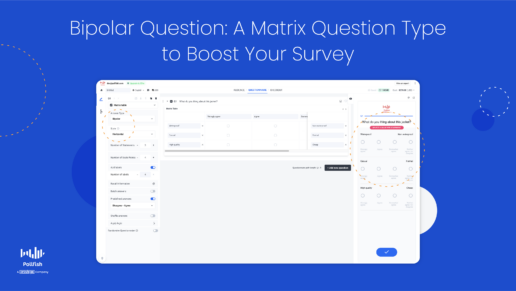
The following displays how this new question type looks on the Pollfish platform:

How the Bipolar Question Type Differs from the Likert Question Type
Both of these question types are variations of the Matrix question. As such, the Matrix question type exists as the parent question category, while Bipolar and Likert Scale variations are the more granular child categories.
Both categories therefore can use a scale of 5-7 questions and both use a Matrix table, but their distinct version of it.
Let’s explore how they differ from each other in the following table:
| Bipolar Scale Matrix Question | Likert Scale Matrix Question | |
| What’s displayed | Two extremes of a scale in a table format. | A list of statements as rows and scale points as columns in a table format. |
| Question options | Respondents select a point between the two extremes. | A single answer, a multiple answer, a drop-down list, or a drag and drop. |
| Answer Labeling | Because the two extremes are marked, labeling individual points is optional. | Each option always has a label. |
| Answer Options | Respondents can provide just one answer. | Respondents can provide more than one answer. |
How to Use the Bipolar Matrix Question Variation on Pollfish
Creating this question type and using it on the Pollfish market research platform is easy to do. First, go to the questionnaire section of your survey. Then, select your question type in the lefthand panel.
Then choose from the following options to set up your Bipolar Scale:
- There are 2 extreme-scale values for each statement.
- Select the length of the scale points and add the number of labels, as you will have to choose how to represent the Bipolar question to your respondents.
- Use rows and columns( horizontal and vertical cells or use the Sliders.
Afterward, choose from the available settings for your Bipolar Matrix question:
- The number of statements, AKA, rows has no restriction.
- Scale points, the radio buttons available also have a few restrictions and conditions:
- Include up to 20 for Horizontal and Vertical cells.
- Use up to 11 for the slider.
- Use up to 20 statements for all forms.
- Labels, which are optional and go above the scale points. They do not have to be the same number as the scale points.
Don’t forget to type in your question and have your answer options (the points) you seek to fill in.
Next, consider how we implement this question type:
- In the questionnaire
- Using advanced skip logic
- On mobile and desktop versions
- On the results page
- In exports, BQ and file exports
- With Survey Translations
Finally, review your question and answer options (the points) and add more Bipolar or other questions to your questionnaire.
Curious about how to build your ideal survey? You can learn how to make your own survey in just three easy steps on the Pollfish online survey platform.
Setting Up the Ideal Matrix Table
You can now use the Pollfish platform to create a specialized Matrix question: the Bipolar question type. A variation of the Matrix question, it helps you create a more custom question format that guides respondents on which extreme their answer falls under.
Giving you the chance to fish out more accurate answers while creating a more engaging survey experience, using this question variation is a must. That’s why it is equally important to select a strong online survey platform that facilitates creating this question type.
But there’s more when it comes to choosing the right online survey platform. You should choose a survey provider that enables you to survey anyone. As such, you’ll need a platform with a reach to millions of consumers, along with one that offers the Distribution Link feature.
The former method works via Random Device Engagement, which targets and gathers respondents where they voluntarily are across different digital channels. Thus, it distributes surveys randomly, across a wide network of digital properties. This includes websites, mobile sites and mobile apps, making for a randomized survey deployment.
The latter method, which uses the Distribution Link feature empowers you to send your survey to specific customers, instead of only deploying them across a large network. This enables you to target respondents you know are your customers via email and social media as well as adding your link across digital channels, such as landing pages, homepages, etc.
It is also important to use a mobile-first platform, as mobile dominates the digital space and no one wants to take surveys in a shoddy mobile environment.
The online survey platform you opt for should also offer artificial intelligence and machine learning to remove low-quality data, offer a broad range of survey and question types and disqualify low-quality data.
With an online survey platform that offers all of these capabilities, you’ll be able to form your ideal survey and easily set up and use the Bipolar Scale question variation.
How to Conduct a Consumer Analysis for Business Growth
How to Conduct a Consumer Analysis for Business Growth

All businesses need to conduct a consumer analysis to achieve any sort of industry success, as it is largely dependent on customer satisfaction. Given that customers are the lifeblood of any business, you should never invest in any marketing or outreach campaign before examining your target market.
76% of customers expect companies to understand their needs. However, only 17% of customers believe that businesses listen to their feedback. This grim statistic highlights the fact that many brands simply don’t use the data they collect, if they collect any at all.
To carry out consumer analysis, brands should not merely gather data from their websites; they need to execute market research, a kind of research that places consumer data at the fore. Consumer analysis is key to the broader practice of market research.
Unfortunately, only 19% of brands conduct consumer analysis, properly segment their audiences and personalize their offers. As such, it is understandable why less than one-fifth of consumers believe brands are listening to them.
This article expounds on consumer analysis, its importance, how to conduct it and how to use market research to perform it.
Understanding Consumer Analysis
Consumer analysis refers to the process of gaining detailed consumer information, typically through market research techniques, which focus on the customer aspect of market analysis.
A consumer analysis involves identifying a target market and its different segments, understanding customer behavior, along with consumer preferences and anything else that affects how customers interact and patronize a business.
To conduct a consumer analysis, businesses need to collect data beyond their websites. This does not end with examining purchase data, returns, payments and advertising costs, as it largely depends on studying the customers themselves.
As such, it involves tracking customer buying behavior, their desires, dislikes, lifestyle, aversions, needs and more.
The purpose of taking part in a consumer analysis is to investigate the portion of any population that is most likely to purchase your products or services, which is typically called a target market. By establishing different groups of consumers and understanding their needs, you can properly cater to them and build consumer loyalty.
The Parts of a Consumer Analysis
This kind of analysis carries several objectives, which the following lays out:
- Producing a profile of consumers: This involves demographic, psychographic, economic, social and geographical characteristics of the consumers.
- It also includes any of their special interests and habits.
- It covers the consumer buying process, which involves how they make their decisions, the time and frequency of their purchase, how they purchase and how they pay.
- Customer profiles can take the form of fictional, yet representational buyers called customer personas.
- Benefits gained by the consumers: These include various benefits that a brand derives from potential and current customers.
- It includes monetary benefits, psychological benefits and high and low involvement benefits, which depend on the products.
- It also encompasses purchaser benefit depending on whether you operate a B2B or B2C business.
- The business’s role in meeting the consumers’ needs: This includes an analysis of your business itself in relation to customers’ needs, pain points and problems.
- You must be able to answer how your business is able to resolve your customers’ problems.
- After identifying different segments and personas, you should rationalize how each group can specifically benefit from your offerings.
The Importance of Consumer Analysis
This kind of analysis is important for several reasons, which carry benefits for your business.
First off, it is necessary for the founding document of a business: the business plan. This kind of analysis is a decisive component of any business plan and in all stages of growth. That’s because this kind of analysis identifies your target market, its value and how your business is particularly equipped to help its target market members.
Forging brand awareness is key for business growth; as such, businesses often spend much of their budget on marketing. Not all channels bring in the same foot traffic and some have higher bounce rates than others. A consumer analysis creates marketing efficiency, as it allows you to understand consumer preferences when it comes to marketing channels and content marketing strategy.
This kind of analysis also allows businesses to be well aware of the motivational factors behind their customers’ purchases. By understanding what motivates consumers to make a purchase, you can improve your business strategies by understanding how to cater to those motivations and needs.

Piggybacking off of the need to understand what motivates your consumers to buy, a consumer analysis helps you increase sales. By understanding the motivations behind purchases, you can market your products and services far more proactively.
This is because by thoroughly analyzing your customers, you’ll be able to tap into their biggest needs and strongest opinions. Knowing these will ensure you avoid negative associations for your consumers while understanding what will have positive effects. This includes understanding cultural trends, along with logistical aspects, such as shipping times.
A consumer analysis can even help improve your profit margins. This is because not every customer is built the same in terms of buying behavior and most importantly, customer lifetime value (CLV). Some consumers will buy from your brand a few times a year, while others may do so on a more regular basis. Other consumers will bring in one-fourth in revenue throughout their relationship with your business, therefore bringing a higher CLV.
By analyzing your different segments and personas, you’ll be able to see which ones are worth marketing certain products/services to. It will also help you adjust your pricing plans accordingly and innovate to suit particular consumer segments.
Finally, this kind of analysis is critical for building and maintaining customer retention, which keeps your business afloat, as it is less expensive to sell to existing customers. By examining your consumers and being attuned to all their quirks and needs, you’ll be able to satisfy them. Doing so on a consistent basis will strengthen your consumer loyalty and enable you to increase your customer retention rate.
How to Conduct a Consumer Analysis with Market Research
Conducting a consumer analysis involves studying your consumers closely after identifying them. As such, there are different approaches to performing this kind of analysis. We stress the importance of market research for completing such an analysis, as it involves the means for gaining the insights you’ll need.
The analysis we put together involves using a market research platform as the main vessel for extracting consumer insights.

The following explains how to conduct a consumer analysis:
- Put together a preliminary list of the demographics you suspect to be in your target market.
- Add in inferences about location and psychographic preferences.
- Perform secondary research on these groups for further information and identification.
- Use a market research platform to conduct primary research on your consumers.
- Create surveys that ask questions that allow you to segment your consumers into different segments based on their demographics, location, lifestyle, buying behaviors and habits.
- Probe further into their psychographics by asking questions about what annoys them and distresses them, along with what they like, desire and prefer, particularly in regards to your niche and products/services.
- Once you have segmented your consumers via the market segmentation methods laid out above, form surveys that address their problems.
- This will allow you to understand how to position your brand favorably and as the solution to their problems and supplier of their needs.
- Create follow-up questions to understand the needs of your consumers, along with what they’re currently doing to meet their needs.
- Ask about their preferences in regards to price, brands and other considerations. For example, the model of a product, its year of release, etc.
- Use the data you garnered as a means to assign value to your different consumer segments.
- It may be too early to calculate your customer lifetime value, unless you’ve already analyzed your consumers previously.
- This is especially true if you’re conducting this analysis in a well-established business, or at least in the aftermath of a business plan.
- Analyze all your data in the dashboard of your online survey platform.
- You should use a platform that offers different visualizations and export options of the data, so that you can share it across your team and truly form data democratization.
- Analyze your own brand in relation to your consumers.
- What are your strongest selling points, especially in regards to your consumer insights?
- How can you help them the most?
- Or, how can you market yourself to point out that you help with all of their needs?
- Show how your company’s product and/or service meets your consumers’ wants and needs.
- Detail how your brand can remove all of their issues in relation to your offerings.
- Take action and form marketing campaigns to reach your consumers.
- You should prioritize which segment and persona to market to first.
Pleasing All Your Consumers
Consumer analysis helps market research professionals determine the desires, needs and difficulties of their consumers. Meeting the needs of consumers increases sales and profits and has the potential to build consumer loyalty.
In this way, by analyzing your target market, you’ll be able to satisfy it, thereby curtailing customer attrition. After all, if you don’t satisfy your customers and they feel that you’re not paying attention to their needs, they can easily switch brands, cutting their business relationship with your brand for good.
Thus, you should conduct a consumer analysis regularly, regardless if you are just putting together a business plan, or have been in business for years. In order to facilitate a consumer analysis, you’ll need to use market research software, particularly a survey platform, as it allows you to conduct primary market research.
Use an online survey platform that makes it easy to create and deploy consumer surveys. It should offer random device engagement (RDE) sampling to reach customers in their natural digital environments.
You should also use a mobile-first platform since mobile dominates the digital space and nobody wants to take surveys in a poorly-built mobile.
Your online survey platform should also offer artificial intelligence and machine learning to remove low-quality data, disqualify low-quality data and offer a broad range of survey and question types.
The survey platform should offer advanced skip logic to route respondents to relevant follow-up questions based on their previous answers. It should also make it easy to form a customer journey survey to survey your respondents across their customer journeys.
Additionally, it should also allow you to survey anyone. You’ll need a platform with a reach to millions of consumers, along with one that offers the Distribution Link feature. This feature will allow you to send your survey to specific customers, instead of only deploying them across a vast network.
With an online survey platform featuring all of these capabilities, you’ll be able to adequately create a consumer analysis.
How To Conduct A Survey That You Can Trust In 8 Steps
How To Conduct A Survey That You Can Trust In 8 Steps

So you want to conduct a survey, not any run-of-the-mill survey, but one that you can trust, that is, one that quickly gathers the total number of survey respondents you selected — with the correct demographic and psychographic traits.
To do so, you’ll need to be able to preset these requirements in an online survey platform.
You’ll first need to find a potent online survey platform, along with understanding how to conduct a survey that provides accurate and reliable data on your target market.
While building a strong survey campaign can appear to be difficult, if not downright intimidating, it is much simpler than it looks. This simplicity will depend on the survey platform you choose, as they are not all the same.
Nonetheless, there’s a process to conduct a survey that you can use across multiple campaigns, whether you need to conduct local or global surveys, study customer behavior, or even increase your customer retention rate.
Luckily, we’ve prepared an easy-to-follow, 8-step process for conducting surveys. This article is an 8-step guide to help you to design, conduct, and organize an effective survey in no time. Let’s dive in.
Table of Contents: How To Conduct A Survey That You Can Trust In 8 Steps
- The Importance of Conducting Surveys
- What You Need to Conduct a Survey
- Steps to Conduct a Survey
- Step 1: Identify Your Research Goal
- Step 2: Define Your Survey Audience
- Step 3: Come up with Preliminary Questions
- Step 4: Design Your Questionnaire
- Step 5: Distribute Your Survey
- Step 6: Organize Survey Responses
- Step 7. Analyze and Present Survey Results
- Step 8: Take Action
- Making Every Survey Count
The Importance of Conducting Surveys
First off, let’s uncover why you should conduct a survey in the first place. After all, there are a variety of other market research techniques you can use, including both primary and secondary research methods.
One of the most important reasons to conduct survey research is due to the prowess of surveys; they grant you original hard data and facts. You can use surveys to study virtually any subject and gain both quantitative and qualitative insights.
Data, especially customer data, is becoming more and more sought after, as 40% of organizations aim to increase data-driven marketing budgets, and 64% of marketing leaders believe that data-driven strategies are vital in today’s economy. Surveys act as a convenient conduit to gain access to any sort of data, whether it is consumer-related or otherwise.
Conducting surveys on your customers is one of the most effective ways to collect invaluable data and gain answers to concerns that are important to you. This is core to market research, as it allows you to better understand those most likely to buy from you, aka, your target market.

So how can you use surveys as a means of data for decision-making? There are numerous campaigns and insights that surveys can avail and unlock.
Surveys let you uncover hidden growth opportunities, reveal public sentiment, gain deep insights into customer buying behavior, and even get extra media coverage when prominent publications cite the findings of your research.
They also prevent you from making the wrong business decisions, whether it deals with releasing a new product, creating an ad campaign that won’t resonate, appealing to the wrong persona and much more. Thus, surveys allow you to discover your risks, decide on whether they are worth taking and avoid mistakes.
As an added bonus, simply the act of conducting a survey affects customer behavior, along with their opinions of a company. Specifically, the satisfaction of writing a positive survey response creates a desire to buy more of a product. With this information in tow, brands that include their name and likeness can increase sales simply by conducting a survey.
As such, surveys don’t merely provide you with an understanding of your customers’ needs, wants and sentiments; they also allow you to affect their perception of your brand and their willingness to buy from you.
In this way, and as mentioned in the above link, surveys, especially those that provide positive experiences, contribute to your revenue, which keeps your business afloat. Aside from granting you new customers, you can also use them to survey existing customers.
By offering them a good experience and presenting your company in the best possible light, surveys also help you boost consumer loyalty, which is an absolute must. Loyalty is the core of customer retention, which is often cited as more important than customer acquisition.
For example, did you know that 80% of profits come from just 20% of your existing customers? In addition, retaining customers is far less costly than acquiring new ones. There are plenty of statistics that back up the claim that customer retention is both more profitable and less expensive to achieve than customer acquisition.
For example, consider the following:
- Increasing customer retention by just 5% can increase profits from 25-95%.
- The success rate of selling to an existing customer is between 60-70%, while the success rate of selling to a new customer is only 5-20%.
All in all, conducting a survey is crucial to the well-being of your customers and your business. Surveys help you unearth virtually any insights which you can then use to guide your next or ongoing business move.
What You Need to Conduct a Survey
If you want to get meaningful results that you can act on, there are certain things you’ll need to have and certain actions you’ll need to take. These will steer your survey campaign in the right direction, give you the most accurate and useful results and ward off survey bias.
Before we dive into the steps to conduct a survey, let’s glance over the things you’ll need (not all of which are tangible), to conduct your survey. These are a must and must be present within the online survey platform (or market research agency) that you use.
The following list lays out everything you need to conduct a successful survey:
- Survey the correct population,
- Use the correct survey distribution method (see Step 5)
- Make sure your survey provides a pleasant survey experience
- This includes ALL digital properties where your survey will live, such as websites, mobile sites, apps and more.
- Have the ability to customize your surveys to your liking
- Have various questionnaire building options, such as
- Survey templates
- Advanced skip logic
- Different screening options for demographic and psychographic screening
- A filtering system
- Screening questions
- A wide variety of question types you can use, such as
- Matrix questions
- Open-ending questions
- Likert scale questions
- Rating scale questions
- Be able to create a variety of specialized surveys, such as
- The Net Promoter Score (NPS) survey

- The Customer Satisfaction Score Survey, aka, CSAT survey
- The CET (Customer Effort Score survey)
- Visual rating surveys, which include
- ones that use hearts,
- stars
- emojis
- other visual ratings as scaled questions).
- Both B2C and B2B surveys
- The Net Promoter Score (NPS) survey
- Access to granular insights via a post-survey results dashboard and a survey builder.
- Use a platform that offers 24-hour technical support
- Can conduct global market research
- Leverage a system that offers a wealth of technical and quality checks to avoid survey fraud
- This helps you avoid
- Gibberish answers
- Respondents who aren’t paying attention
- Flatliners (those who keep answering with the same choice in multiple-choice questions)
- Bots
- Those hiding their location via VPN
- This helps you avoid
As you can gather, there are various elements to a successful survey. You’ll need to therefore carefully select your market research platform — or agency, if you’re taking the syndicated research path.
You don’t want to settle for a low-tier platform, otherwise, you risk collecting unneeded biases and a whole host of low-quality data.
Steps to Conduct a Survey

Follow along the 8 steps in this guide to conduct meaningful survey research.
- Step 1: Identify your research goals
- Step 2: Define your target audience
- Step 3: Come up with preliminary questions
- Step 4: Design your questionnaire
- Step 5: Distribute your survey
- Step 6: Organize survey responses
- Step 7: Analyze and present survey results
- Step 8: Take action
Step 1: Identify Your Research Goal
Every successful survey has a purpose. You’ll need to identify yours to get started. This will serve as the basis of the entire survey campaign.
In order to identify your research goal, you’ll need to consider the insights your business needs most. Consider the following questions to ask yourself and your team:
- Do you need to steer an advertising campaign?
- Do you need to form a marketing strategy?
- Are you trying to find out why you are losing customers?
- Do you want to know if your policies are effective?
- Are you figuring out what to do in the current market?
- Do you need to discover your own employees’ sentiment about your workplace?
- Would you like to cut back your customer attrition rate?
The kinds of questions you need to ask yourself and your company’s different departments are limitless.
We suggest forming a survey that relates to your most pressing needs, or setting up a proactive survey study, that is, a survey campaign designed before you go through with something, such as designing a new feature or ad.
Understanding your survey’s main goal both improves its quality and reduces the time you’ll spend on executing your research.
In case you struggle to pinpoint your exact goal, write down a list of all the questions and issues your market research campaign needs and prioritize the most important ones.
In addition, ask yourself and your team questions to better understand your own standing in regards to market research, your existing tools, campaigns and more. These are your peripheral questions, which will help you determine your key research goal.
The following questions will help you understand your survey goal better:
- Do you understand who comprises your target market?
- Do you need to segment your target market further?
- Do you already have any existing data that you can use?
- Do you need data to improve an existing product or launch another?
- What resources do you have to perform the survey?
- What actions are you going to take after the survey is complete?
After you have figured out the main goal of your research, you will need to define your survey audience.
Step 2: Define Your Survey Audience
Identifying your survey target audience is key to any successful market research campaign. After all, it is the audience that you seek to study, to learn how its members tick, their habits, sentiments, etc.
The wrong survey audience will invalidate your study, as it will be irrelevant to your business or study.
There are two main concerns when it comes to surveying participants: who should I survey and how many participants do I need?
Let’s clarify both.

Who should I survey and who is in my target market?
Surveying the right people makes all the difference. That’s why before determining your survey audience, you’ll need to first identify the makeup of your target market. To do so, you’ll need to conduct secondary research, along with consolidating what you already know about your target market.
In addition, you’ll need to conduct market segmentation, which will allow you to break your wider target market into various segments. These can exist on the basis of various factors, such as age, ethnicity and other demographic factors, along with behavioral aspects, such as buying habits, frequency of purchase, brand trust and more.
You can do this by conducting an RFM analysis, which is an abbreviation of Recency, Frequency and Monetary Value. In this analysis, researchers estimate the value of a customer based on the three data points in its abbreviated title. This is one of the models for customer behavior segmentation.
Targeting a specific audience is important for many reasons. For example, suppose you want to learn if iPhone users are happy with the recent product updates.
By surveying random iPhone users, you may notice that the majority of responses are somewhat neutral. But if you target specifically the Gen Z generation, you might learn that the younger demographic is worried about having to buy extra accessories.
The more defined your target audience criteria are, the more accurate and deep your survey insights will be. Thus, make sure to brainstorm, segment and fully identify your target market and your own customer personas before setting up your survey questionnaire.
Identifying them first will show you which target audience you’ll need for your survey to gain the most accurate insights and help you fulfill your survey goal.
How many survey respondents do I need?
When doctors want to examine your blood, they don’t drain all of it - they just need to take a small sample. The same principle stands with surveys: a small sample of survey respondents can accurately represent the opinions of a larger group.
For example, if there are 5,000 people in your company and you want to know how well the latest HR policy was received, you don’t need to survey all 5,000. In fact, surveying just 146 employees will be enough.
Thus, if you want to learn what all American high schoolers think about the recent TikTok ban, you don’t need to ask all 76 million of them. Surveying between 200 and 600 respondents will give you a sufficient amount of opinions to draw from.
For the majority of studies, 200 to 800 respondents will be enough to represent the thoughts and opinions of a particular population. However, all studies are not built the same, nor are they geared towards the same kind of longevity, think longitudinal surveys versus cross-sectional surveys.
As such, you’ll need to calculate your survey sampling size, which is also referred to as a sampling pool.
If you want to calculate how many respondents you’ll need to get scientifically accurate survey results, feel free to use our sample size calculator.

Step 3: Come up with Preliminary Questions
Now that you’ve carefully selected a main survey goal and theme, along with having identified who to survey and how many to include in your sampling size, it is time to get to the heart of your survey: the questionnaire — or at least the beginning of it.
To do this, you’ll need to consider the main goal and subgoals of your survey campaign. As such, write down the most pressing questions you have. We suggest coming up with a list of 10 questions.
Note that not ALL of them need to be in your survey, in fact, we suggest keeping your questionnaire short. Even users of a game who’ve come across your survey and decided to take it for in-game survey incentives will hesitate to take a lengthy survey.
As such, your preliminary 10 (or more) questions are just that: preliminary. Not all of them will make it to your questionnaire, as they are meant for brainstorming ideas.
As you create these questions, heed the following tips:
- Create questions based on the survey campaign you’re going to use.
- For example, if you’re going to run a longitudinal study, you’ll need to create questions that span through various time periods.
- Or, for a cross-sectional study, you’ll need to create questions for just one survey and thus have one primary focus of the study.
- Do any of your questions appear too similar to one another? If so, consider merging them or removing a few.
- Decide whether certain questions need follow-up questions.
- For example, if you ask a question in which a certain answer requires more information, consider using follow-up questions.
- That’s where advanced skip logic becomes handy, as it routes respondents to relevant follow-up questions.
- This creates paths in your survey and allows you to understand your respondents and the subject of the original question at a deeper level.
- This can also be relevant to the first point, as you can use similar questions as potential follow-up questions.
- Do your questions pertain to certain customer segments or personas?
- If so, refer to your customer segmentation and personas list. You may need to break your survey into two or more, depending on how many customer segments it can be used for.
- You can also add multiple audiences in one survey.
- Show your preliminary set of questions to your team/colleagues for their feedback and suggestions.
- Here, you can get into the nitty-gritty of what is most important for your study by way of other relevant opinions that will help shape it.
Step 4: Design Your Questionnaire
Next, we’re going to move on to designing the questionnaire itself. This will largely depend on the survey platform you use. As aforementioned, you’ll need to use a strong market research SaaS platform that offers a variety of features and services to form a robust survey campaign.

Make sure your survey platform allows you to build the questions you need at ease and speed.
It’s key to note that the quality of a questionnaire is where the majority of surveys fall short. Experiments suggest that sensitive or vague opinion questions increase the potential of error by up to 30%. Put simply, your survey is as good as your questionnaire is.
Make sure your questions are clear and don’t contain jargon or uncommon abbreviations. This is key to shaping the survey experience.
A poor example of a survey question: Do you think VR is going to take off in the next 5 years?
A better example of a survey question: Do you think virtual reality (VR) is going to take off in the next 5 years?
In some instances, a poor question is one that yields scant information. In this case, it is key to follow it up with another, or create it so that it doesn’t require additional questions to begin with. In this case, a yes or no question constitutes a poor example, whereas an open-ended question is the better example.
A poor example: Do you agree that this is a great movie?
A better example: What do you think of this movie?
Take some time to learn how to write clear, unbiased, and effective survey questions to get the best results out of your research.
Step 5: Distribute Your Survey
There are several ways to distribute a survey. These include legacy distribution methods and modern ones. While it may not appear to be very important, choosing how your survey is distributed is as important as choosing who you want to survey.
This is because survey distribution accounts for many aspects of your study, including the following:
- Where your survey will exist
- In the digital vs analog world
- On websites or apps
- Used as part of a focus group
- If your target market see your survey based on its distribution channel(s)
- When your target market will see your survey
- How quickly you’ll gain respondents and completed surveys
- When you can access your post-survey dashboard
- When you can carry out a survey data analysis
- Associations of your brand (if you mention it in the survey)
- How long it takes to complete your survey
- For example, an online survey platform that continues iterating until it receives all required responses works faster than do interviews that a market research firm conducts.
The environment of the survey is critical to its exposure by your target market, as Point 2 states. This is because different demographics spend time online (and in the real world) differently.
Let’s continue with the example of surveying Gen Z iPhone users. Suppose you moderate a local school Facebook group and decide to post your survey there. Even if you get a large number of responses, the results may not accurately affect this demographic.
This is because in this case, you don't pick survey participants randomly, instead, you survey only those who joined the local school Facebook group that you conveniently happen to moderate.
This is called convenience sampling, since the majority of survey participants unintentionally live in one area. The survey didn’t account for Gen Z users from other areas with different average household incomes.
To ensure you get the most accurate survey results, use a survey platform that can help you reach your targeted demographics more precisely and at speed. In short, avoid convenience sampling.
Instead, opt for organic sampling, which gathers survey respondents by distributing your survey to the places they spend their time organically. On the Pollfish online survey platform, we use organic sampling in the form of RDE sampling, or Random Device Engagement sampling.
 RDE sampling is a kind of organic sampling in which polling relies on advertising networks, or other portals on digital devices, to engage random people where they naturally spend time. This can occur on gaming and mobile apps.
This is the opposite of a research panel, which is a research method that pre-recruits and prescreens a group of research participants who have opted in to take part as the studied subjects of a market research campaign.
Lastly, before we provide a few examples of survey distribution methods, it is also critical to be strategic about when to send your survey. For this, we recommend reading our quick guide on the best time to send a survey.
Here are a few common ways to distribute your surveys:
- Email. You can distribute your survey by email, especially if you have access to an established email list. The two main drawbacks of email surveys are that it’s harder to set specific target audience parameters and email response rates are generally low.
- Social media: if you survey people via social media channels, beware that sometimes social media groups attract people with shared interests that may not represent the opinion of your target audience or the general public.
- Online survey platforms: survey platforms such as Pollfish allow you to hyper-target specific audiences, control the number of participants, distribute the survey in different ways, reach all quotas, easily organize your survey results and more.
- Survey panels: A survey panel is a consistent group of survey participants, who have pre-recruited and pre-screened, who opt into a survey study. Researchers would return to the same people to run surveys or host interviews repeatedly over time.
- Syndicated research: Syndicated research refers to research conducted by a market research firm, oftentimes independently. It is published and sold by a market research firm, which is usually industry-specific and funded by several companies within a particular industry. The firm and its partner companies own the data that the firm collects. Other companies in their particular industry may purchase the data.
Besides these prominent survey channels, there are other survey solutions you can use; make sure to select the one most pertinent to your market research needs.
Step 6: Organize Survey Responses
After you’ve gathered your responses, you’ll need to organize the data before starting your analysis. As with the prior steps, this will largely depend on your survey tool, which also dictates your survey distribution, audience targeting and creation.
Here are the steps to prepare your data for analysis:
- Clean. Sometimes people fill out the survey twice by mistake. Although Pollfish survey technology prevents duplicate responses altogether, if you’re conducting a survey on your own, or via syndicated research, make sure to clean duplicates and “funny” answers before you proceed to organize your data.
- Organize. Group survey answers that are similar to each other and try finding patterns that allow you to structure your data.
- Visualize. Try finding ways of visualizing survey responses using graphs, charts and images. Visualized survey data is easier to analyze and refer to, especially if you want to share survey results with other people.
Step 7. Analyze and Present Survey Results
The data you collected during your survey can be presented and analyzed in many different ways, so make sure to go back to the survey goal that we covered in Step 1.
Analyzing survey results and writing a report often go hand in hand, so it’s a good practice to go back and forth between the two until you fully narrow down your findings.
Here are some questions that will help you write a better report:
- Did you achieve your survey goals?
- How can you organize your findings into cohesive narratives?
- What are the main insights that you gathered?
- How can you use the collected data in the future?
- Are there other ways this data can be interpreted?
Keep your margin of error in mind during your survey analysis. This measurement points to the degree of error in the results of a survey, specifically one that relies on the random sampling method.
It is imperative to keep the margin of error low, as a high margin of error reveals a smaller likelihood of survey results to reflect the true views of your survey target audience. As such, a higher margin of error renders your survey less reliable and inconclusive.
If you are presenting a report to others, remember that different audiences may be interested in different aspects of your survey.
In case your audience is primarily business stakeholders, then the main focus should be concrete customer preferences or aversions, along with actionable suggestions.
If you are presenting a survey to other researchers, they will be more interested in the technical aspects of your survey such as target audience, sample size, and data analysis method.
Make sure to consolidate your survey data analysis into one document. The document should be divided into the themes, patterns and other central areas of focus of which you’ve collected and analyzed data to draw different conclusions.
It will be this data — not the raw data in your dashboard — that will guide your business decisions, changes and all other courses of action.
Step 8: Take Action
In this step, you’re going to consult the information you’ve gathered and analyzed in Steps 6 and 7. You’ll need to create a document of your findings, one that exists outside your dashboard and is central to your survey analysis.
This document should cover central findings, along with key granular ones. It should also answer some of the key concerns you had in Step 1, along with the questions designed for your respondents themselves.
Do your results and analysis answer all the inquiries and curiosities you had about the topic at hand? If so, it is time to take action. If not, then you should create another survey, one that focuses on the things that are left unanswered, or anything you need more information on.

Sometimes, the latter is most common, with survey campaigns lacking clarity, therefore lacking completion. However, not to worry, just create another survey. If you have the contact information of your respondents, just send them a follow-up survey. If not, send your new survey as you had originally done.
We recommend using an online survey provider that offers the random device engagement method, which, as aforementioned, is a kind of organic sampling that uses digital properties to query respondents where they visit organically.
If, however, you have all the insights you need, it is time to take data-informed action. There are many ways to take action on any given topic. The following list enumerates various ways to act on your survey data and analysis:
- The establishment of something (ad campaigns, marketing strategy, pricing, a slogan, etc)
- Changing something already in existence (ads, videos, promotions, pricing, etc)
- Scrapping aspects of an ad, marketing, sales or any other business campaign or activity
- Terminating an action or campaign entirely
- The formation of slightly different approaches based on different market segments
All in all, after you’ve followed these steps, you will be much closer to your original goal, whether it is solely to have invaluable customer/subject data, or to use that data to make immediate or long-term decisions.
Therein lies the power of surveys, they grant you the knowledge you can use for a host of decision-making.
Making Every Survey Count
Every business has a slew of questions about its industry, competitors and customers. As such, they must use market research to crack these challenges and properly serve their target market.
Conducting a survey is at the forefront of conducting this kind of research, as it grants you firsthand insights, tailored specifically to your target market, with your most requisite questions.
The challenge in conducting a survey manifold: finding a survey solution to easily distribute your questions to the right audience, creating a survey with the proper questions, distributing the survey in the right channels, consolidating your data and more.
Following our eight steps will help you conduct meaningful and unbiased surveys to answer your most demanding questions. However, adhering to this process is not enough.
You’ll need to find a potent online survey platform to facilitate your entire survey process, from targeting, to questionnaire building, filtering data and more.
Ideally, it should provide various quality and technical checks to ward off survey fraud, offer a mobile-first survey environment and allow you to survey anyone, not just via on network on the RDE method (although this method is incredibly effective).
It should allow you to survey specific people, such as via email, or whichever digital channel you seek to use. Luckily, there’s the Distribution Link feature, which enables you to do just that.
Good luck!
[wp-faq-schema]

Sending and Targeting Surveys to Anyone With the Distribution Link
Sending and Targeting Surveys to Anyone With the New Distribution Link

The Pollfish platform just got much more powerful. We now offer another major way to deploy surveys so that researchers can target the exact people they seek to study for all of their research needs.
We’re thrilled to introduce the Distribution Link, a feature that completes the Pollfish survey distribution and deployment functionality. It is currently FREE to use this DIY market research tool.
With this latest feature, you can target respondents in the most precise way: via their identities instead of their demographics, location, and other screening filters you’ll find on our platform.
This feature fortifies your survey outreach process, arming you with the knowledge of specific respondents. As such, it provides a powerful addition to market research techniques and gives you the full Pollfish experience.
This article explains the Pollfish Distribution Link feature, so that you can apply it to all your unique respondent targeting needs.
Understanding the Pollfish Distribution Link Product Feature
The Distribution Link is a new product feature for distributing your surveys to the exact targets you seek to complete them. It serves as an alternative to our current survey deployment method: that of random device engagement sampling or RDE sampling.
With RDE sampling, the Pollfish platform launches your survey to hundreds of thousands of highly-trafficked websites, mobile sites and apps, prompting random internet users to take your surveys. Of course, only those who qualify to take it based on your screening section are granted entry into the survey.
This way, only members of your targeted population will participate in your survey and they are targeted in a completely randomized way. While this strategy is useful and efficient, bringing you quality data and speed to insights, it was rather incomplete.
This is not to say that you couldn’t extract high-quality data from the Pollfish platform through its survey fraud protection and quality checks system or that you couldn’t target people based on demographics, psychographics, location, etc via the RDE approach. In fact, that is exactly what the RDE method was built for: quick insights from a vast and random sampling pool.
While this is an innovative approach, it was incomplete in that it didn’t allow you to send your survey(s) yourself to specific individuals. But now you can with the Distribution Link feature.
The Distribution Link allows researchers to send their survey(s) themselves to their exact targets, actual individuals rather than a random pool. But it can do much more.
Since this feature is a link, you can send it through various means and reap various benefits.
Distribution Link Facts, Cost and How to Add it to Your Survey Campaign
The researcher can create a draft and instead of distributing it via the Pollfish network, they can generate a link that potential respondents can click on to reach the survey. As such, there will be no checkout page, but a link that researchers can share across mediums.
The first release is available for all accounts for free.

The following explains how to apply the Distribution Link feature to your survey:
-
- Click on ‘’Create new survey’’ on the Pollfish platform.
- Then, select the option of “create a link” to share the survey.
- Select to start through a template or from scratch.
- You’ll then be directed to the Questionnaire page, where you can select your intended respondent demographics and other qualifications.
- You can also add screening questions that will allow or bar entry to the survey to respondents who answer them in a particular way.
- After filtering options in the Questionnaire page, Then you’ll be taken to the Questionnaire page, where you can design your questionnaire or alter the template.
- If you want to screen your audience do so through the ADL tab.
- When you send a user to the end of a survey through the ADL tab, this is due to:
-
-
- A successful survey completion
- Screen out termination
- Profiling termination
- Quality termination
-
Please note the following changes we’ve made in 2022:
Quality termination is replacing the Disqualification rules feature in the Distribution Link feature. Additionally, screenout and profiling terminations through ADL are replacing the Audience page and screening questions in this feature.


Capabilities and Benefits of the Distribution Link Feature
This feature presents a potent way to collect survey responses; as such, it is another means of survey sampling methods. It has a slew of various capabilities and benefits. The following lists all that researchers can do with the Distribution Link feature:
- Appears as an easy-to-access, sharable link.
- Allows you to hyper-target your target market sample.
- Permits you to reach specific individuals.
- Grants you the power to survey consumers and leads at key moments in their customer journey.
- Enables you to gain consumer opinions about events in their customer experience (CX) while they’re fresh on their minds.
- Allows you to understand what customers don’t like or where you went wrong as these events are still occurring.
- Gives you access into the minds of specific people, at specific times in their CX.
- Makes it possible to ask consumers about your company, specifically, their experience with it, as opposed to more general questions about their thoughts about your niche and cultural climate.
- Brings you insights from key stakeholders and players in your industry and certain companies.
- Provides an alternative survey sampling approach you can use alongside RDE sampling, allowing you to conduct comparative analyses between the two sets of data.
Methods and Campaigns to Use with the Distribution Link Feature
The Distribution Link feature opens doors to conducting several key market research campaigns. It also augments your survey deployment by providing more methods of sending your surveys. This means you are not limited to sending the surveys to specific people through a single channel.
Instead, this feature offers far more options to carry out your research campaigns and reap critical data for decision making. As such, it diversifies your options for distributing your surveys, along with enabling you to carry out and refine critical business campaigns.

The following lists the different methods and campaigns you can use with the Distribution Link feature:
- Email Specific Targets
- This serves as the classic method for inviting targeted people to take your survey.
- You ought to email consumers at specific times in their customer buying journey.
- There are various points in the customer journey and sales funnel that are opportune to survey your target market, such as: post-purchase, cart abandonment/ lack of purchase, bounces, email list sign-ups, a discussion with a representative, etc.
- There are several best practices you should use to increase your survey completion rate if you choose to email your targets.
- Social Media survey invitations.
- With the Distribution Link feature, you can copy/paste the link to the survey you want to deploy across any social media channel.
- This way, you can compare visitors from social media with other means of extracting data, whether it is with other Distribution LInk methods or via RDE sampling.
- B2B Feedback via B2B surveys
- You can gain critical insights with your business clients, vendors and partners to smooth various contracts, processes, integrations and other business dealings.
- With this feature, you can contact these entities directly, so you’ll know exactly who has provided answers to your survey.
- Create this survey type with the correct B2B survey questions.
- Content Marketing Strategy campaigns
- With RDE sampling, you cannot reach out to specific site users that visited and interacted with your website and its content.
- With the Distribution Link feature, you can survey people who have interacted with your content, are subscribed to your newsletter, visit your site regularly, have signed up for a mailing list, etc.
- The link allows you to attach your brand and its experience to the survey, which is also useful for brand visibility.
- Demand Generation campaigns
- If you do not want to directly mention your survey in social media or email messages/campaigns, you can still use the Distribution Link in your landing pages.
- This provides a more indirect way to access your survey, however, a landing page can provide an in-depth explanation, or a bulleted list describing your survey.
- Use CTAs in your landing pages to link to your Distribution Link survey.
- Employee Feedback Survey Campaigns
- Send surveys to your team only, or even specific departments with various employee-facing surveys.
- Use the employee satisfaction survey or the eNPS survey to gauge employee fulfillment, happiness and how likely they are to recommend working at your organization.
- Keep burnout at bay with the employee burnout survey.
- Recognize high-performing and hard-working employees with the employee recognition survey.
How to Use the Feature
- Create your questionnaire
- Select if you want to ask a question and screen the respondents (for profiling, quality, or screener) through the ADL.
- The Link Settings page is combined with the Share page title :
- Set up maximum responses if need be.
- Allow multiple responses from the same respondent.
- Select if you want to be informed of new responses.
- Set an expiration date for your survey.
- Add a custom “thank you” message.
- Select what will occur when a respondent adds a complete
- Send them to the Pollfish homepage.
- Send them to the results.
- Add custom redirect links.
- The results will be the same as regular ones, with the ability to delete a response.
Passthrough Parameters
This is a new implementation for 2022. In conjunction with the redirect URLs, we now support passthrough parameters. This feature allows researchers to pass different identifiers and parameters through the distribution entry link and redirect URL’s for each respondent or a batch of respondents. All parameters are also saved and are available at the XLS export.

Passthrough parameters allow you to pass information to and from a website by simply adding, or appending, specific information to the end of a URL.
You can append as many parameters as you want to your survey link.So what is their purpose in the context of market research? They enable researchers to pass different identifiers, AKA, parameters through survey URLs. The respondents then retrieve them through the redirect URLs.
They are predominantly used to track and match a respondent with a certain response. In Pollfish, you append the user ID at the entry URL and retrieve it at the redirect URL.
By doing so, you can match a respondent profile from the Pollfish respondent pool with a response on a Distribution Link survey.
Personalizing Your Survey Campaigns
Personalization is crucial in marketing and market research and with the Distribution Link feature, you have the option of personalizing your survey to its targeted respondents. You may know exactly who you seek to target if you’re setting up a B2B survey with a client, vendor or partner.
Or, if a customer on your website provides their key identifying details, such as their name, location, email address and more, this also gives you an avenue for personalization. You can then set up a personalized survey and send it to specific individuals with the Distribution Link.The key is to use a strong online survey platform like Pollfish, which now arms you with this link feature that makes it easy to make your own survey in only three steps. With the Distribution Link feature, Pollfish empowers your market research and general research campaigns more than ever before.
Diving Into the Competitor Survey for All Competitive Analyses
Diving Into the Competitor Survey for All Competitive Analyses

All businesses should deploy the competitor survey periodically, to keep a watchful eye on their competitors and their target market’s perception of their competitors. Competition is alive and well across every vertical, so it is critical to stay in the know on this front.
94% of businesses are investing in competitor intelligence and for good reason, as one of the main reasons why businesses lose their customers is because customers abandon them for their competitors.
In fact, 89% of customers switched to doing business with a company’s rival due to poor customer service. As such, all businesses must strive to surpass their competitors in a variety of matters, from product satisfaction to customer convenience.
That way, they can build brand trust to arm themselves against customers abandoning ship.
This article examines the competitor survey, competitive analysis, its importance, when to use the survey and how to create one.
Understanding the Competitor Survey
The competitor analysis survey is a critical online survey that helps businesses across industries understand their competitors’ business performance, especially in comparison to themselves.
This survey is the leading tool in competitor analysis, which is the practice of identifying your competitors and evaluating them on their strategies, target market perception, strengths and weaknesses and other key characteristics relative to your own.
Competitor analysis allows you to assess and fully understand your market in terms of its key players. It also grants you insight into your own standing and how you compare with your direct contenders.
Competitor analysis helps you assure that you’re allotting resources in productive ways by understanding your competitors, what has worked efficiently for them and what hasn’t. It assures you don’t fall behind and keep up with them, whether it is through product improvement and innovation, customer support, CX and all else.
The competitor survey helps you understand your competitors through the perceptions of your target market. After all, it is your customers whose opinions matter most and you’d be hard-pressed for an employee in your rival company to reveal trade secrets — or any at all.
However, you can still gain competitive insights by surveying certain competitors with B2B surveys. This is especially useful in business partnerships. While you may not get access to your direct competitors, you can still collect crucial information from indirect competitors that help inform on the state of your industry and niche.
Given that competitive analysis is most productive when consistently conducted, you should deploy the competitor survey regularly.
The Importance of the Competitor Survey
This type of survey has several advantages.
First off, by using this survey, you get access to firsthand insights from your customers, allowing you to glean all of their opinions on your competitors’ performance. Whether it comes to their brand messages, products or CX, this survey gives you a clear view into how they see your business rivals.
As such, you can use this survey to form a comparison between you and the competition. You can do so by asking your respondents to choose their favorite brand in a list and include your brand. You can also ask them to rate each brand by using a ranking question.

Additionally, this survey grants you key data into your customer behavior as it relates to your contenders. In this regard, you can survey customers on where they buy from your competitors,’ how they shop from them, how often, whether they’ll buy more during a certain event (ex: promotion) and more. In this way, you can create a kind of RFM analysis from this kind of survey.
It allows you to conduct competitive research by keeping track of your competitors through the eyes of your customers. Essentially, it is a kind of brand tracking, but instead of focusing on how your own brand is perceived, the spotlight is on your counterparts — unless of course, you explicitly ask questions that compare you to your rivals.
By understanding what your target market likes and dislikes about how your competitors operate, you get a twofold advantage. Firstly, you’ll generate ideas on how to run marketing campaigns, how to innovate your products, augment your customer support and improve across your entire customer experience. Secondly, you’ll also know what to avoid and do away with, based on what your customers view unfavorably about your opponents.
In regards to the former, you’ll also form ideas on how to target and acquire new customers, which has the potential to lower your customer acquisition cost. This is because you’ll be armed with data for decision-making, the kind that shows you exactly what your target customers want and expect.
When to Use a Competitor Survey
There are various times to implement the competitor survey for your competitive analysis. These often depend on your marketing campaigns and the time of the year. The following includes several opportune times for deploying this kind of survey.
- Shortly after your competitor(s) release new products or services.
- During heightened times of customer attrition. For example, when you notice high bounce rates on product and landing pages, along with customers abandoning their shopping carts.
- Shortly after you released new products, a new campaign or content.
- This can include new services.
- This can also include new website experiences, whether you offer a new subscription, UI elements, etc.
- During an in-home use test.
- One of many market research techniques, this allows companies to understand how their target market interacts with their products before they officially launch them.
- It grants businesses to understand how their customers use their products in natural settings instead of at customer facilities.
- Before launching a new product or innovating on a product idea.
- You should be aware of similar such products from your competitors along with your customers’ opinions of them.
- This way, when forming new products as well as post-production but before they go to market, you will understand how to best market them.
How to Create a Competitor Survey
To create a competitor survey, you will first need to work on another aspect of competitor analysis: identifying your competitors. This requires doing some secondary market research. A good starting point is to google the products sold within your niche.
Pay attention to the first and second-page rankings of the SERP (search engine results page). Additionally, take a look at the ads that show; these will appear at the very top of the SERP and are marked by the word “ads.”
When you google the common offering found in your niche, you’ll notice some competitors will rank for content aside from only the products and services. Some of these will take the form of a featured snippet. This kind of positioning places content above the very first search engine result.
Instead of appearing as a link and meta description, the snippet extracts more information from the page it’s highlighting. As such, the extracted content will be longer.
 Companies that land feature snippets perform well in terms of SEO. As you’re gathering your list of competitors, you can move on to the following steps, which guide you on how to create the competitor survey:
- Put together a list of at least 10 competitors, including indirect competitors.
- Start by understanding how customers feel about them by targeting your various market segments and customer personas in a preliminary competitor survey.
- In this survey, conduct brand awareness research on your competitors to see whether your customers know about their existence before you probe any further.
- This will keep your survey short, which is a general survey best practice.
- Next, choose a particular theme and campaign for the survey study.
- It can be based on a new product your competitor released, a seasonal campaign, or one with general questions about how customers feel about it.
- Use the above section on when to use this survey to provide some ideas on when to launch its study and what to base the study on.
- Create several key questions based on the theme of the study.
- Deploy your survey at a favorable time.
- Learn about the best time to send a survey.
- You should send it to a vast publishing network, along with identified, individual customers.
- Analyze your survey results.
- Decide whether you need further information and if you do, create a follow-up survey.
- Choose another theme for the survey.
- There are plenty of topics to base your survey on, such as testing the brand trust of your contenders or for brand tracking.
- Analyze and iterate if need be.
- Then, make decisions based on your customer data.
Staying Ahead of the Competition
To remain competitive, you’ll need to conduct a competitive analysis of your competition. You can easily achieve this with survey research. The key is to find a stong online survey platform to carry out your research and present it in a way that’s most convenient for you.
As such, you should use an online survey platform that makes it easy to create and deploy consumer surveys. It should offer random device engagement (RDE) sampling to reach customers in their natural digital environments, as opposed to pre-recruiting them.
You should also use a mobile-first platform since mobile dominates the digital space and no one wants to take surveys in a mobile environment that’s not adept for mobile devices.
Your online survey platform should also offer artificial intelligence and machine learning to remove low-quality data, disqualify low-quality data and offer a broad range of survey and question types.
The survey platform should offer advanced skip logic to route respondents to relevant follow-up questions based on their previous answers. It should also make it easy to form a customer journey survey to survey your respondents across their customer journeys.
Additionally, it should also allow you to survey anyone. As such, you’ll need a platform with a reach to millions of consumers, along with one that offers the Distribution Link feature. This feature will allow you to send your survey to specific customers, instead of only deploying them across a vast network.
With an online survey platform with all of these capabilities, you’ll be able to gain useful insights on your competitors from your target market.
How to Avoid Order Cancellation with Market Research
How to Avoid Order Cancellation with Market Research

All businesses contend with the negative outcome of order cancellation, some at far higher rates than others.
Aside from canceling orders, some orders that go through wind up being canceled post-purchase, as 30% of all products ordered online are returned, compared to 8.89% in brick-and-mortar stores.
Although it is expected for customers to return products, incurring this rate of cancellation is worrisome, as it represents almost a third of lost revenue.
Unfortunately, order cancellation doesn’t merely occur within products, as it also rears its head in subscriptions. Nearly 40% of subscribers of any service type cancel in less than three months; over half of all subscribers cancel within six.
You can find the root cause of order cancellation, which almost always includes some customer dissatisfaction by conducting market research.
This article lays out order cancellation in its various contexts, its causes, how to reduce it through best practices and market research.
Understanding the Contexts of Order Cancellation
As the introduction briefly touched upon, order cancellation doesn’t simply occur among product purchases. Instead, order cancellation refers to the abandonment of all products and services that your target market was in the process of buying, along with the reversal of already purchased products and services.
In the case of the latter scenario, customers cancel an order they’ve already purchased or received, or in some cases, have already used for a certain amount of time, which often is determined by a business’ return window.
Customers cancel their orders for many reasons. The root source of order cancellation is customer dissatisfaction, as the number one reason customers cancel an order is due to changing their minds. Customers can change their minds for several reasons and due to various situations.
The key is to discover the causes of unhappiness among customers when interacting with your business, whether it stems from the products/services themselves, communication issues with your customer service team, or a lack of catering to other consumer preferences.
To avoid order cancellation, you ought to fully understand the contexts and causes of it.
The Causes of Order Cancellation
As aforementioned, order cancellation often occurs when customers experience dissatisfaction and unhappiness. These sentiments do not merely occur after customers have used a product or service, as various factors affect customer satisfaction and customer expectations.
The following addresses common causes behind canceled orders, whether they are products, subscriptions, or other services:
- Longer Deliveries
- 38% of online shoppers will cancel their order if the delivery will take longer than a week.
- This rate declines when fewer days are required to wait for the delivery.
- For example, 16% of customers will drop their order if the delivery takes 6-7 days; 15% will cancel their order if the delivery takes 4-5 days and 8% will abandon their order if delivery arrives in 3 days or fewer.
- No mention of a delivery date
- 24% of shoppers would cancel their order if the business they’re patronizing provides no delivery date.
- Customers don’t appreciate being kept in the dark about when they’ll receive their purchases.
- Unexpected Shipping costs
- 25% of online shoppers will cancel their order due to unexpected shipping costs added to the order just before the checkout.
- In this respect, transparency is key, especially since it involves prices.
- High Shipping costs
- 63% of shoppers abandon their orders due to excessive shipping costs.
- When customers abandon their carts, they often turn to competitors who offer the same or similar products or services, but at lower or no-cost shipping.
- Over-purchasing
- 30% of shoppers deliberately over-purchase and subsequently return unwanted items.
- 19% of shoppers order multiple versions of the same item, which they use to decide once they’re delivered.
- Certain customer personas are prone to purchase more due to income, lifestyle or simply to later compare products.
- Loss of interest or need
- This can occur among products or subscriptions, whether they are of the physical or digital kind.
- An example of the former includes subscriptions to items, such as hobby items (arts and crafts, toiletries, etc.) and food deliveries.
- An example of the latter can include SaaS subscriptions or content websites, such as news sites, trade publications, statistics sites and market research publications.
How to Avoid Order Cancellation with Market Research
Despite the many sources of order cancellation, you can reduce it by conducting market research. This kind of consumer research allows businesses to understand their target market in greater depth.
By understanding all your customers’ wants, needs, interests, aversions and customer behavior, you’ll be in sync with your customers, allowing you to properly meet all of their needs. After all, the most ideal way to innovate, market and communicate with your customers is by knowing what they want and expect in the first place.
There are various market research techniques that you can apply to understand your customers in greater detail. This involves researching their preferences surrounding checkout, shipping and all other topics that involve their placement of an order, whether it is digital or physical.
 Given that many cancellations occur before a customer receives or uses their purchases, many of these topics involve your customers’ UX, as they include the usability of placing an order and navigating your website and other digital properties. As such, you can conduct research on this aspect with the UX survey by using the proper UX survey questions.
To better understand how easy or difficult it is for your customers to interact with your company at any touchpoint, you should use the CES survey, aka the Customer Effort Score survey. This survey involves using its titular score, which measures the degree or amount of effort that a customer puts into a certain interaction with a business.
To reduce order cancellation, use it to study your customers’ at any touchpoint that involves an order, whether it leads up to it, or occurs post-purchase. As such, you can ask questions that inquire into ordering something online, over the phone, changing an order, dealing with customer service and more.
Given that most order cancellations — especially those that involve customers changing their minds — involve customer satisfaction, particularly a lack thereof, you should conduct the customer satisfaction survey and its varieties.
This survey allows you to dig deep into various aspects of the customer experience in which customers can rate their satisfaction, as well as sound off on what went amiss, what they liked and didn’t like, along with the possibility of providing a recommendation. As for the latter, the best bet is to send an NPS survey (Net Promoter Score Survey), which uses a scale of 1-10, in which customers rate the likeness of their recommending the company to others.
There are various other kinds of surveys you can use to reduce order cancellation, such as the customer experience survey, which addresses various aspects of the CX. You can use it to zoom in on purchases, orders and customer buying behavior.
When to Apply Surveys to Reduce Order Cancellation
Don’t forget to survey various customers at various points in their customer buying journey to retain them. When you retain customers, you’ll in turn build loyalty and stamp out customer attrition, therefore lowering the chances of order cancellation.
The following lists when to survey customers and which points in the customer journey you should pay particular attention to minimize cancellations:
- Customers who have saved items in their cart or wish list.
- Customers who have abandoned their cart.
- Customers who subscribed to a newsletter or other email messaging service.
- Those who have interacted with your UI or other digital properties.
- Those who have interacted with customer service, whether in-store, over email, phone, or chat.
- Those who made a recent purchase.
- Those who went back to change anything in their order, whether it is its quantity, a new item, change of address, delivery method, etc.
- Customers who are waiting on a purchase delivery.
- Customers who have canceled orders before they’ve arrived or have used them (includes both physical and digital subscriptions).
- Customers who have received and used their purchases for some time (ranging from a week to months, depending on their purchase).
Best Practices to Use in the CX to Stamp Out Order Cancellation
Aside from carrying out market research, you should follow several best practices to minimize order cancellations. These will allow you to build loyalty by retaining your customers and therefore, the order that they make.
The following list displays the best practices to use to curb order cancellation. It addresses the causes of canceled orders that were highlighted in the previous section. Once you use these practices hand-in-hand with market research, you’ll be on the right track to fostering retention.
- Avoid long delivery times.
- Offer quicker delivery options, such as two-day shipping, next-day and even same-day delivery if possible.
- This will give customers various delivery choices which they can choose based on their spending power and the urgency of their purchase.
- Today’s customers have grown accustomed to rapid delivery options in e-commerce.
- If a business cannot meet that demand, customers will turn elsewhere to buy from a business that can.
- Always include delivery dates.
- Never leave customers wondering when they’ll receive their items or subscriptions.
- Creating uncertainty will only taint their perception and trust in your business.
- If you’re not sure because if the delivery service you use isn’t certain either, offer an estimated delivery time.

- Be upfront with all shipping and delivery costs.
- Aside from hiding the date of delivery, omitting shipping and delivery costs is a major mistake.
- Customers want to be in the know of how much they’ll be charged.
- Whether you offer a few, a single, or various delivery options, always include all the fees involved.
- Keep shipping and handling costs low.
- Consider the fact that most customers are investing in your products and services. As such, they will want to keep shipping fees to a minimum.
- Additionally, customers have become accustomed to free or discounted shipping fees that many companies offer.
- Offer as many details of each product and service to avoid over-purchasing.
- Avoid customers who purposely over-purchase for comparisons by providing detailed product and service copy.
- Never allow your end-users to wonder how one item differs from another.
- Accentuate all the benefits of each product and service.
- Constantly survey your target market to understand their needs and interests better.
- This will allow you to innovate appropriately and use data for decision-making properly.
- Study your customers by breaking them down into distinct segments via market segmentation.
- Study them further by analyzing and catering specifically to customer personas.
- Personalize the customer experience.
- Build marketing personalization campaigns, as this is a known method for retaining customers.
- No one likes to be marketed to; instead, personalize the CX via market research efforts.
- Implement various customer retention strategies.
- Retention is far more important than customer acquisition, as it costs less and reaps more value.
- Increasing customer retention by 5% can increase profits from 25-95%.
- Conduct the customer retention survey to understand customers better and retain them.
Retaining All Your Business
You’ll need to work towards retaining your customers to minimize order cancellation significantly. Conducting market research plays a major role in both matters, as it allows you to informatively serve your customers by understanding all of their wants, needs, dislikes and sentiments.
Each customer segment is different, both in terms of its demographic and psychographic makeup. To hyper-target your customers, both as a means of researching them and satisfying them, you’ll need to use a strong market research platform.
Use an online survey platform that makes it easy to create various consumer surveys. It should offer random device engagement (RDE) sampling to reach customers in their natural digital environments, instead of pre-recruiting them. This removes social pressures in their responses, cutting back on survey bias.
You should also use a mobile-first platform since mobile dominates the digital space and no one wants to take surveys in a mobile environment that’s not adept for mobile devices.
Your online survey platform should also offer artificial intelligence and machine learning to remove low-quality data, disqualify low-quality data and offer a broad range of survey and question types.
Additionally, it should also allow you to survey anyone. As such, you’ll need a platform with a reach to millions of consumers, along with one that offers the Distribution Link feature. This feature will allow you to send your survey to specific customers, such as those who placed a recent order, instead of only deploying them across a vast network.
With an online survey platform with all of these capabilities, you’ll be able to reduce order cancellations and retain all of your customers.
Diving into the Customer Service Satisfaction Survey to Improve All Customer Service Sessions
Diving into the Customer Service Satisfaction Survey to Improve All Customer Service Sessions

The customer service satisfaction survey is the chief tool to use to assure you offer the best customer service sessions. Your customers are bound to elicit customer service activities with your business, no matter how well they know your products.
Whether it’s for technical support, a glitch in a product or help with your digital properties, seeking out and receiving customer service is a major part of your customer experience. It can occur in all parts of the customer buying journey, including pre-sales and post-sales periods.
As such, you’ll need to optimize your customer service satisfaction, just as you would with any other part of your CX. This is also because customers don’t keep their brand perception to themselves.
72% of customers will share a positive customer service experience with 6 or more people. However, unsatisfied customers also share their experiences; 13% of unhappy customers will share their experiences with 15 people or more.
To take matters into further perspective, 70% of customers say they’ll support a company that delivers great customer service. 17% of Americans are even willing to pay more for a business that has a good reputation regarding its customer service.
These statics prove the weight that customer service satisfaction has on businesses. You can optimize yours by gauging this experience through surveys.
This article explains the customer service satisfaction survey, its importance, when to use it and how to create one.
Understanding the Customer Service Satisfaction Survey
The customer service satisfaction survey is a survey that inquires into customer service satisfaction, as its name suggests. It is a kind of customer service survey, but it should not be mistaken for one, as there are a few distinctions between the two.
The customer service survey is a broader survey type that can be used across the customer buying journey, whereas the customer service satisfaction survey specifically focuses on the satisfaction portion of a customer service session. In this regard, this survey zeros in on support sessions, which are typically conducted after a customer has already made a purchase.
However, this is not a fast and hard rule, as there are other instances in a customer journey where customers receive customer service. Businesses will need to probe them on their satisfaction with these experiences as well.
As such, this kind of survey is centered on gathering customer feedback on the satisfaction aspect of various kinds of customer service. Businesses can use it to measure customer happiness and dissatisfaction during the service session, learn how to improve their service and discover how to streamline future customer service sessions.
When it comes to differentiating from other customer satisfaction surveys, the customer service satisfaction survey entails using customer service representatives to help come up with the questions. This is because you’ll need to use questions specific to the customer service session; otherwise, your customers won’t want to take part in the survey, as it will come across as too generic and not useful to their situation.
The Importance of the Customer Service Satisfaction Survey
The customer service satisfaction survey is critical to use for a number of reasons, including the ones mentioned in the intro.
To piggyback off of the intro, the importance of this survey comes into play, given that you can use it to improve your overall customer experience. Given that customer service sessions involve interacting with a company, usually for an extended period, it plays a major role in CX.
In fact, 1 in 3 customers will leave a business they love after only one bad experience, while 92% would completely abandon a company after two or three negative interactions. There are many things that contribute to a bad customer service experience — some aren’t as obvious as others.
This is where the customer service satisfaction survey is useful, as it helps you find the things that bother your customers, ones which you may have overlooked or never had considered as sources of problems.
A poor customer service experience can be due to the lack of a follow-up. In this case, businesses that have time-poor employees are at a disadvantage, unless they commit to following up with the customers they’ve assisted in a customer service session.
However, even if you follow up with customers you’ve assisted, the customers themselves may lack the time and will to speak with you, if it’s over the phone. Emailing customers is the easy route; however, they may be unwilling to begin an email conversation with customer service agents.

In such a case, the customer service satisfaction survey is especially useful, as it provides a quick and easy method to follow up with your customers after a customer service session. You’ll show your customers you care about their opinions on their customer service experience without asking them for too much time while reaping the benefits of their insights.
As such, this survey helps build connections between you and your customers. The stronger your connection with customers, the more they’ll rely on your products and services. As such, this survey can be used as a tool that goes beyond merely learning about how satisfied customers were with the customer service they got. It also doesn’t stop at improving your CX. Instead, by building relationships with customers, you’re also building brand trust, the cornerstone of consumer loyalty.
Loyal customers are far more inclined on making repeat purchases than causal customers. These are the most quality customers you can strive for, as they will continuously purchase from your brand and even become brand advocates. Loyal customers also tend to have a higher Customer Lifetime Value (CLV).
Given that this survey can help foster brand loyalty and a high CLV, it will in turn lower customer attrition along with your customer churn rate, as you are retaining your customers.
All brands should use the customer service satisfaction survey, as it can reveal critical insights on how to improve your customer service.
When to Use the Customer Service Satisfaction Survey
You’ve probably had various kinds of customer service sessions with your customers. Sometimes, what may appear to be a regular in-store or online encounter, such as a chat, turns out to be something more significant, as it involves customers interacting with your support or sales employees for a considerable amount of time.
Or, it may be quick, but provided invaluable help for your customers. These qualify as customer service sessions as well.
This begs the question of when is the best time to send a customer service satisfaction survey.
The following lists the most apt times to send a customer service satisfaction survey:
- After any situation in which a customer received assistance from an employee, whether it is a customer service employee or others.
- This can involve solicited help, in which customers set up a call or at-home meeting with a representative, or when your employees approach the customers.
- Directly after a scheduled meeting, phone call or other customer service session.
- It is best to let the customers know that you intend to survey them by emailing them.
- This is also a good time to collect their email addresses if you haven’t already.
- This usually occurs after a customer has purchased from you.
- After a customer sampled your product at a store and spoke with a sales representative.
- This occurs usually before a customer has made a purchase and is still deliberating whether to buy from you or a competitor.
- This is a good opportunity to understand customer satisfaction with your customer service in the early stages of your customers’ relationship with you.
- After an impromptu customer service chatting session.
- Some chatting sessions can be minor, with customers asking basic questions that can be found elsewhere on your website.
- But others are more significant, granting key information to customers about all your offerings.
- This can occur at various places in the customer journey, from pre-sales, to after a recent purchase and well after purchasing.
- After customers interacted with a Voice of the Customer (VoC) program, such as a phone call, or in-person experience.
- At times, your support employees may offer specific customer service during these times, so these sessions can extend beyond customers’ venting about their issues or other feedback.
- You can frame the survey as being sent to better help the customers further, even after they gave their VoC feedback.
How to Create a Customer Service Satisfaction Survey
There are various instances where you’ll need to use a customer service satisfaction survey, as the above section explains. They will help you gauge how satisfied your customers are at different points of being served.
If you’re not sure how to go about creating this survey and need a few pointers, the following will guide you.
The following explains how to create a customer service satisfaction survey in a step-by-step way. Check out how to create customer service survey questions.

- Determine a recent instance with a customer, in which they received customer service.
- Refer to the above section to help you decide what to accomplish with your customer service satisfaction survey.
- Decide on the correct online survey platform.
- There is a swath of online survey tools but they don’t all offer the same capabilities, user-friendliness and speed to insights as does Pollfish.
- In the screener section of the survey, select the demographics, location and other traits with which you're going to qualify the respondents of the survey.
- Use screening questions to select respondents even more granularly, by qualifying only those who answer in a particular way to take the survey.
- Form a few key preliminary questions for the questionnaire portion and guide the direction of your survey.
- These should be based on the nature of the customer service.
- Choose the survey type you need for your campaign.
- In the questionnaire section, add in your preliminary questions. Choose from a multitude of types of survey questions.
- Create both general questions and those that are very specific to the customer service session you had.
- Your customer service representative will need to come up with the questions.
- As such, this kind of survey will involve more than just your analysts and market researchers, as it will require forming specific questions from sessions with your customer support team.
- Use advanced skip logic to route respondents to relevant follow-up questions based on their answers.
- With skip logic, you can ask a quantitative question using multiple choice and follow-up with a qualitative, open-ended question.
- Create both general questions and those that are very specific to the customer service session you had.
- Always make the survey unique to your brand if you send it to specific people instead of mass-sending it as in Step A.
- Write an effective email invitation by mentioning the importance of the survey and the fact that you value your customers’ time.
- You can include survey incentives.
- Include a call to action (CTA) to an online survey, such as one that exists on a landing page, or post-checkout.
- Be sure it stands out to your respondents.
- Thank your customers for taking your survey with follow-up emails and a “Thank You” on the final page of your online survey.
- Analyze your survey and use it to make changes to improve your customer service satisfaction.
- This may include changing your customer service representatives’ tone of voice, their introduction statements to the customers, etc.
- This may also lead you to omit certain things your customer service representatives currently use when assisting your customers.
Forging the Most Satisfying Customer Service Meetings
There are various key aspects that makeup of customer experience; customer service sessions are one of the most important factors, as these meetings allow customers to resolve issues, ask key questions about your products and services, acquaint themselves with your offerings and virtually anything else related to customer service.
You’ll need a strong market research platform to host your customer service satisfaction survey campaigns. The platform you use should also allow you to survey anyone. As such, you’ll need a platform with a reach to millions of consumers, along with one that offers the Distribution Link feature.
This feature will allow you to send your survey to specific customers, instead of only deploying them across a vast network.
It is also important to use a mobile-first platform, as mobile dominates the digital space and no one wants to take surveys in a shoddy mobile environment.
The online survey platform you opt for should also offer artificial intelligence and machine learning to remove low-quality data, offer a broad range of survey and question types and disqualify low-quality data.
With an online survey platform with all of these capabilities, you’ll be able to measure and improve your customer service satisfaction survey.